In my last blog I indicated that in the next one I would write something about crime and punishment. For more than half my life, I have written extensively on the subject, in letters to editors, editorials, essays, and anthologies. In fact, I am working on collecting this work into a collection, tentatively entitled, “No Rights that Are Bound to Be Respected,” which speaks to the white supremacist thinking outlined in the United States Supreme Court decision in Dred Scott (1857). My most recent piece is in the textbook:
As a writer, inspiration comes from many sources. Each day I read and post on my social media accounts the Equal Justice Initiative’s (EJI) “ History of Racial Injustice,” which mostly documents, though not exclusively, the stories of “Black victims of racial terror,” and other people of color.
For a couple of years I have been reading “A History of Racial Injustice,” yet just the other day I was struck by how I should write a collection of poetry on EJI’s stories of “Black victims of racial terror.”
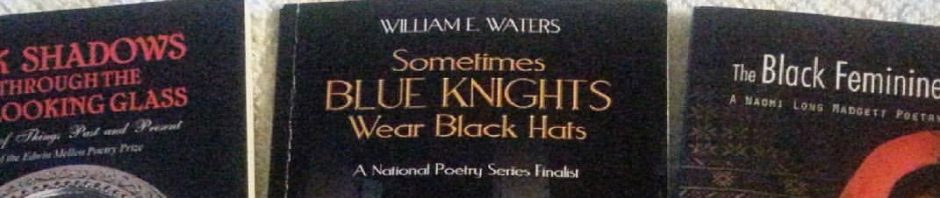
More than twenty years ago, I started writing poems on cases of law enforcement misconduct that was reported in the news. I didn’t set out to write a collection, but after a little more than a year I had enough poems on law enforcement misconduct to put in a collection. This was long before #BlackLivesMatter and law enforcement’s response, #BlueLivesMatter. Of course, their lives matter, but not as a counterpoint to Black lives or as propaganda to detract from some officers’ misconduct. Many of the “cases” that ended up in my collection, there seemed to be a better way to resolve than with deadly force. I understand how tough a job it is being a police officer. I know I couldn’t be a police officer, because I would end up in a similar collection to Sometimes Blue Knights Wear Black Hats, which was a National Poetry Series Finalist.
Since we are entering a political season, there will be much ado about law and order and crime and punishment, a tried but tired method of politicians, both Dems and Republicans, as their bona fides of “toughness.” It’s easy to talk tough when other people, specifically police officers, are putting in the work as well as putting their lives on the line. Political mantras mean nothing when heroes are dead and or they make a deadly “mistake” and there is a civilian casualty. To add insult to injury, law enforcement almost never owns up to questionable killings of civilians, and thus the creation of #BlackLivesMatter,
Crime and punishment should not be a partisan issue, but in an historically separate and unequal nation, most glaring in the criminal legal system, Lady Justice is seen as wielding her sword against people of color, striking them down without mercy.
In my next blog I will write about the process I am engaged in writing poetry that speaks to EJI’s history of racial terror.


 Easy Waters