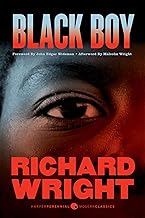
When I first read Richard Wright’s Black Boy more than 40 years ago when I was a teenager, little that I knew about literature, I thought the writing was superb. I was doing a little writing then and thought Wright was a good writer to study to learn the craft. I aspired to be Wright reincarnated, since I was born a month before he died! Of course, then I didn’t appreciate or understand that Wright’s story gave me a peek into the life of my father as a Black boy growing up in the segregated South a generation after Wright was born.
My father was a Native Southern Son. He was born in North Carolina and as a teenager, because of conflict with his father, left home and moved to Virginia. At 18 years of age, he was drafted into the segregated U.S. Army to serve during World War II. A couple of years after his discharge from the Army in 1946, my father made his way up North to New York City, to the borough of Brooklyn. My father probably left the South for the same reasons as Wright. I don’t know. My father never talked about growing up in the segregated South, at least not to his children. In fact, although my father was always present in our lives until his death, I can’t recall him saying three consecutive sentences. You could say that he was the strong silent type. Today we would probably ascribe his silence to trauma, the trauma of being born and growing up in the segregated South 61 years after the supposed end of the Civil War, 49 years after the end of Reconstruction, when Jim Crow, the quintessential American racist terrorist, haunted the lives of Black folk with unspeakable violence. Nonetheless, every year, around the Fourth of July, from the early 1960s until his death in 1982, my father would get in his Cadillac and head down South to visit his family. He never took any of his children South. I resented him for this. I didn’t understand that this was his way to protect me. But as a tween and a teen I didn’t know about the lynching of Emmett Till a few short years after my father left the South, a few short years before I was born. My father probably had images of “Strange Fruit” dancing in his head if he even entertained bringing his headstrong first-born son South. (I didn’t grow up with a fear of white people.) I often wonder why my father left the South. I imagine him in his Army uniform and being threatened by white men, probably called “boy” or “nigger.” And how he had to act in the face of this. As Wright describes his dealings with white men, how he had to fall “quickly into that nigger-being-a-good-natured-boy-in-the-presence-of-a-white-man-pattern.” Wright’s descriptions of his and Black folk’s dealings with white folk is haunting. He describes “the dark fears” he had known all his life navigating the segregated South.
As an adult, visiting and navigating the “New South” long after my father had died, I marveled at the temerity of white folk to memorialize and celebrate its “lost cause” with monuments and statues of Confederate Rebels, of men who had engaged in treason. The descendants of these treasonous Confederates dared to attack Black American soldiers in uniform who had fought in two world wars to make the world safe for democracy and to end all wars! On the other hand, in this New South, white people appeared to be different, unlike their parents and grandparents. When I was in Nashville, TN for a week, more white people smiled at me and greeted me more so than white people in New York City in a year. Perhaps the new lynching was to kill with kindness. But I knew that that atavistic violence of white men towards Black people could be triggered at any moment, for an insult, real or imagined, especially towards their womenfolk.
Many lynchings of Black men was because of an accusation, real or imagined, of a Black man assaulting, even “sassing,” a white woman. What was it about them that brought white men’s temperature to boil and explode in violence? Today we speak of Karens, and we know that they know that they have the power to conjure up violence against Black men seemingly out of thin air. What was it about white women?
I recall rifling through a drawer of my father’s. I came across a box of bullets, and a gun. I held the gun in my hand and felt its power, giving me the power to take life. I quickly put it back, not wanting to be corrupted by its power. That was the only time I held a gun. Was it even legal? Why would my father need a gun? Was he haunted by white men who had run him out of the South? Did they populate his dreams, chasing him until they caught and lynched him and riddled his dead body with bullets? Were their womenfolk succubae? With a little more rifling through my father’s drawer, I came across a photo viewer. I put it up to my eye and saw a naked white woman. There wasn’t anything special or spectacular about her. How could she incite and inspire such violence against Black men? Was this why my father had fled the South? Did he hold secret fantasies about white women? Had he wrongly approached one and had signed his own death warrant?
*************
Before I left Nashville, I stopped at a gift store and the smiling white woman clerk wearing clinging daisy dukes and decked out in a sleeveless blouse with the Confederate flag tried to sell me a Confederate flag. There were all kinds of Confederate paraphernalia in the store. Had I walked back in time? There ought to be a law against selling this crap. But this is what it means to live in a “free country.” You can celebrate and flaunt treason. Not everything was Confederate. There were salt and pepper shakers of stereotypical Sambo and Mamie. At least they were not dressed in Confederate garb, just a slave slip for Mamie, and short pants overalls for Sambo, their oversized lips looking like they had collagen injections. I shook my head and bought a set to give to a coworker. Because I am a storyteller, and my coworker would think I made this story up, I had to have evidence of this find. As I left the Confederate gift shop, the white woman seductively smiled at me, even though I hadn’t bought a Confederate flag. My purchase of the Mamie and Sambo salt and pepper shakers were enough. I hadn’t left the gift store emptyhanded. It was then the insidiousness of it all struck me. For some white people, Black people existed for their sport or entertainment. And the coup de grace, lynchings, were not only public spectacles, but they were also festivals and orgies of hate.
Looking back on that day in the Confederate gift store, it was even harder for me to imagine how Wright and my father navigated their way out of the segregated South.


 Easy Waters
A powerful story written with the truth and strength and grace
LikeLike