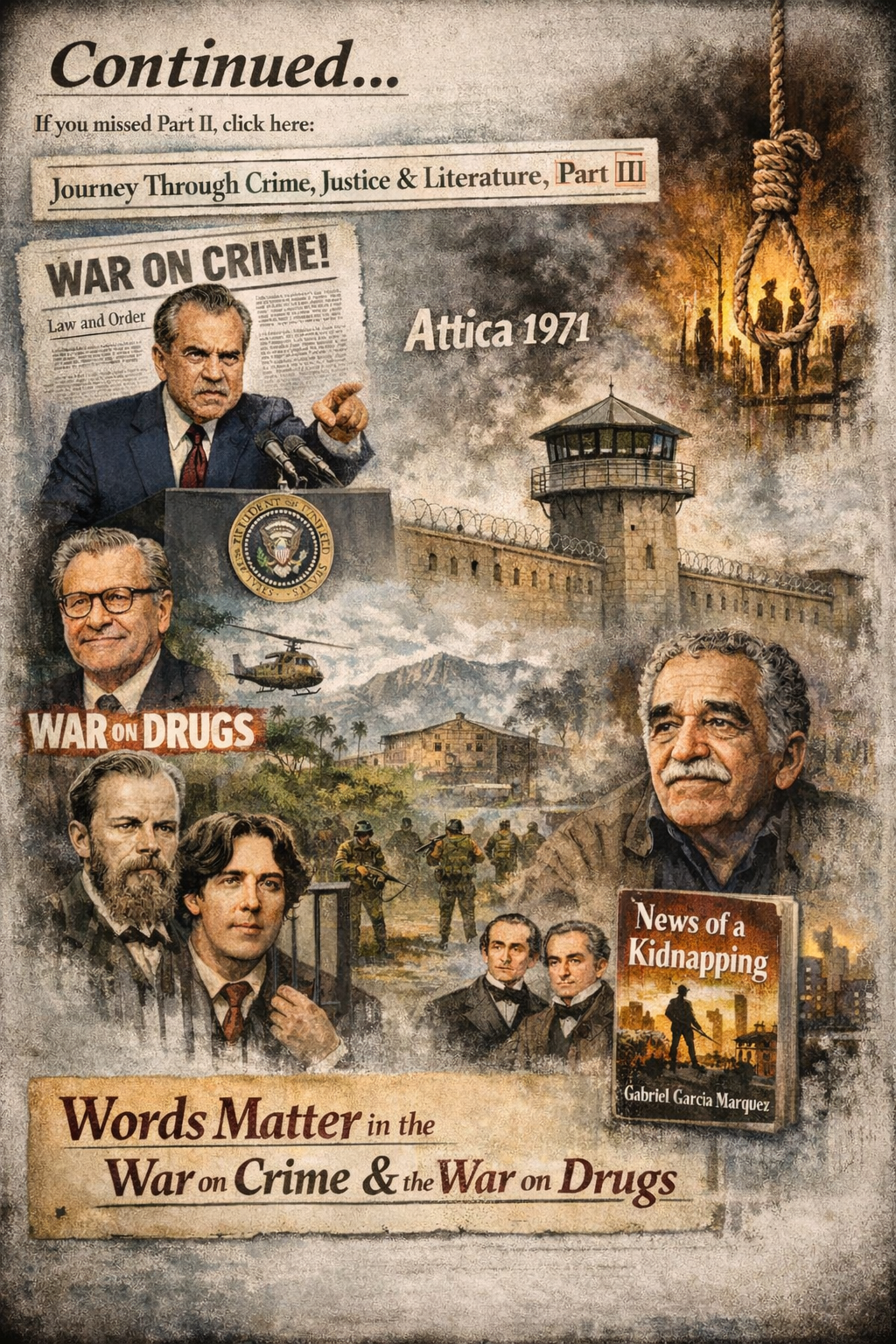
Continued… (If you missed the second installment, then click here: Journey Through Crime, Justice & Literature, Part II)
The modern War on Crime, as we know it, was inaugurated with Richard Nixon’s campaign for the presidency in 1968. Nixon declared that the Great Society had become “lawless,” and some of the tough-on-crime talk began, as well as the politics to finance the prison-industrial complex. Shortly thereafter, in 1973, Nelson Rockefeller, New York’s governor, launched his War on Drugs, which was picked up by the Reagan administration a decade later and expanded from a domestic war to include Latin America. (Worth noting is that Rockefeller was appointed vice president of the United States by President Gerald Ford in December 1974, after the “I am not a crook” Richard Nixon resigned in light of Watergate.”)
As with all wars, the War on Crime and the War on Drugs also launched a war of words. Only recently have some of the propaganda and stigmatizing language that’s a holdover from these wars been addressed, often by people who have been prisoners of war in these campaigns.
Language has been crucial in how we tell and discuss the story of crime and punishment. For example, under Governor Rockefeller’s watch, a Commission to study the prison system in New York was set up in the 1960s. It was tasked with making recommendations to reform the carceral system. After nearly five years of studying the prison system, the Commission released its report with recommendations. Had some of these recommendations been implemented, New York State may have averted the bloodiest prison rebellion in the nation’s history at Attica Correctional Facility in September 1971. Although comprehensive reforms to the carceral system were recommended by the Commission, the best New York could do at this time was to change the names of the system and its players. On July 8, 1970, New York State prisons became correctional facilities; guards became corrections officers; and prisoners became inmates. Nothing changed. There was no measure of magic in the name changes. A year later, Attica erupted. (Note that the current Corrections language in New York state identifies people in prison as “incarcerated individuals,” II for short.)
One of the greatest storytellers of the 20th century, Nobel laureate Gabriel Garcia Marquez, Colombian writer and journalist, famous for Cien años de soledad (One Hundred Years of Solitude), during his successful career as a novelist and short storyteller, returned to his journalist roots and wrote a story about crime if not punishment, News of a Kidnapping (1996), that chronicles the 1990 kidnappings of ten prominent Colombians by Pablo Escobar’s Medellin Cartel, using them as leverage against extradition to the U.S.
Marquez, known for the “magical realism” in his fiction, in News of a Kidnapping demonstrates that he hasn’t lost his magic (“journalistic”) touch, which brought me back to what inspired me to write about crime and punishment, and how stories of crime and punishment not only inspired but also informed my writing and becoming a writer. By the time I read News of a Kidnapping, I had won numerous awards as a poet, playwright, and essayist, and shortly thereafter won the Edwin Mellen Poetry Prize for my epic poem, Black Shadows and Through the White Looking Glass: Remembrance of Things Past and Present (1998). Still, like Marquez – I am in no way comparing myself to the master storyteller – my roots were in journalism, including a stint as a reporter at large for the Hudson Valley Black Press, reporting on the goings on in the prison-industrial complex in New York.
Two of the great writers of the 19th century, Fyodor Dostoyevsky and Oscar Wilde, spent time in prison. Dostoyevsky’s The House of the Dead (1861-62) is based on his prison camp experiences, and it inaugurates the Russian tradition of “prison camp literature.” In the 20th century, another Russian author, Aleksandr Solzhenitsyn, would pen The Gulag Archipelago: An Experiment in Literary Investigation (1973), based in part on his own experience as a Gulag prisoner.
Oscar Wilde, the great Irish author, poet, and playwright, in 1895, was convicted of gross indecency with other men. For these crimes, Wilde spent two years hard labor in various prisons, ending up in HM Prison Reading. In his last year in prison, Wilde wrote De Profundis (Out of the depths), published posthumously in 1905. De Profundis stands as one of the most intimate prison writings in modern literature. The main themes are suffering and self-reckoning; love, betrayal, and responsibility; spiritual transformation; and art, identity, and redemption. When I first read De Profundis, I thought of The Four Zoas by William Blake, another one of my namesakes, and how the poem applied to Wilde:
What is the price of Experience? Do men buy it for a song?
Or wisdom for a dance in the street? No, it is bought with the price
Of all that a man hath, his house, his wife, his children
Wisdom is sold in the desolate market [prison] where none come to buy
And in the wither’d field where the farmer ploughs for bread in vain
Prison transformed Wilde’s vanity as a satirist or dramatist into a moral and spiritual thinker. De Profundis anticipates themes later developed in The Ballad of Reading Gaol.
In 1897-98, Wilde wrote his last work, The Ballad of Reading Gaol, in exile. Ever the wag, Wilde suggested that the ballad be published in Reynold’s Magazine, “because it circulates widely among the criminal class – to which I now belong – for once I will be read by my peers.”
The Ballad of Reading Gaol is not a love ballad, in the traditional sense. It is one of the greatest personal, poetic polemics against what we have come to call the prison-industrial complex. During Wilde’s imprisonment, Charles Thomas Woolridge was hanged for cutting the throat of his wife, Laura Ellen Woolridge. Charles Thomas Woolridge, though unnamed, is the main character of the ballad, in that the observations of the balladeer center around the impending execution of Woolridge. Woolridge, though, is every prisoner, for…
…each man kills the thing he loves.
Wilde’s The Ballad of Reading Gaol is as haunting as Strange Fruit, written and composed by Abel Meeropol, which Billie Holiday made famous with her rendition. Meeropol wrote Strange Fruit as a protest poem, exposing American racism, personified in the lynchings of Black people, mostly Black men, though Black women were also lynched. One could argue that Wilde wrote The Ballad of Reading Gaol as a protest poem.
When Wilde was on the lecture circuit throughout Canada and the U.S. in 1882, he denounced lynching. Wilde is among a small number of prominent 19th-century European intellectuals who publicly criticized American racial violence while it was ongoing, rather than retrospectively. Publicly, Wilde described lynching as a “horrible crime” and a “monstrous thing,” especially from a nation that claimed to value liberty and civilization. Wilde also argued that lynching revealed a profound contradiction in American democracy.
Alexis de Tocqueville, famous for Democracy in America, is often described as the most acute foreign 19th-century observer of American society through his book. De Tocqueville and Gustave de Beaumont actually came to America in 1831 to assess the American prison system. De Beaumont was the lead writer of The United States Penitentiary System and its Application in France (1833), with De Tocqueville supplying facts and ideas. The book did not look at the penitentiary through a racial lens, but as a “neutral moral technology” aimed at reforming the soul. Nonetheless, the writings of De Tocqueville and De Beaumont prefigure contemporary debates on “mass incarceration.” Both Michelle Alexander, in The New Jim Crow, and another Frenchman, Loic Wacquant, in “Class, race & hyperincarceration in revanchist America,” go behind the curtain of the wizards who justify 20th-century prison expansion through using formally universal language (‘crime,” “order,” “public safety”).
In the final installment, I will question this language we have adopted and continue to use in telling the story of crime and punishment.


 Easy Waters
Reading Journey Through Crime, Justice, and Literature Part III made me realize that presidents—both historically and in the present day—have routinely used propagandistic rhetoric to recast ordinary social issues, such as poverty, into narratives of social “wars,” most notably the “war on crime.” This recasting has repeatedly served to justify aggressive and oppressive state interventions directed at historically targeted populations. As a political strategy, it feeds perceptions of crime “pandemics,” manufactures threats to the socio‑racial hierarchy, fabricates moral panic, constructs the war’s targets, and legitimizes disproportionate hyper‑incarceration and disenfranchisement—outcomes sustained by a profit‑centered carceral system.
Except for Presidents Obama and Biden, I argue that no president after LBJ treated racially institutionalized, structured inequality as a realistic policy goal of their domestic agenda. Across presidential administrations, propagandistic yet ostensibly race‑neutral rhetoric frequently masked racially differential outcomes behind “colorblind” language and dog‑whistle narratives. I propose two phases in the evolution of racial governance in modern U.S. presidencies, informed by earlier racial governance practices. Phase 1 consisted of addressing social issues through symbolic racial coding, deploying terms such as “War on Crime,” “Law and Order,” “War on Drugs,” and “Tough on Crime,” and adopting a “colorblind” rhetorical administrative style. These narrative frames avoided explicit racial reference while producing disproportionately harmful racial outcomes. Phase 2, represented by what I call Trump 2.0, marks the amplification of earlier narrative strategies into a more explicit, confrontational political style—one that uses racialized fear, crisis fabrication, and punitive rhetoric to shape governance, even where Trump is simultaneously celebrated as an American hero and sanctioned for criminality.
This rhetorical trajectory traces back to Woodrow Wilson’s nationalization of Jim Crow and extends to the contemporary vision associated with Trump 2.0, revealing a consistent, century‑long manipulation of presidential rhetoric. This journey demonstrates that “law and order” has rarely been about objective public safety; rather, it has functioned as a calculated political technology used to recast systemic inequality as individual criminality. By reframing poverty, addiction, and racial dissent as “wars” on crime and drugs, successive administrations have manufactured moral panics that justify the expansion of a punitive, profit‑centered carceral state.
(This reply is taken from a larger manuscript titled A Century of Presidential Propagandized Rhetoric, Criminalizing the Narrative.)
Dr. Michael G. Pass is an assistant professor in criminal justice and criminology at Lincoln University in the anthropology, sociology, and criminal justice department, PA. He is also a Fedcap Group CIPI fellow, appointed as a criminal legal system scholar to contribute to research and program development, focusing on workforce innovation and social impact initiatives. Engaged in collaborative projects aimed at advancing evidence-based practices and policy recommendations to improve economic opportunities for underserved communities.
LikeLiked by 1 person