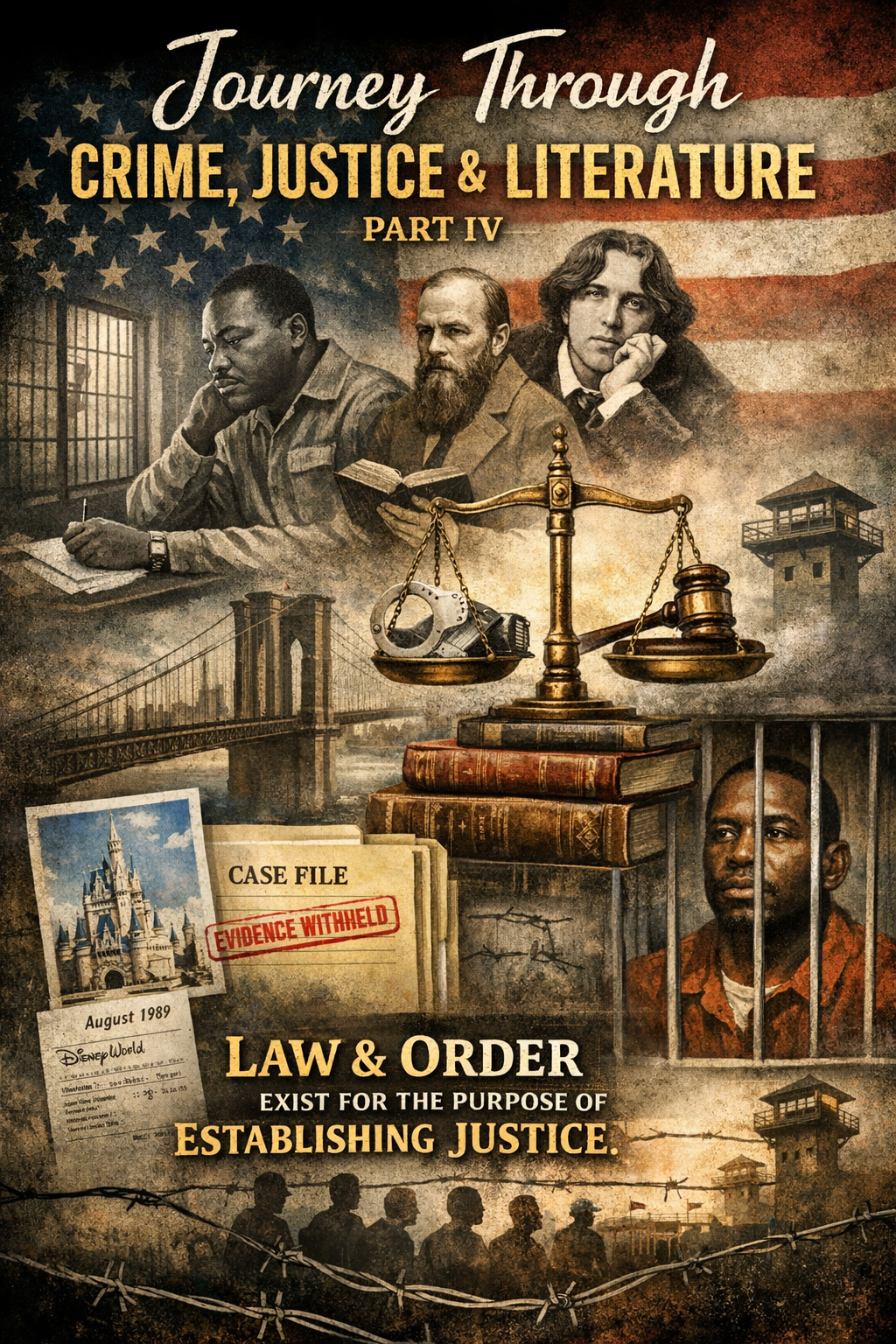
I began writing this fourth and “final” installment of “Journey Through Crime, Justice & Literature” on Martin Luther King Day. I re-read Dr. King’s “Letter from Birmingham Jail” (16 April 1963), not for purposes of this series, but on this day to fill my mind and heart with the ideas that guided King’s life and led to his death. Somewhat serendipitously, the “Letter from Birmingham Jail” fits in with my narrative, in large part because it is about justice, law, and order. In fact, in the Letter, King writes, “law and order exist for the purpose of establishing justice.” Additionally, King’s Letter is part of the tradition of “prison camp literature” inaugurated by the great Russian author, Fyodor Dostoyevsky, best illustrated in The House of the Dead. MLK’s Letter was penned nearly 100 years after Dostoyevsky published The House of the Dead.
As Oscar Wilde’s De Profundis stands as one of the most intimate prison writings in modern literature, MLK’s “Letter from Birmingham Jail” stands with it in that tradition. MLK’s letter is deeply personal and prophetic. Although it is addressed to “My Dear Fellow Clergymen,” because it is timeless, and because of the issues it raises, it is addressed to all of us as well, and perhaps is more relevant today than when King wrote it. It is a long letter, as is De Profundis, because it is informed and inspired by a long journey, challenging the law’s delay in delivering justice.
This series is inspired by listening to people from many walks of life, CEOs of nonprofits, Presidents of institutions of higher learning, people convicted of crimes, and their family members, as well as survivors of crime, talk about justice, mostly the criminal “justice” system. From my listening sessions, I came to deeply understand that one’s hermeneutics of justice depends in large part on one’s interaction with the system and one’s role within it. People who have committed crimes, people who have been harmed by crime, people charged with administering and overseeing justice, politicians who pass laws that are part of comprehensive crime bills – all see this amorphous idea and ideal of justice differently. Men of color, such as myself, disproportionately impacted and punished by what many fancy and call a system of criminal justice, can produce volumes of evidence challenging this notion of criminal justice. Here, I’ll present one more example, who happens to be another neighborhood childhood friend. The People of the State of New York v. Jonathan Fleming.
Fleming was convicted of a 1989 Brooklyn killing. He was accused of shooting and killing his childhood friend, Darryl Alston. Fleming claimed that he was at Disney World in Orlando, Florida, with his family at the time of the killing. Evidence, including a hotel receipt placing him at Disney World in Orlando, proved he was over 1,000 miles away when the crime was committed. Nonetheless, Fleming was convicted of second-degree murder and sentenced to the maximum sentence of 25 years to life. Up until the time he was exonerated (April 2014), Fleming maintained his innocence. The backstory of this crime, and Fleming’s punishment, highlights how many prosecutors seek convictions at the expense of justice. In investigating the charges against Fleming, the District Attorney’s Office unearthed evidence that Fleming was in fact, in Orlando when the killing occurred. This evidence was buried in Fleming’s case folder. It was exculpatory evidence that should have been turned over to Fleming’s defense attorney, but it wasn’t. It sat in Fleming’s case folder from 1989 until 2014. Had Kenneth P. Thompson not defeated Charles J. Hynes in 2013 for the Brooklyn District Attorney’s office, Fleming might still be in prison. Hynes lost the Democratic primary vote to Thompson. Hynes then turned around and ran against Thompson as a Republican. Hynes lost the general election to Thompson, and Thompson became the first Black District Attorney of Kings County. Thompson immediately set up a Conviction Integrity Unit, perhaps because he was wondering why Hynes, by hook or crook, did not want to give up the D.A.’s seat. What bodies had Hynes buried alive but in plain sight in case folders? Fleming can be thankful that Thompson defeated Hynes and unearthed his wrongful conviction. The City of New York would ultimately settle a lawsuit with Fleming for $6.25 million in 2015.
I fantasize about a system of justice where prosecutors would be held accountable for egregious misconduct. In the case of Fleming, they would be incarcerated for the exact amount of time Fleming served.
I am one individual, yet I know of many cases of injustice, where, because of the very nature of our adversarial system, prosecutors seek “winning” (convictions) at the expense of justice. Many people have been sacrificed on the “bench” of criminal justice: people who were actually innocent of the crimes for which they were charged, but were knowingly and maliciously tried by prosecutors; people who were guilty of the crimes for which they were convicted, but were overcharged and railroaded and not given the benefit of a reasonable doubt and their constitutional right to due process of law; people who faced zealously vindictive professional ladder-climbing prosecutors and judges who rubberstamped prosecutorial misconduct – these members of the bar who only care about building a reputation as “tough on crime,” and the idea and the ideal of justice becomes a casualty.
According to legal historian Sara Mayeux, thinking and talking about police, courts, jails and prisons, or as Michael G. Pass, poet and PhD, states, “cops, courts, and corrections,” as one holistic “criminal justice system” is a 1960s construct, and it converges in 1967 through work connected to President Lyndon B. Johnson’s Commission on Law Enforcement and Administration of Justice (the “Johnson Crime Commission”). Ironically, Johnson’s Great Society was characterized by Richard Nixon as “lawless,” not to mention Nixon’s Watergate lawlessness. Even more ironic, if I may say so, “lawlessness” has been a feature of “white justice” leveled at Black folk by white folk: the 1863 Draft Riots in New York City; the 2,000 documented lynchings of Black people by white mobs during the Reconstruction era (1865-1877); the 4,500 documented racial terror lynchings from Post-Reconstruction through WWII-era (1877-1950); the more than 250 deaths during the “Red Summer” of 1919, which raged for 10 months across 25 race riots; the 39 documented deaths during the Tulsa Race Riot of 1921, though credible historical estimates commonly place the true toll up to around 300; the wide estimate of 27-150 deaths during the week of the Rosewood massacre in January 1923; and the death and violence Black folk, and a small number of their white allies, suffered during the Civil Rights Era (1950-1968).
The Johnson Crime Commission did not address white lawlessness – so much for law and order! Neither did Nixon’s War on Crime.
Nixon’s War on Crime, beginning in 1968, which continues to this day, and New York Governor Nelson Rockefeller’s War on Drugs, beginning in 1973, laid the framework for the prison industrial complex and what came to be called “mass incarceration.”
“Mass incarceration” is a misnomer. It is another term we must put on trial and interrogate, as well as the term “criminal justice system.” If, as a society, Black men are disproportionately imprisoned, then this is not mass incarceration. Black men in the U.S. between the ages 13 and 50, the group most likely to be imprisoned, make up approximately 4.4%-4.7% of the entire U.S. population. However, depending on the era, Black males constitute roughly 32%-37% or 35%-40% of the jail and prison population. Here, it is worth noting that “theories” of Black criminality, which propelled “mass incarceration,” didn’t surface until after slavery and Reconstruction, where laws, Black Codes were enacted with the intent to imprison and “re-enslave” Black folk, sanctioned by the Thirteenth Amendment of the U.S. Constitution. From the Black Codes to the present day, we even had politicians like Hillary Clinton push a false narrative about “superpredators,” that is, young Black men between the ages of 13-30, who were primed to commit horrendous crimes. They would be the fuel in the school-to-prison pipeline.
Loic Wacquant, another Frenchman – early in the series I referenced Alexis de Tocqueville and Gustave de Beaumont – challenges this concept of “mass incarceration.” In “Class, race & hyperincarceration,” Wacquant writes:
…the stupendous expansion and intensification of the activities of the American police, criminal courts, and prison over the past thirty years have been finely targeted, first by class, second by race, and third by place, leading not to mass incarceration but to hyperincarceration of (sub) proletarian African American men from the imploding ghetto. (2010)
Wacquant traces this phenomenon to circa 1980, but the roots of this lie within the Thirteenth Amendment of the U.S. Constitution.
As the Thirteenth Amendment sought to re-enslave Black people under color of law after they had been “duly convicted of crimes,” the War on Crime sought to deal with deep and abiding injustice by incarcerating young Black men, those who weren’t killed because they had embraced Black Power as a political philosophy in the 1960s and 1970s.
Only recently, less than ten years, has a spotlight been put on the role of the Thirteenth Amendment in fueling the pipeline to prison and the disproportionate imprisonment of Black men, most notably in Ava DuVernay’s 2016 documentary, 13th.
The end of the American Civil War in 1865 marked a new chapter in the story of America, but there were various elements still wishing to hold on to the legacy of slavery and its mores, and it was made manifest in the Thirteenth Amendment.
As I stated in the beginning of this series, I have been thinking about and writing about crime and punishment since I was 16. Additionally, as I stated earlier in this series, the War on Crime and the War on Drugs were accompanied by a propaganda war, a War of Words. Many of the words and terms that we use to talk about the “criminal justice system” are holdovers from these wars and have no useful purpose in contemporary conversations about crime and punishment. But not only have some of us failed to interrogate these words and terms, but some, who work in the various hubs of the prison-industrial complex, also defend these words and terms, including journalists, who would argue that certain stigmatizing labels, such as “felon” are “shorthand” and easier to put in headlines. But as one journalist, Margaret Colgate Love, writes in a short piece, “What’s In a Name? A Lot, When the Name is ‘Felon,’”: “Journalists play a key role in advancing the cause of social justice, and they do it through the language they use.” Love also writes, “Skilled writers can find ways to avoid using words that are toxic.” I think we will have to go a step further. We will need the equivalent of the Nuremberg trials and/or a truth and reconciliation process to address and abolish the thinking that created and propped up and continues to propel this system we would like to believe is a system of justice.


 Easy Waters