In a six-day span, I attended my baby brother’s funeral, our two daughters’ graduations, from middle school and high school, and my sister Cheryl’s milestone (60th) birthday celebration.
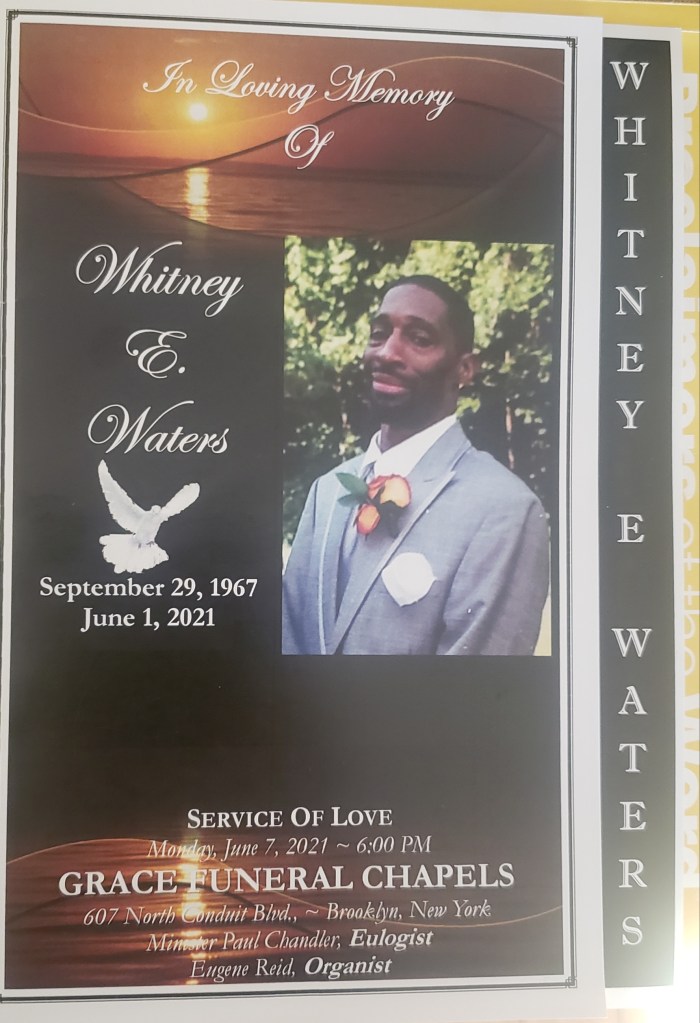
At Whitney’s funeral, I spoke on behalf of our family. Here, I want to share those words.
The last seven days I have cried more than I have in my 60 years of life. I am tired. I have been wrestling with God these past seven days, fighting him over the death of my baby brother.
I barely understand the mystery of life. I certainly do not understand the mystery of death. “The Last shall be first?” Is this what you mean, God?
Whitney was the last child born of our mother and father. He was born into a household of a mother, a father, a brother, and three sisters.
Whitney was the comedian in the family. If you were going to meet him for the first time, then my sisters would joke and apologize in advance. Whitney had a wicked wit — I called him Whit — and although he never said anything offensive, my sisters were just covering the bases, because we really did not know what Whitney might say or do.
I am the historian in the family, and I fancy myself a storyteller. I am going to tell you two stories. Spoiler alert! They both are about the love we, my sisters and I, have for our baby brother.
But before story time, I want to thank everyone for their love and support for my family, and Whitney’s extended families, and of course, Whitney’s fiancee, Cynthia.
Cynthia and Whitney were to be married on August 21st. We had planned a wedding. Instead, we are at Whitney’s funeral. Whitney was the best man at my wedding. I was to be his best man at his wedding. That’s how the Waters brothers roll!
Cynthia, I believe we have three stages of life. We, men, barely get it right the first two times. Whitney was in his third life. He reconnected with you, the love of his life. When I got married, Whitney told me he had never seen me happier. I had not seen him happier once he committed to marry you.
STORY ONE
In one of the pictures in the slide show, Whitney is 10 years of age, at our mother’s funeral. He is surrounded by a cousin, and his three sisters, his guardian angels, dressed in white.
Jeanette, on that day, became Whitney’s mother. I know that grief cannot be quantified, and our grief is exponential, four times the greatest number, but Jeanette’s grief is double ours, her siblings. She was Whitney’s sister, but became his mother when she was 19. Obviously, she did a great job raising our brother.
Growing up, Jeanette was known as “Fighting Jeanette.” She had some epic rumbles in the concrete jungle of the Marcy Projects that would have made Muhammad Ali proud. Jeanette, if she had to, would fight for our brother, would put her life on the line for him.
Cheryl embodies our mother’s spirit. If she had not heard from Whitney in two or three days, then she would call him until she got him, telling him that he could not let two or three days go by without calling one of us. The “Us” referred to one of his three sisters.
Cheryl, Whitney’s Guardian Angel.
Wanda was the baby until Whitney came along. From the very beginning, she fiercely loved him. Wanda had to compete with our mother and two sisters for facetime with our baby brother. She was last in the pecking order to hold him and spend time with him.
Wanda does not remember this, She was 5 or 6, but one day, she finally had her facetime with Whitney. She was in our parents’ room, cuddling him. I snatched Whitney out of Wanda’s arms. Our mother had a tabletop sewing machine right next to the bed. On it was a disposable razor. One second I was holding Whitney, the next I was holding my shoulder, a gash on it, and Whitney was back in Wanda’s arms. She moved like a ninja!
I tell this story because it speaks to, even at a young age, the fierceness of Wanda’s love for Whitney. From this day on, I will remember this scar on my shoulder as a symbol of Wanda’s fierce love for Whitney.
In this story, Wanda is the Equalizer. Think Latifah reprising the role of Denzel Washington, in The Equalizer, on the small screen. And me, even at my young age, I just wanted to spend more time with my baby brother. I had lived in a household with three sisters, and they have this sisterhood thing going on. Always have. Then, even though I could not articulate it, with the birth of my brother, we now had a brotherhood.
And now for a commercial.
Brothers, there’s this book The Body Keeps Score. All you need to know about it is that the body remembers everything, what has happened to it. I know we sometimes think we are invincible, and when younger, immortal. But we’re not. If you are experiencing pain, then do not ignore it. Your body is trying to get our attention, to tell you that it needs something. Don’t hesitate to go to the doctor. Most ills are preventable or treatable. Sisters, nag the men yin your life to go to the doctor until they go to the doctor!
STORY TWO
In the last chapter of the Gospel According to John, the Risen Christ has a conversation with Simon Peter. He asks him the same question three times. Do you love me? To which Simon Peter says yes.
To fully understand this exchange, we need to know that Jesus and Simon Peter are using two different words for love. Those wise Greeks had five words for love. (What we call the New Testament was originally written in Greek.) I’ll roughly translate.
Jesus says, do you have this great, unconditional love for me?
Simon Peter answers, I love you like a brother.
Jesus says again, do you have this great, unconditional love for me?
Again, Simon Peter replies, I love you like a brother.
Knowing that this is as good as it gets, the third time Jesus says to Simon Peter, do you love me like a brother?
And they really are not on the same page. For the third time Simon Peter says, Yes, I love you like a bother! He says this as if Jesus finally gets it!
I love my brother like a brother. He was my brother. But I also loved my brother with the great, unconditional, nonjudgmental love that Simon Peter could not articulate to Jesus.
In conclusion, I want to leave you with two lines from a song.
At I.S. 318, I was in the chorus. Our signature song was Diana Ross’ “Touch Me in the Morning.” Tuesday morning [June 1, 2021], Jeanette and I touched our baby brother after he had breathed his last breath, and through my grief that song flooded my mind.
Wasn’t it me who said that nothing good’s gonna last forever?
And wasn’t it me who said, let’s just be glad for the time together?
We are glad for the time together with you, Whitney!








 Easy Waters