Linda Fairstein’s reckoning, not her demonization

Len Levitt, in an Op-ed piece in amNew York, 6/18/19, “The campaign to demonize Linda Fairstein,” as it relates to her behavior to convict the Central Park Five, writes that we “seem to be going through a period of racial reckoning.  But do Fairstein’s pursuers actually think they can help undo, or repay, 300 years of past injuries to blacks by demonizing her?”  (This is about the last 30 years, and this is about this one case!)

That’s reaching!  Linda Fairstein was not alone in demonizing the young men wrongly convicted of a terrible crime they did not commit.  The tabloids also demonized the young men.  The Donald demonized the young men, even took out a full page ad in the New York Times, a paper he now hates, calling for the death of the young men.

The bottom line is that in the annals of criminal jurisprudence, there are numerous cases where prosecutors did not pursue justice, but were intent on securing convictions, by any means necessary, which has included knowingly using false testimony.  (There’s a famous United States Supreme Court case on the knowing use of false evidence that overturned a bloody murder conviction because during his summation the prosecutor repeatedly mentioned “bloody” garments found at the crime scene, when all along the prosecutor knew that it was paint on the garments, not blood.)  And then there is the sophistical rationalization in trying, railroading and convicting people when there is less than sufficient evidence to secure their convictions, in fact, that they might even be innocent, that they are “guilty of something” if not this crime.  This even stretches the legal concept of “vicarious liability.”

So Fairstein’s publisher dropped her.  (I confess that I’ve read and enjoyed about ten of her books.)  That’s a drop in the bucket to what the innocent young men went through.  So Fairstein had to resign from a few Boards.  That will not dramatically alter her life in the way that a wrongful conviction altered the lives of the innocent young men.

Anyone familiar with the criminal legal system knows that many a prosecutor, not just Fairstein, used it as a launching pad to further their careers in law and in the literary world.

“When They See Us” is simply one case, one glaring example that exposes how the criminal legal system typically manufactures a case.  Prosecutors have enjoyed absolute immunity from the behavior demonstrated by Fairstein, behavior that should be criminal.  Is this a reckoning for Fairstein?  Yes.  But in no way is it a “racial reckoning.”  It’s a reckoning about justice, which we have come to equate with guilty verdicts, which isn’t justice at all.  It’s a reckoning about fairness, which Fairstein wasn’t in the Central Park Five Case.

#WhenTheySeeUs #CancelLindaFairstein

Posted in being a teenager, crime, juveniles, Lest We Forget | Tagged , , , , | 1 Comment

“NYPD detective indicted on perjury charges: DA”

Joseph Franco, a suspended NYPD detective, was indicted for perjury, official misconduct and filing false documents in connection with narcotic cases he was involved in between 2017 and 2018.  As a result of Franco’s perjury and related charges, three people pleaded guilty and two were serving state prison sentences before prosecutors, while probing official corruption within the NYPD, unearthed Franco’s lies.  It is once again worth noting that innocent people plead guilty to crimes they did not commit because they know that the scales of justice are unbalanced and heavily weighted against them and places those accused of crimes at a distinct disadvantage.

For quite some time I have argued that people who knowingly and falsely accuse people of crimes, including police officers and prosecutors who ignore and or withhold exculpatory evidence that would exonerate innocent people, should be subject to a sentence equivalent to the charges they falsely accused people that led to convictions.

As of now, Judge Mark Dwyer released Franco on his own recognizance.  Where is the justice in that, not withstanding the presumption of innocence?

Posted in ezwwaters, Justice Chronicles, Lest We Forget, Streets of Rage, Urban Impact | Tagged , , , , , , | Leave a comment

On this Day in American History, April 24, 2019 – White supremacist killer of James Byrd Jr. Executed

Some say it was “one of the most notorious hate crimes of modern times.” James Byrd Jr., a 48 year old Black male, was targeted and murdered by white racists in 1998 in Jasper, Texas. They tied him to their 1982 Ford pickup truck and dragged him approximately three miles before dumping his body in front of an African-American Church.

For his crime, John William King, 44, was put to death by lethal injection and pronounced dead at 7:08 p.m. on April 24, 2019 at the state’s death chamber in Huntsville.

I just wonder if Donald Trump considers King one of the “good people.”

Posted in crime, ezwwaters, Justice Chronicles, Lest We Forget | Tagged , , , , , , | Leave a comment

#NationalRacistAnthem (My Favorite Things)

Blood drops on roses
And nooses on niggas
Bright copper kettles and boiling some jiggers
Brown men and brown women hung up on trees
These are a few of my favorite things

White-hooded Klansmen and black burning bodies
Nazis and skinheads
And thugs with thick ropes
Wild men who rage with blood on their wings
These are a few of my favorite things

Men in white dresses with red satin sashes
Blood drops that that stay on my nose and eyelashes
Blazing hot summers that lead to tall trees
These are a few of my favorite things

When the dog barks
When the hose stings
When I’m feeling sad
I simply remember my favorite things
And then I don’t feel so bad

Blood drops on roses
And nooses on niggas
Bright copper kettles and boiling some jiggers
Brown men and brown women hung up on trees
These are a few of my favorite things

White-hooded Klansmen and black burning bodies
Nazis and skinheads
And thugs with thick ropes
Wild men who rage with blood on their wings
These are a few of my favorite things

Men in white dresses with red satin sashes
Blood drops that that stay on my nose and eyelashes
Blazing hot summers that lead to tall trees
These are a few of my favorite things

When the dog barks
When the hose stings
When I’m feeling sad
I simply remember my favorite things
And then I don’t feel so bad
P.S. Inspired by VA Gov. Ralph Northam,and the “good [white nationalists] people.” Forgive me Oscar Hammerstein and Richard Rodgers

Posted in Uncategorized | Tagged , , , , , , , , , , | Leave a comment

Amadou Diallo — 20 years later

Today is the 20th anniversary of the killing of Amadou Diallo by New York’s “Finest.”

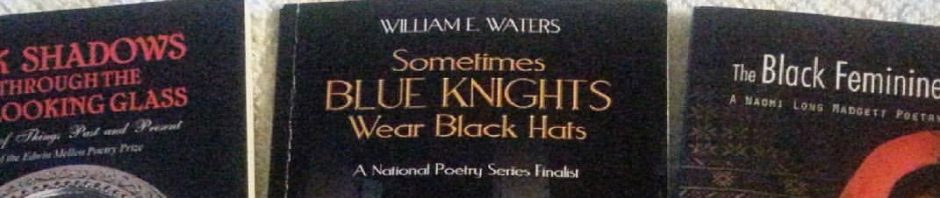
All those years ago, I wrote the following poem, which is included in my collection, “Sometimes Blue Knights Wear Black Hats”:

ON A BRONX STREET AFTER THE AMADOU DIALLO TRIAL

Wrinkled black baby flesh

Held in trembling wrinkled black hands.

(SHOUTED) “Kill him now!  You may as well kill him now!”

It was a scene reminiscent of Abraham

In the land of Moriah,

A father offering his son as a sacrifice.

(SHOUTED) “Kill him now!  You may as well kill him now!”

As clueless as Isaac,

As innocent as the babe he was.

If he could only talk, like Isaac.

“Father, where is the lamb for the burnt offering?”

It is a tale as old as the Bible:

God requesting a burnt offering;

Pharaoh commanding every Hebrew boy

Be thrown into the Nile;

Herod killing all the children

In and around Bethlehem

Who were two years or under.

Wrinkled black baby flesh

held in trembling wrinkled black hands.

(SOFTLY) “Kill him now!  You may as well kill him now!”

The above referenced book is available on Amazon: https://www.amazon.com/Sometimes-Blue-Knights-Wear-Black/dp/1481722867/ref=sr_1_1?ie=UTF8&qid=1549279733&sr=8-1&keywords=sometimes+blue+knights+wear+black+hats


Posted in Uncategorized | Leave a comment

Ham Sandwiches, Indictments, and Unjust Convictions

One of the fundamental problems of the U.S. criminal legal system is the nearly unfettered power of prosecutors to indict, so much so that Judge Learned Hand once quipped that a prosecutor could get a ham sandwich indicted.  (Note that this quip is often ascribed to former New York State Court of Appeals Chief Judge, Solomon “Sol” Wachtler, who was ultimately indicted, and pleaded guilty to harassing his former lover and threatening to kidnap her daughter.  He would spend a total of 13 months in federal prison and a halfway house.)  What should be added to that quip, known by most people not professionally affiliated with the legal system but working outside of its structures,  that is, advocates and policy makers seeking to right the sales of justice, is that these indictments often lead to convictions, many “erroneous,” which have led to far too many innocent people spending decades in prison.  A case in point: Jonathan Fleming was convicted of a 1989 murder that was committed in Brooklyn when the prosecutors knew that when the crime was committed Fleming was with his family in Disney World in Florida.  With typical prosecutorial arrogance, the prosecution left this exculpatory evidence, which had not been turned over to the defense, in Fleming’s case folder.  After spending nearly 25 years in prison, Kenneth P. Thompson, elected as Kings County (Brooklyn) District Attorney in 2014, looked at a number of cases of his predecessors, Charles Hynes and Elizabeth Holtzman, and unearthed Fleming’s case and the blatant prosecutorial “misconduct” that led to his conviction.  Fleming was ultimately released and exonerated.  (There are a number of other cases where people who served decades in prison under Hynes’ watch were exonerated.)

When a prosecutor brags about his or her conviction rate, just think what lengths they have gone to achieve such: knowingly using false testimony in order to obtain a conviction, withholding exculpatory evidence, that is, evidence that may prove innocence, and even manufacturing evidence.  In the final analysis, prosecutors are supposed to seek justice, not convictions, but in a nation where “justice” is equated with convictions and punishments, we have pigs flying out of Grand Juries handing down indictments, most which are tantamount to convictions.

Posted in crime, Justice Chronicles, Streets of Rage, Urban Impact | Tagged , , , , , , , , , , | Leave a comment

Death of a Kingmaker

William C. Thompson Sr. passed away on Christmas Eve, a belated gift to the thousands of people who were railroaded under his judicial watch when he was the Administrative Judge in Kings County Supreme Court.

The praises have been pouring in for Judge Thompson, mostly from politicians.  Mayor Bill de Blasio tweeted, “As a judge and the first African American state senator from Brooklyn, William C. Thompson Sr. stood up against racism and injustice in our city for decades.”

I know people normally do not speak ill of the dead, but the fact that he was a trailblazer does not negate the fact that as a judge he presided over countless star chambers and share in the guilt and the sin of hyper incarceration.  The Honorable Bruce Wright mentions “Willie” in his book, “Black Robes, White Justice,” commenting that he was a self-styled “kingmaker” when he was the Administrative Judge in Kings County Supreme Court, when Administrative Judges assigned cases to trial judges.

Willie would marry another judge, Sybil Hart Kooper, and he assigned high profile cases and cases with a high probability of convictions to her when he was Administrative Judge.  For example, she presided over the infamous 1982 murder of William Turks, who was beaten to death by a mob of white thugs.  In fact, at the sentencing of one of the mob, Gino Bova, Judge Kooper said, before pronouncing sentence, “There was a lynch mob on Avenue X that night.  The only thing missing was a robe and a tree.” This played splendidly with the Press, but note though that Bova was not convicted of murder, but of manslaughter, and given 5 to 15 years.  Judge Kooper presided over a number of similar cases involving Black youth, and they were often convicted of murder and sentenced to 20 years to life.

As a court watcher, monitoring Judge Kooper’s cases, Willie would often visit her courtroom and court her while young men of color were facing his Lady Justice, a cruel white bitch who, when in 1985 she was appointed to the Second Department Appellate Davison, trial lawyers whispered to their clients after they had been summarily convicted in her court that she “would do less harm” in the Appellate Division because she would be one of a panel of judges.

Lest we forget, Willie, this trailblazer, became nothing more than a cog in the machinery of injustice, instead of, as the kingmaker, ensuring that the scales of justice would be balanced.

Posted in Justice Chronicles, Uncategorized | Tagged , , , , , , , , , | 1 Comment

The White Hats Are Coming…

White supremacist flyers were found in Van Cortlandt Park in the Bronx.  Under the heading, “White Excellence,” the flyers called on white men to “defend your heritage” – of lynching and racial violence against Black people? – and stop Blacks and the “spread of radical Islam.”

As a sign of white solidarity, the writers of the flyers requested that white people wear a white hat or shirt every Wednesday while eating or drinking on Katonah Avenue to “show you’re here.”  They concluded that there would be [Ku Klux Klan?] meetings and a demonstration on November 14, 2018.

It looks like the white hats have been emboldened by the Chief Red Hat who currently occupies the White House.

The white hats are not simply coming – they are already here.  They have always been with us in AmeriKKKa.  They stopped wearing white robes in public – now they’ll be wearing white shirts in public on Wednesdays.  (Some had donned black robes after they put their white robes in the closet.)  Now, with a “[white] nationalist” occupying the White House, these minions of racism publicly display their true colors – just the white in the red, white, and blue.  God bless [white] America!

Posted in Uncategorized | Tagged , , , , , , , , , | 1 Comment

On this day in American history, November 7, 1931 — Fisk University Dean and Student Die In Car Wreck After Denied Hospital Care Due to Race

On November 7, 1931, Dean Juliette Derricotte of Fisk University in Nashville was driving three students to her parents’ home in Atlanta when a Model T driven by an older white man suddenly swerved and struck Ms. Derricotte’s car, overturning it into a ditch. The white driver stopped to yell at the black occupants of Ms. Derricotte’s car for damaging his own vehicle, then left the scene. Nearby Hamilton Memorial Hospital in Dalton, Georgia, did not admit African American patients, so Ms. Derricotte and the three students were treated by a white doctor at his office in Dalton and then taken to the home of an African American woman to recuperate – though Ms. Derricotte and one of the students, Nina Johnson, were critically injured.

Six hours after the accident, one of the less seriously injured students was able to reach a Chattanooga hospital by phone, and arrangements were made to transport Ms. Derricotte and Ms. Johnson the 35 miles to that facility. However, it was too late: Ms. Derricotte died on her way to the hospital, at age 34, and Ms. Johnson died the next day.

The Committee on Interracial Cooperation opened an investigation into the incident, and Walter White, secretary of the New York-based NAACP, traveled south in December 1931 to learn more. He later concluded, “The barbarity of race segregation in the South is shown in all its brutal ugliness by the willingness to let cultured, respected, and leading colored women die for lack of hospital facilities which are available to any white person no matter how low in social scale.”

“The Equal Justice Initiative (EJI) is proud to present A History of Racial Injustice – 2018 Calendar.  America’s history of racial inequality continues to undermine fair treatment, equal justice, and opportunity for many Americans.  The genocide of Native people, the legacy of slavery and racial terror, and the legally supported abuse of racial minorities are not well understood.  EJI believes that a deeper engagement with our nation’s history of racial injustice is important to addressing present-day questions of social justice and equality.

Posted in Uncategorized | Tagged , , , , , , | Leave a comment

On this day in American history, November 7, 1955 — U.S. Supreme Court Affirms Ruling Outlawing Racial Segregation in Public Recreational Facilities

In Mayor and City Council of Baltimore v. Dawson, African Americans living in Baltimore, Maryland, sued the city’s mayor and city council for maintaining racially segregated, publicly-funded beaches and parks. A federal district court initially dismissed the complaint, holding that the “separate but equal” doctrine established in 1896 by the United States Supreme Court in Plessy v. Ferguson permitted racial segregation as long as the facilities or services involved were substantially equal between races.

On March 14, 1955, the United States Court of Appeals for the Fourth Circuit overturned that ruling, rejecting the city’s argument that racial segregation was justified as a means of ensuring order and avoiding racial conflict. In its decision, the Fourth Circuit held that “segregation cannot be justified as a means to preserve the public peace merely because the tangible facilities furnished to one race are equal to those furnished by the other.” In the view of the court, legal support for the doctrine of “separate but equal” had been swept away by recent landmark Supreme Court rulings like Brown v. Board of Education, decided the previous year.

The City of Baltimore appealed the ruling to the Supreme Court. On November 7, 1955, the Court affirmed the Fourth Circuit’s decision in a per curiam order endorsing the lower court’s rejection of segregation in public recreational facilities and adopting its decision as national, binding precedent.

“The Equal Justice Initiative (EJI) is proud to present A History of Racial Injustice – 2018 Calendar.  America’s history of racial inequality continues to undermine fair treatment, equal justice, and opportunity for many Americans.  The genocide of Native people, the legacy of slavery and racial terror, and the legally supported abuse of racial minorities are not well understood.  EJI believes that a deeper engagement with our nation’s history of racial injustice is important to addressing present-day questions of social justice and equality.

Posted in Uncategorized | Tagged , , , , , | Leave a comment