The King is Dead!

The King is dead!

I was 7 years young when Martin Luther King, Jr. was assassinated. Growing up in the ‘60s, what one historian called the Decisive Decade, there was death all around.

At 7, I didn’t understand the impact of King’s death, of his assassination – it is my first “political” memory. Around me, all the grown-ups were saying, “They killed another Black man!” I didn’t know who “they” were. I only knew that “they” had killed another Black man. Later I would learn that “they” had also killed a President, and his brother, and….

Later, I would write a poem, referring to these killings as “assassinations with political ramifications.” These killings would spill over into the ‘70s, and if Richard Nixon was right, for the wrong reasons, we were living in a “lawless society.”

I know as a society we have come a long way, but I also know that we have a long way to go, specifically to realize a just society.

Today, as we remember Dr. King, on this day, we should celebrate his life, what he stood for, and remember those words he wrote from the Birmingham Jail: “injustice anywhere is a threat to justice everywhere.” And then we need to do something.

The King is dead! Long live the King and the ideals he stood for

Posted in Murder, Patriotism, Politics | Tagged , , , , , , , | Leave a comment

Even a Black Poet is Considered Armed and Extremely Dangerous

(For Henry Dumas)

It was a time
when a president,
a presidential candidate,
a Prince of Peace,
a Black knight in shining armor,
and Black Panthers,
were gunned down.

Assassinations with political ramifications.

But who’d think
that a poet
would be gunned down too?

This Bard was described
as an incredible artist,
someone who wrote
“the most beautiful,
moving and profound poetry.”

Poetry for My People

He was armed
with brilliance,
and magnetism.

Did this make him dangerous?

In “The Waking Dream”
he had a wise woman say:
“They kills em off
as fast as we can birth em.”

Assassinations with political ramifications.

Our Black Boys.
Our Native Sons.
Our Men-Children in the Promised Land.
Our Princes of Peace.
Our Black knights.
And our Black Panthers.
Black males who cried “I am!”

This was a time
of chickens coming home to roost,
of COINTELPRO,
and conspiracies.

Guess who’s not coming to dinner?

A precursor of many more killings by cops —
“justifiable homicides,” so we are told.

“They kills em off as fast as we can birth em.”

A promising poet,
armed with brilliance,
and magnetism.

Did this make him dangerous?

An innocent Black man.
A case of “mistaken identity.”
Shot dead by a white transit cop.

“These devils are devils and sons of devils.”

Maybe his words damned him.

This was a time
of chickens coming home to roost,
of COINTELPRO
and conspiracies.

Posted in Malcolm X, Martin Luther King, Murder, Poetry, Politics, Revolution, Uncategorized, Urban Impact | Tagged , , , , | Leave a comment

Nelson Mandela — On Love, Commitment and Freedom

This is an excerpt from an essay I wrote a number of years ago about Nelson and Winnie Mandela:

I think we also have to break away from the bourgeois tradition of romantic love which isn’t necessarily about creating the conditions for what you call critical affirmation…. We must think of not just romantic love, but of love in general as being about people mutually meeting each other’s needs and giving and receiving critical feedback.

–bell hooks, Breaking Bread

I
…When I think of a love that epitomizes these things – commitment and freedom – I think of Winnie and Nelson Mandela. He, a freedom fighter, imprisoned for nearly three decades by the now defunct apartheid regime in South Africa. She, also a freedom fighter, his wife, his comrade, fighting for and waiting for his release those three decades. When I think of their love, specifically Winnie’s for Nelson, I know that it was a great love she had for him, that they had for each other – a love of commitment to each other, to the struggle for freedom, on a personal as well as a political level – for only a great love could have withstood the test of prison time – three decades of fighting and waiting to realize their love in a state of physical as well as political freedom.

When Nelson Mandela was finally released from prison, we wanted to see a happy ending. We wanted to see Nelson and Winnie together, happily ever after. Because we grew up on fairy tales and notions of romantic love – which are constantly reinforced by love songs, movies and romance novels – we wanted to see the personal triumph over the political. It was heartbreaking to see the political triumph over the personal. Diehard romantics probably would have preferred to see Winnie and Nelson together in exile rather than a part in a new, provisionally free South Africa with Nelson as president.

I can only speculate, but I think that during Nelson’s nearly three decades of imprisonment, Winnie’s love for him transformed from the personal to the political. I think Winnie knew this more so than Nelson. I think Nelson knew this too, but that he sustained himself on romantic notions of revolutionary love, that is, that his wife, his comrade, would be by his side until he was free because the personal and the political were inextricably linked; moreover, if separated, the personal would triumph over the political, that they would triumph together. In any event, I think that sometime during his captivity Nelson realized that if he truly loved Winnie, he had to give her her freedom. He had to tell her that the personal was over although the political would never be until a free South Africa was realized. The greatest act of love would have been giving Winnie her personal freedom while he was still imprisoned, but he did not, perhaps trying to keep the personal and the political together, which could not be. In the final analysis, once freed, Nelson chose the political over the personal – there was something politically expedient about their breakup, something that smacked of betrayal, something that perhaps made us lose faith in both romantic and revolutionary love.

Posted in Nelson Mandela, Uncategorized | Tagged , , , , , , | Leave a comment

There are no second acts in American lives?

F. Scott Fitzgerald famously wrote, “There are no second acts in American lives.”

That’s only true if your life is a one act play! I’m in my third act, approaching the climatic scene, and the denouement won’t be anti-climatic!

Posted in F. Scott Fitzgerald | Tagged , , | Leave a comment

For Black People and All Peoples who Supported the Right to Vote for Blacks

Vote!

There was a time when Black people and all women could not vote in this country. The Union was formed in 1776, and Black men did not get the right to vote until 1870, with the passage of the 15th Amendment. All women did not get the right to vote until 1920, with the passage of the 19th Amendment.

After the passage of the 15th Amendment, White men instituted poll taxes and literacy tests to prevent Black men from voting, and later Black women. Poll taxes were ruled Constitutional by the United States Supreme Court in Breedlove v. Shuttles in 1937. Poll taxes remained in effect until 1964, with the passage of the 24th Amendment. And of course there was the Voting Rights Act of 1965, which prohibits states and local governments from imposing any “voting qualifications or prerequisite to voting, or standard, practice, or procedure…to deny or abridge the right of any citizen to vote on account of race or color.”

And remember, countless Blacks as well as a number of a Whites were beaten, threatened and killed for Black people to possess this right to vote. If you don’t vote for any other reason, vote to honor the people who died in order to secure the vote.

Posted in Uncategorized | 1 Comment

Voting in NYC — for District Attorney of Kings County

No excuse not to vote, especially for Kings County (Brooklyn) District Attorney. Let Charles Hynes know that he can’t jump from the Democratic to the Republican and Conservative parties because he lost the Democratic primary to Ken Thompson. He had his time; now he needs to ride off into the sunset. Democrats who have loyally supported Hynes as a Democrat ought not to jump ship to Republican or Conservative Party and vote for Hynes.

Posted in Uncategorized | Leave a comment

Waiting for Parole — Between Hope and Despair

Posted in Uncategorized | 1 Comment

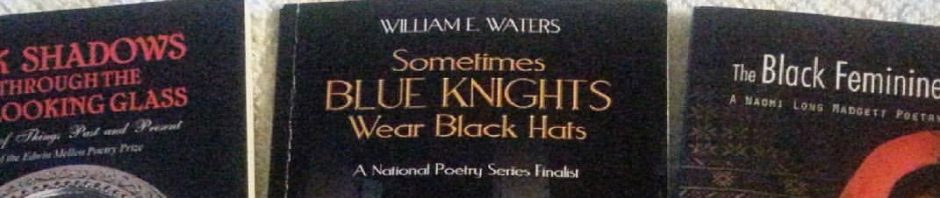
“The Gift of Story and Song” — From my book, “Black Shadows and Through the White Looking Glass

From Griots to the Last Poets

From Phillis Wheatley

            to Gwendolyn Brooks.

From highly imitative        

            to Pulitzer Prize-winning poetry.

From Various Subjects, Religious and Moral

            to Annie Allen.

From Zora Neale Hurston

            to Toni Morrison.

From Their Eyes Were Watching God

            to Paradise.

From folklore

            to Nobel Laureate fiction.

From Mules and Men

            to Beloved.


From Richard Wright

            to James Baldwin

            to Walter Mosley.

From Native Son

            to “Sonny’s Blues”

            to A Devil in a Blue Dress.


From the Royal Family –

Count Basie, Duke Ellington

and Nat King Cole

            to the King of Pop.

From a Lady singing the blues

            to the Funky Divas.

From the Queen of Soul

            to Queen Latifah.

From Bojangles

            to M.C. Hammer

            to the Tap Dance Kid.

From Porgy and Bess

            to Jelly’s Last Jam.

From slave songs and spirituals

            to soul.

From delta blues

            to rhythm and blues.

From New Orleans jazz

            to Brass Construction.

From ragtime

            to rock ‘n’ roll

            to rap.


The gift of story and song.

Posted in Uncategorized | Tagged , , | Leave a comment

Review of my book, Black Shadows and Through the White Looking Glass, by Norman Leer

Following is a review of my book, “Black Shadows and Through the White Looking Glass,”
when it was first issued, by Norman Leer: “…this poem is a powerful expression of black anger and despair.  Waters clearly knows his history…  I’m impressed that Waters is able to relate slavery back to historic and current African practices, which were in fact aggravated and exploited but not originated by Europeans… The poem has some excellent material on the sexual exploitation of blacks by whites during slavery, and on the artificial color categories that emerged from this and that were used to buttress segregation and racism.  Stylistically, the poem is strong when it uses repetition to support its angers and ironies…  One might say that Waters’ poem celebrates the heroism of black survival.

Posted in Black Shadows and Through the White Looking Glass, Poetry, Slavery | Tagged , , , , , , | Leave a comment

The Three Erics

Three years ago, when I turned 50 years of age, I wrote a poem in the tradition of Ginsberg’s “Howl!,” talking about what had happened to some of the best of my generation. I titled it “Celebrating Fifty Years of Life.”

Nine days ago I turned 53. Someone I know said I should re-post “Celebrating Fifty Years of Life.” It made me think of how far I have come, and how many I know, the best and the brightest and the boldest, didn’t make it this far.

I want to talk about the Three Erics, three people I know also named Eric, that I grew up with, people who lived in the same neighborhood: Marcy Houses. Before Jay-Z put Marcy on the map, there was the Three Erics. Eric T. – the boldest. He was physically precocious, at 16 could’ve taken on and beaten the future Heavyweight Champ, Mike Tyson. The thing that distinguished Eric T. was his big head. His head was so big one would think it was an easy target to hit when he was boxing street battles royal. He would bob and weave that head like Joe Frazier, adding a snake move, and was nearly impossible to hit. Three attempts on his life, before aged 18, failed. The fourth attempt, a bullet to the head, he couldn’t bob and weave. A year later I would meet his killer, like most killers, unremarkable, unassuming. Eric T., the neighborhood bully, finally met his match. Dead before 20.

Eric H. – the brightest. He was smart, probably thought he could outsmart the world. Had the cunning of a politician, the street smarts of a philosopher. He also epitomized cool. He was one of the best dressers I knew, and I took a few tips from his style book, and I knew that he had something when my oldest sister, a fashion maven, commented on my style. He’s the one who gave me the nickname Easy, Easy Waters, probably because there were too many Erics in our neighborhood. He was also lucky, always one step ahead of everyone. But his luck ran out. He died in a Federal prison, a “hole in his heart.” Dead before 30.

Eric W. – the best. He had the benefit of a father who was present, a father who raised him as a Nation of Islam (NOI) Muslim. He oozed that NOI confidence, that confidence you saw in “Black Muslims,” epitomized by Malcolm X, that made them glow – clean cut and clean shaven, no nonsense. There was a little bit of Malcolm X in all Black Muslims post 1965-1978, and less so thereafter. Malcolm X’s story, one of the classic redemptive tales. Some of his immortal words: “There’s no shame in having been a criminal, only in remaining one.”

So today, I remember the Three Erics. I miss them – the youth that grew up and old fast – but they are still alive in me, in that in my teens I emulated them and the best they had to offer is embodied in me.
Posted in Fathers, Growing Up, Malcolm X, Uncategorized, Urban Impact | Tagged , , , , , , | Leave a comment