Netflix’s “The Fall of the House of Usher”

I just finished binge-watching Netflix’s “The Fall of the House of Usher,” ostensibly about Edgar Allan Poe’s short story of the same name, with a modern twist.  People familiar with Poe’s works will see that much of his work beyond “The Fall of the House of Usher” is woven into this eight-episode “season.”

I was first introduced to Poe in college, and I confess that I haven’t read him since. I read his short stories, including “The Gold-Bug,” “The Cask of Amontillado,” “Ligeia,” and of course “The Fall of the House of Usher,” and his poems, “The Raven, “Anabel Lee,” “The City in the Sea,” and “Lenore.”  In one way or another, elements of these stories and poems by Poe find their way into the episodes, sometimes as characters, such as Anabel Lee, Lenore, Griswold, Tamerlane, and Auguste Duphin.

The language in Netflix’s “The Fall of the House of Usher” is by turns vulgar and poetic.  Verna, a principal but “dark” character throughout the stories, offers the following to one of the other characters: “Language in its highest expression is musical.”  The music throughout the series ranges from classical to disco.  But what ties the story together, what tells the story, is its poetry.  Verna says, “What’s a poem, after all, if not a safe space for a difficult truth.”  (Poets should love that line!)  Poe wrote about difficult truths.

Poe was also a cryptographer.  I won’t give it away, but with a little detective work, there’s something for the viewer to decipher.

Finally, if you haven’t read “The Fall of the House of Usher,” you can still watch and enjoy the Netflix “series.”  However, if you have read a little Poe, beginning with the title story, as well as the poems mentioned herein, you will better appreciate the story and the genius of Poe.

Posted in ezwwaters, Poetry | Tagged , , , , , , , , , , , | Leave a comment

A NYC Subway Story: Just Another Day in the ‘Hood!

At the Utica Avenue train station (in Crown Heights, Brooklyn), a peripatetic philosophical “passenger” is lecturing two of New York’s Finest.  He tells them that they don’t patrol the streets “to serve and protect” the people,” but to perpetuate the illusion of public safety.  He then tells the police officers, “You are part of the biggest gang in New York City!”  The officers simply stand there, just another day in the neighborhood, another subway story.  The officers also demonstrate remarkable restraint, in that the philosopher is all up in their personal space.  He could easily have ended up in a chokehold!

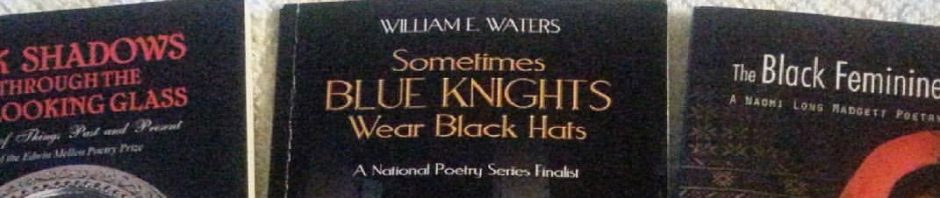
#SometimesBlueKnightsWearBlackHats

Posted in ezwwaters, NYPD, Sometimes Blue Knights Wear Black Hats, Streets of Rage | Tagged , , , , , | 2 Comments

Pascal’s wager — Don’t bet against God!

My morning meditation was on Pascal’s wager.  Blaise Pascal was a seventeenth-century French Mathematician, philosopher, physicist, and theologian.  Pascal’s wager was posthumously published in Pensées (“Thoughts”).  The wager essentially states that if you bet against the existence of God and God does in fact exist, then you lose “an eternity in Heaven in [the]Abrahamic tradition,” and are subject to “boundless losses associated [with] eternity in Hell.”  On the other hand, if God does not exist, then what have you lost?  Finite pleasures and luxuries in this world.

Two of my oldest and dearest friends are Christian and Muslim, both part of the Abrahamic religions.

From the Crusades to the present day, Christians and Muslims have engaged in actual and theological wars.  The followers of both religions believe that they have “exclusive access to divine truth.”  What I have learned in my study of theology, is that you can’t win a debate from the confessional-religious approach, which is rooted in belief.  We can look at and analyze the history and interactions of the Abrahamic religions, including Judaism, Christianity, and Islam, in order of historical revelation, and even deconstruct the literary motifs in their Holy Books, but we cannot, though we do, debate about belief.  If I have not learned anything from my studies, I have learned that belief is essentially not up for debate, regardless of your faith tradition.

I have this vision…that Jews, Christians, and Muslims will all meet in the afterlife, and because they didn’t bet against God, they have made and secured their places.

In these religious debates, we often don’t hear about the core things the Abrahamic (Ibrahim) religions have in common, only the differences, where we are, at the very least, willing to engage in a war of words.

I have this vision, which isn’t up for debate, because it’s my dream, that Jews, Christians, and Muslims will all meet in the afterlife, and because they didn’t bet against God, they have made and secured their places.  To paraphrase Gibran Khalil Gibran, the Lebanese American writer, poet, visual artist and philosopher, the major religions are like the fingers on the hand of God, all leading to God.

Posted in ezwwaters, Jesus, Religion | Tagged , , , , , , , | Leave a comment

Black Youthful Fate

As youth they couldn’t wait
To reach for the very stars
For them no such thing as fate
As youth they couldn’t wait
To reach for the very stars

Their dreams never appeared to be too far
For them no such thing as fate
They’d be driving their own luxury cars
Their dreams never appeared to be too far
For them no such thing as fate

The Watchers had already foretold their fate
From windows reinforced with bars
They wouldn’t live long enough to mate
The Watchers had already foretold their fate
From windows reinforced with bars

Their date with destiny couldn’t wait
They’d never reach the stars
Too soon they’d be introduced to fate
Their date with destiny couldn’t wait
They’d never reach the stars

Dreams falling from the sky like dead stars
Rushing headfirst toward their fate
Dreams crashed from joy riding in cars
Dreams falling from the sky like dead stars
Rushing headfirst toward their fate

their fate

Posted in ezwwaters, Growing Up, Poetry, raising black boys | 2 Comments

The Watermelon Man in Williamsburg — “Only in New York!”

If you live in New York City, or if you have visited NYC, then you probably have an “Only in New York Story.”

I am walking down the street in Williamsburg, the land of Hasidim and Hipsters, when I come across a group, mostly white people, with a couple of Black people sprinkled among them, being led by a tour guide.

If you live In New York City, then you are bound to bump into tourists, some led by tour guides.  But this group catches my attention.  As the tour guide delivers his spiel, I can’t take my eyes off of four people.  They are rolling a large watermelon down the street.  It is the largest watermelon I have ever seen.  It is the size of a Mercedes Sprinter.  “Only in New York!” I mutter under my breath.  Out of curiosity, I join the tourists.  The tour guide is talking about the Great Migration of Hipsters into Williamsburg. I look around, see Hipsters here and there, totally not representing or defining Brooklyn cool.  I look back at the men pushing the ginormous watermelon through the streets of Williamsburg.  They stop at a red light.  The tour guide says that at one time Williamsburg was overrun with crime, and that the number one crime was the theft of watermelon.  He is demonstrating how safe the neighborhood is now by having the four tourists roll the gigantic watermelon down the street.  At this time, I’ve had enough!  I’m a born and bred Brooklynite, from what was designated as East Williamsburg. I can’t broker lies about my beloved borough, now considered the “coolest City on the planet.”  Don’t give Hipsters credit for that!  Disgusted, I jump on top of the watermelon and start hacking at it with a machete, but I can’t cut through the rind.  I jump off the watermelon, push the tourists pushing it out of the way, and give the watermelon a swift kick.  It rolls into oncoming traffic, right into a Mercedes Sprinter, which it almost overturns.  Jaded New Yorkers are aghast.  We have seen everything, but not a gigantic watermelon rolling down the street!

The tour guide points at me, yells, “Hey, Watermelon Man!”  I wake up.  “Only in New York,” I say, “even in my dreams.”

Posted in ezwwaters | Tagged , , | Leave a comment

NYC Subway Story

On my morning commute, as my train approaches the station, I see a Brother reading The Idiot, by Dostoevsky.  (People who know my literary tastes, know that I had a “Russian Period,” when I was reading many Russian authors.  Dostoevsky is my favorite, and my favorite book by him is Crime and Punishment.)

“Have you read Crime and Punishment?” I asked the Brother.

“Yes, and The Brothers Karamazov,” the Brother added.

I had done my due diligence.  I have read all of Dostoevsky.  I am at my stop.  I want to stay on the train and talk to the Brother about Russian Literature.  I want to know if he has read Pushkin, Tolstoy, and Solzhenitsyn.  People who read books on trains, I think, are not just escaping interaction with their fellow commuters.  Granted, they are in another world, but they are more inclined to talk to someone about the book and books than a commuter on his or her phone, lost in the matrix.  What do you think? I have had countless conversations with commuters reading books.  I have also caught commuters sitting next to me reading what I am reading, writing or editing.  Believe it or not, I can write on trains!  Many a blog I wrote during my commute!

Posted in ezwwaters | Tagged , , , , , , , | Leave a comment

Virginia on My Mind

There is something that keeps drawing me back to Virginia.  Although my father was born in North Carolina, he grew up in Virginia and returned there in 1946 after he was discharged from the segregated U.S. Army.  He was drafted as a teenager to serve in the Army during World War II.  Virginia advertises itself as the state for lovers, but I know that is not what draws me back to her.

Growing up, every year, around the Fourth of July, my father would jump in his Cadillac and make the trek to Virginia to visit his family.  Afterall, he was a Native Southern Son and, despite the South’s history, I think there is something there that draws Native Southern Sons and Daughters back.  I am a Native New Yorker, so I know this is not the case for me.  My father never took me, his first-born son, on his treks to Virginia.  I resented him for this until I learned the history of the South, in which we were still living when I was a child.  For me, the trips would have been during the mid-1960s and early 1970s, when segregation in the South still reigned supreme.  With this knowledge of the history of the South, I came to understand why my father did not take me on his treks down South.  This was a way for my father to protect me from the ways of white folk in the South.  He knew, once he crossed the Mason-Dixon line, that his ability to protect me was greatly diminished.

So what draws me back to Virginia again and again?  I think that part of my father’s soul is here, and that I am searching and seeking to commune with him – he passed away when I was 21.  I have so many questions for him: Did you aspire to be a writer, as I have heard from one of my oldest cousins on my maternal side? Why exactly did you leave the South?  For a better life?  Or did you flee because of white folk?  As a veteran, were you targeted by white folk because you dared to wear your uniform in public?  (Note that during the race riots of 1919, that Red Summer, Black World War I veterans were targeted by white folk, to put them back in their place, in case they got any ideas about fighting for freedom in America, and this targeted violence continued against Black World War II veterans.)

On this Virginia trip, it struck me, that my father not only did not bring me on his treks down South to protect me from white folk, but also to protect himself, his secrets. I think most if not all parents have secrets they do not tell their children, and if your parents die before you can have adult conversations with them, then they take those secrets to the grave.

My oldest sister, Jeanette, thinks that I am obsessed with our ancestry, our family history.  In unearthing some of the family secrets, I am back in 1805, in Bath County, North Carolina.  Looking at a census report, I see that one of my paternal ancestors is listed as a Negro and head of household.  His wife is also listed as a Negro.  One of their daughters is listed as a Mulatta.

This is no secret, the miscegenation, most of it white men raping Black women, in the South.  What is a secret in my family tree is the white father of my 1805 Mulatta ancestor.  Regardless of how hard I shake the family tree, this white father will not fall out.

History, at its best, fills in the blanks of the historical record.  In the final analysis, I am simply filling in the blanks, the gaps in knowledge, of my family history, with Virginia on my mind.

Posted in Black Shadows and Through the White Looking Glass, ezwwaters, Family, Fatherhood, Fathers, Genealogy, Growing Up, race, Slavery | Tagged , , , , , , , , , | 1 Comment

Remembering My Father as I Remember Maceo Snipes, Black Veteran, Shot to Death After Voting in Georgia Primary — July 18, 1946

As a teenager my father, a Native Southern Son (NC and VA), was drafted to serve in the segregated U.S. Army during World War II. Shortly after he was honorably discharged from the Army in 1946, he moved to Brooklyn, NY. He never talked about growing up in the segregated South or serving in the segregated U.S. Army, but every summer around the 4th of July he would get in his Caddy and drive South to visit family — the 1960s and early 70s. He never took any of us South. I often wonder if, as a WWII veteran, he was targeted by white racists and decided to flee the South. Later, as a student of American history, I came to understand that my father did not want to subject his first-born son to the ways of white folk in the South, and he probably knew that I would not be able to navigate the racist rules because I grew up NOT afraid of white folk. If he ever thought about me joining him on his road trip South, then he probably thought about Emmett Till and quickly abandoned that idea.

Lest we forget!

Posted in Black patriotism, Black Shadows and Through the White Looking Glass, crime, ezwwaters, Family, Fatherhood, Fathers, Growing Up, Lest We Forget, Murder, Politics, race, raising black boys, Relationships | Tagged , , , | Leave a comment

The Inexplicable Endurance of the N Word

As some of you know, I am currently teaching a course, African American Literature in the 20th Century, for Bennington College.  The primary text for the course is The Norton Anthology of African American Literature, 3rd Edition.  In the anthology there is an excerpt from James Weldon Johnson’s book, The Autobiography of an Ex-Colored Man, ostensibly about “passing.”  I first read this book more than 30 years ago.  Note that this book was written more than 100 years ago.  In it, the narrator is at an establishment where colored men are playing pool.  People are betting on each shot, talking trash when shots are missed.  The narrator then makes this observation:

I noticed that among this class of colored men the word “nigger” was freely used in about the same sense as the word “fellow,” and sometimes as a term of almost endearment; but I soon learned that its use was positively and absolutely prohibited to white men.

In the late 1960s, during the Black Power Movement, we had hopes that the N Word would die — Die Nigger Die! We also hoped that Jemima and Tom would die, but they are still alive, and the N Word endures.

Posted in Black patriotism, Black Shadows and Through the White Looking Glass, Lest We Forget, race | Tagged , , , , , , | 2 Comments

James Baldwin’s Journey Through Politics

Thirty years ago I wrote an essay, “The Election Time Blues.”  It spoke about how political discourse in America was depressing; at least, it depressed me, and it continues to do so.  When crime is on the platform, it becomes even more depressing.

Both Democrats and Republicans have played the “crime card” in seeking election or reelection.  Think Nixon’s War on Crime (1968), Rockefeller’s War on Drugs (1973), Reagan’s War on Drugs (1980), Bush I’s War on Crime (1988)  (using the Willie Horton Effect), Clinton’s War on Crime, and Terrorism (1992), and Trump’s attempt to use the crime card in his reelection bid (2020).

As we enter the presidential sweepstakes, as the usual suspects line up to run, I’m rereading James Baldwin’s essay, “Journey to Atlanta,” written in 1948.  This election cycle, we already know what to expect.  Democrats will make empty promises to its Black constituency, the most faithful bloc of voters for the Dems, and Black voters will vote for them simply because Democrats appear to be the lesser of two evils.  Trump will ask Black voters, “What do you have to lose?’  And the sad thing is the truth in Trump’s statement, and we know that truth isn’t often uttered from his lips!  But Trump’s point is better said by James Baldwin:

It is considered a rather cheerful axiom that all Americans distrust politicians….  Of all Americans, Negroes distrust politicians most, or, more accurately, they have been best trained to expect nothing from them; more than other Americans, they are always aware of the enormous gap between election promises and their daily lives.  It is true that the promises excite them, but this is not because they are taken as proof of good intentions.

President Biden has indicated that he is running for reelection.  He doesn’t really excite his constituency, although he appears to be a decent fellow.  Other than choosing a Black woman as his running mate, and nominating a Black woman to the United States Supreme Court – and I in no way diminish the import of those two acts – Joe is just another politician who can’t really deliver on campaign promises.  In fact, campaign promises are just that: promises, unpaid promissory notes.

It is worth noting that James Baldwin’s note on election promises holds true today, more than 60 years later.  There’s that saying that the more things change, the more they remain the same.  That isn’t entirely accurate.  I think it’s fair to say that as a nation America is not that far removed from 1948; at least, not as far removed as she should be.  As Joe has said, “We are better than what we present.  The proof, though, Joe, is in the pudding.  As Isabel Wilkerson writes in her phenomenal book, Caste: The Origins of Our Discontents, that stuff we would like to put behind us, the history of slavery and segregation, lies deep within the permafrost of the America tundra.  Blame it on global warming.  The permafrost has melted and those ugly things seemingly frozen in the past have resurfaced.

There was a time when as Americans we talked of “the best and the brightest” aspiring for political office for the good of the nation, people seemingly with convictions and not simply on a power grab, people who rose to meet the moment – think Abraham Lincoln, FDR, Truman and JFK.  It is not enough to wax nostalgic.  We need people to rise to the moment.  We also need people to get out the way and pass the baton.  Lastly, we need to purge the Halls of Congress of Scoundrels and Scalawags and people waiting to die in office.  This is the journey, we, voters, and the people we vote into office, need to take.

Posted in Black Shadows and Through the White Looking Glass, crime, ezwwaters, James Baldwin, John F. Kennedy, Lest We Forget, Patriotism, Politics, race, Slavery | Tagged , , , , , , , , , , , , , , , , | 1 Comment