National Superhero Day

Today is National Superhero Day. Over the years I’ve written a series of poems about “heroes.” In my last collection, “The Black Blood of Poetry,” which I am shopping around, is this poem:

In Search of a Black Hero

Coming of age in a world without heroes,

Though try as we might to create them:

Batman, Tarzan, Superman –

From comic books, literature, and an insane philosopher.

Tabloids creating latter-day heroes,

From people deputized to serve and protect

To people who have taken the law into their own hands.

Fed a constant staple of bloody news,

Vigilantism as the main course.

Coming of age in a world without heroes,

Though try as we might to create them:

Athletes, entertainers, and even politicians –

From people blessed with power, speed, and height

To dreamers dreaming seemingly impossible dreams.

Madison Avenue magicians conjuring up images

     Of heroes to worship.

Sports pages praising latter-day heroes,

From sluggers to hoopsters

To the all-American Golden White Boy.

Coming of age in a world without heroes,

Though try as we might to create them.

Coming of age in a world without heroes,

Though try as we might to create them.

Posted in Black Shadows and Through the White Looking Glass, Poetry, Sometimes Blue Knights Wear Black Hats, Streets of Rage | Tagged , , , , , , , | Leave a comment

The King is Dead — Long Live the King!

I can’t let this day pass without saying something about the Rev. Dr. Martin Luther King Jr!

In the Decisive Decade (the 1960s), Black leader after Black leader was assassinated, but this is the assassination that made it into my 7-year-old consciousness.  I felt the pain through the adults, through a form of osmosis, and the collective unconscious.  Then, I didn’t understand the ramifications of King’s assassination, but I knew that the world had changed for the worst – it was a seismic shift in the universe.  It was then that I remembered the refrain from my youth: “They (white folk, of course), killed another good Black man.”  Now I understood it.

If you ever wonder why a good Black man is hard to find, look at the Decisive Decade and its legacy.  The assassination of Dr. King, and so many Black leaders, left a void that we haven’t been able to fill.  When my father wouldn’t take me on his annual trip down South around the Fourth of July, I didn’t know that the world wasn’t even safe for a 7-year-old Black Boy.  My father knew that he had to return to his ancestral roots, but that he would not take his first-born son, because he couldn’t protect me from the malevolence in Southern air.

Benjamin Mays, President of Morehouse College, Dr. King’s alma mater, gave his eulogy.  The two had an agreement that whoever passed first, then the other would give the eulogy.  Dr. Mays didn’t think that he, a much older man, would give Dr. King’s eulogy.  But as “fate” would have it, and the assassin’s bullet, Dr. Mays gave Dr. King’s eulogy.  It is such a heartfelt eulogy.  One thing, though, resonates with me.  Dr. Mays said that no one is ahead of his time.  We find ourselves at a particular time and place in history, and we either respond, or we don’t.  Frantz Fanon wrote that each generation must find its calling, fulfill or betray it.

We know that people in the Movement were betrayed by their own.  It seems to be part of the human condition.  When Machiavelli advises the Prince that it is better to be feared than loved, he only states this because his belief system was that man could not be trusted, and that love would be betrayed quicker than fear.

In the final analysis, we know that Dr. King loved us, and he gave his life for us.  I will forever be haunted by that refrain: “They killed another good Black man.” 

Posted in Black Shadows and Through the White Looking Glass, ezwwaters, Martin Luther King, Politics, race, Religion, Revolution, Streets of Rage | Leave a comment

National Poetry Month

April is National Poetry Month. Purchase and read one of my three books of poetry.

My first, award-winning book, Black Shadows and Through the White Looking Glass:

Co-winner of the Edwin Mellen Poetry Prize

. . . this poem is a powerful expression of black anger and despair. Waters clearly knows his history. . .I’m impressed that Waters is able to relate slavery back to historic and current African practices, which were in fact aggravated and exploited but not originated by Europeans. . . The poem has some excellent material on the sexual exploitation of blacks by whites during slavery, and on the artificial color categories that emerged from this and that were used to buttress segregation and racism. Stylistically, the poem is strong when it uses repetition to support its angers and ironies… One might say that Waters’ poem celebrates the heroism of black survival.

— Normal Leer

A National Poetry Series Finalist

This collection began by writing one poem on police misconduct reported in the news. After this, at least once a week, there were more and more reports on police misconduct in the news, resulting in me writing more and more poems on law enforcement misconduct. Within a year, I had more than enough poems for a collection.

A Naomi Long Madgett Poetry Award Finalist

Just a tribute to Black women in history, in literature, and in my life, dedicated to my sisters.

Posted in Black Shadows and Through the White Looking Glass, crime, ezwwaters, Justice Chronicles, Mother's Messages, Murder, NYPD, Poetry, police involved shooting, police-involved killing, Politics, race, raising black boys, Sometimes Blue Knights Wear Black Hats | Tagged , , , | Leave a comment

Mommy

Some people have a fear of growing old.  Some people die young.  Those who fear growing old, methinks they wouldn’t want the alternative, dying young.  Dying young shortens the timeline to fulfill dreams, to see the world, to see your children grow, to see your legacy realized. The theme of immortality plays on the fear of growing old, of not growing old, to be forever young.  Dying young, you are forever young.  Mommy was forty-four when she died, so young, but she lives on in my sisters, and in our hearts and minds (memories).   In my mind, she is forever young.

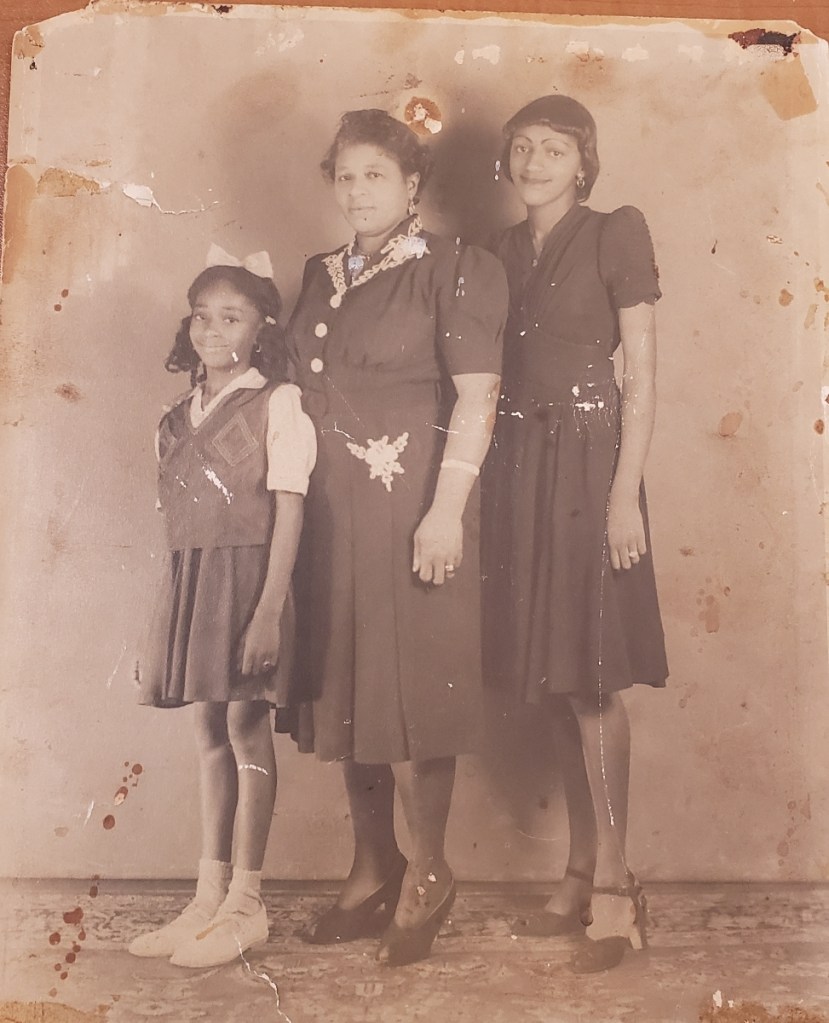
Mommy was the youngest of her siblings.  When she was a teenager, she was already an aunt.  My older cousins have told me that Mommy was the cool aunt.  She was their chaperone, took them to the West Indian Day Parade in Harlem, before it moved to Brooklyn in 1964, the year my sister Wanda was born.  (Here it is important to note that both of my mother’s parents were born in Barbados.)

Earlier today Wanda reminded us of a memory.  Mommy was taking all of us to the circus.  (Wanda said Mommy had her hands full when we were all together.)  My brother and I, if we saw something funny, it didn’t matter where we were, on the train, or in church, we would laugh, and I would avoid Mommy’s fingers that would pinch me.  When my sisters saw a comedic moment in the making, they would not look at their brothers, because they knew we would laugh, and make them laugh.  Later, my brother, “Whitney, not Houston,” would keep us laughing.  We miss his giving spirit, but we mostly miss the laughter he brought into our lives.

Mothers not only bring their children into this world, but they give us something else: the wisdom of Mother Wit.  I remember things my mother said, but one thing stuck with me more than others.  Mommy highly valued education.  She said, when you are educated, you have something that no one can take away from you.  I liked that idea.  To this day, that recording plays in my mind, and I’m a lifelong learner.  Mommy also loved reading, and two of my sisters and I, we say we got Mommy’s reading gene.  We absolutely love reading.  My love of reading led me to writing, and I think my mother would be proud that her firstborn son is an award-winning writer.  My first book, Black Shadows and Through the White Looking Glass: Remembrance of Things Past and Present, is dedicated to Mommy.

In my dedication in Black Shadows, I quote Proverbs 31: “Her children rise up and call her happy.”  I think she was happy with us.

Posted in being a teenager, Black Shadows and Through the White Looking Glass, ezwwaters, Family, Lest We Forget, Mother's Messages, raising black boys, Relationships | 3 Comments

Aunt Willie

Aunt Willie

My Aunt Willie is the cool aunt, the cultured aunt. When my mother passed away when I was seventeen, Aunt Willie became the closest thing to a mother I had. She never forgot my birthday, to this very day. I can, at the very least, expect a call from her on my Born Day.

My Aunt Willie married my mother’s brother. In thinking about this penultimate post for Women’s History Month, I thought about my Uncle Mike (Micah). I was 10 years of age when he passed away. I don’t remember his death, but I remember him taking me and his son Jeffrey “crabbing” at Coney Island. We didn’t catch anything but seaweed, but it was still a memorable occasion. From this simple outing, I learned a lifelong lesson about “presence,” about being present in the life of your children, of young people, of the people with whom you are connected. This lesson informs how I move in the world, personally and professionally, which I call “the ministry of presence.”

It seems like my Aunt Willie has always been present, in one way or another, in my life, in the life of her family, in the life of our family. She is the true Matriarch of our larger family.

At 91, my aunt is still sharp, as sharp as when she was a public school teacher and had to deal with the Pedagogy of the Oppressed, and she has an incredible sense of humor.

Aunt Willie has been blessed with a long life, and we have been blessed by having her in our life.

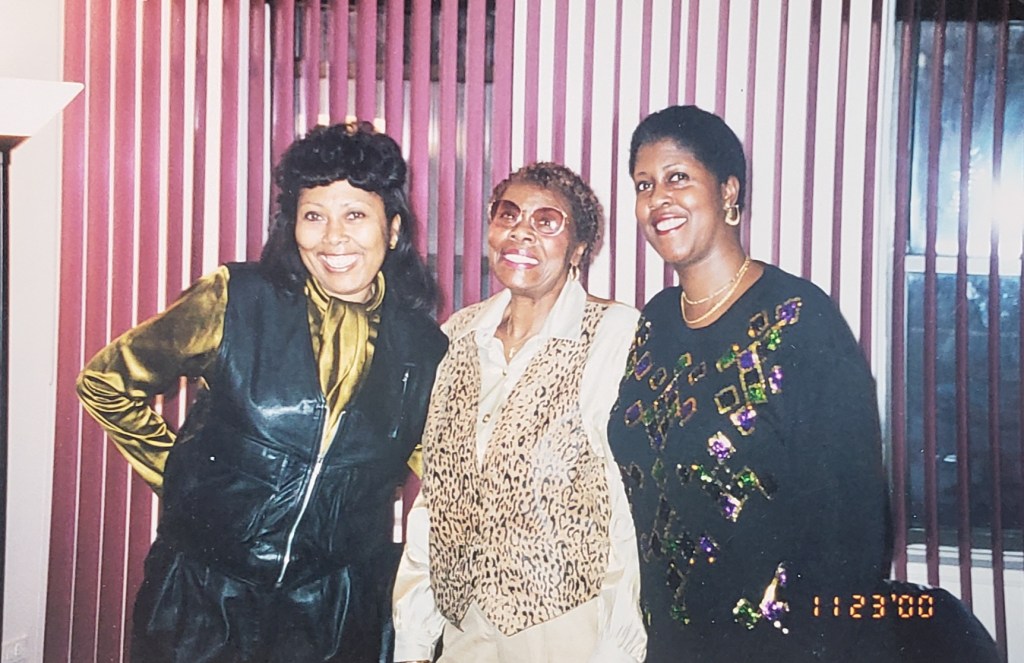
Aunt Willie and her Daughters

Posted in being a teenager, ezwwaters, Family, Fatherhood, Fathers, raising black boys, Relationships | Leave a comment

Vision: To See What Others Can’t

In my work in the last twenty years in the nonprofit arena, I have met and collaborated with dynamic women leaders.  They all had different skill sets and strengths.  Some were fabulous fundraisers, others were powerful public speakers, and yet others were financial wizards.  They worked at grassroots, small, medium, and large organizations.

I struggled with this post, but I’m a  person who gives credit where credit is due.

Christine McMahon, President and CEO of The Fedcap Group, is one of the most visionary nonprofit leaders I have encountered in the past twenty years.  Under her leadership, The Fedcap Group has expanded its footprint, becoming an international organization, with Fedcap U.K., and Fedcap Canada.

Every Wednesday, in her “Wednesday Morning Buzz,” Christine McMahon shares some of her current thinking, along with articles she has been reading that’s informing her thought leadership.  As someone who teaches a graduate level leadership course, I am always gleaning these articles and sharing with my students.  My previous supervisor would, at staff meetings, joke, “I bet you Eric read the latest ‘buzz’ from our President and CEO.”  Once, I responded, ”Why would I not want to get into the head and the thinking of a visionary leader who sees what others can’t?”  I’m my previous supervisor’s successor, in part, methinks, because I, too, see what others can’t.

Posted in ezwwaters, Justice Chronicles | Tagged , , , | Leave a comment

Phenomenal Women Are Everywhere!

As we wind down this Women’s History Month, I would be remiss if I didn’t mention the phenomenal women, Juliette, Giovanni, Belinda, and Irma, on ReServe’s leadership team who have helped me manage one of the organization’s remits with a workforce of two hundred people.  There are other women, not peripheral, but essential, that led this team to success, Bryanna, Tiffany, Yvette, Patricia, Akiko, Diane, Jodi, Cecilia, and Evelyn (Mafan).  And others, Dhanairy and Siana.

I’ve often stated that, growing up with three sisters, I have a sensibility many men don’t have.  I’ve never really given it much thought.  When you grow up a certain way, it’s just part of you; you don’t think about it.  I treat women in the workforce as I would want my sisters treated, with professionalism and respect.  To my credit, or theirs (my sisters), far too many women I have worked with have come to me, before they went to HR, to see if I could address a particular “male” behavior.  To a woman, they’ve said, we don’t get that vibe (toxic masculinity) from you in the workplace.  I’ve taken my understanding of this “vibe” to my coaching sessions with formerly incarcerated men who could very well be like the cavemen in the Geico commercials, but this balance in the workplace is not so easy.

One thing that I’m truly appreciative of the last two years, is working with a truly diverse workforce.  The ReServe workforce doing test and trace work around COVID-19, in the neighborhoods most impacted during this pandemic, spoke more than twenty languages and was as close as I’ve seen a “rainbow coalition.”  In more than 20 years in the nonprofit world, I have not worked with a more diverse workforce, linguistically and racially.  As a native New Yorker, I often marvel at how segregated our diverse City is, even in the workforce.  I’ve worked at nonprofits, and I could surmise, by race, which departments people served.

Our remit revolved around serving people, initially, in thirty-three zip codes most impacted by COVID-19, identified by the Mayor’s Taskforce on Racial Inclusion and Equity (TRIE).  I’ve seen some important things happen with this group, so I remain hopeful about a host of things.

Posted in ezwwaters | Leave a comment

The Amazing Grace of The Most Honorable Ketanji Brown Jackson

Two months ago I didn’t know who Judge Ketanji Brown Jackson was.  Today, the whole world should know her.  The whole world should be in awe of her amazing grace in the face of an unprecedented attack on a U.S. Supreme Court nominee, the first Black woman to receive this ”honor.”

Although the spotlight is on Judge Ketanji Brown Jackson, something else is being highlighted: the virulent racism in the Senate leadership of Republicans.  In this historic moment, any Black Republican should be ashamed to be a Republican, given the treatment of Judge Ketanji Brown Jackson.  In fact, Black Republicans should defect from the Republican Party, become Independents, or revisit a period in American political history and become the new Know-Nothing party (1850-1860), and do nothing.


Those who know me know that I can’t stomach “slave movies,” including Gone With the Wind, Frankly, I don’t give a damn about that “genre” of film.  Add U.S. Senate Confirmation Hearings when Black people are nominees!

Years from now, whether or not Judge Ketanji Brown Jackson becomes the next U.S. Supreme Court Justice, movies will be made about her.  I hope they accurately capture this moment, and portray Senators Cruz and Graham as the wretched wretches they are, without an iota of shame, grace, or honor.

Judge Ketanji Brown Jackson, those who are most important honor you, today and tomorrow.  White America has never honored Black women and their contributions to making this nation great.

Lest we forget, white leaders of this nation suckled at the breasts of Black women, and continue to do so, although they are biting and drawing blood.

Blood is in the mouths of Senators Cruz and Graham.  You want some critical race theory?  When the historical record is written, Cruz and Graham will be a shameful footnote to the story of the Most Honorable Ketanji Brown Jackson.

Posted in ezwwaters, Justice Chronicles, Patriotism, Politics, race | Tagged | Leave a comment

“Life Sentence”

In my post, “The Anatomy of Advocacy – In High Heels,” I mentioned how the successful advocacy of the Ad Hoc Committee on Lifetime Parole was a much longer, untold story.  This is another part of the story.

In addition to research on parole, quantitative out of John Jay College of Criminal Justice, and qualitative out of the CUNY Graduate Center, some Ad Hoc Committee on Lifetime Parole members participated in a documentary, “Life Sentence.”  Lisa Gray, Media Producer / Editor / Consultant at Sound Mind Productions, put together a compelling documentary on the impact of a life sentence.  Many of these life sentences were given to people when they were teenagers, many of them unarmed, nonkilling accomplices in felony-murder, one of the strictest liability crimes on the law books.

In “The Anatomy of Advocacy,” I mentioned Jenna’s Law, how Gov. Pataki got it on the books, and the attendant rider that eliminated release from parole supervision for certain individuals, that is, lifetime parole supervision, which wasn’t part of the original sentence.  When I author the full story, how the Ad Hoc Committee on Lifetime Parole got to advocacy as opposed to a lawsuit challenging the constitutional legitimacy of the amendment of Executive Law 259-j, then the story will come into sharp focus, since I’ve been administering it in doses.  In any event, because people convicted of class A-1 felonies in New York were sentenced under the indeterminate sentencing scheme, Jenna’s Law, which brought determinate sentencing to New York State, didn’t apply to them.  The “loophole,” because these individuals could only be released to parole supervision by the Board of Parole: Gov. Pataki instituted what came to be called the “Pataki Rule,” in short, deny everyone convicted of certain crimes parole.  For those serving an indeterminate sentence of 15 years to life – this is a true story: parole panels repeatedly denied this individual, adding 25 years to the 15 years before he was released to parole supervision! – where there was an expectation to be released to parole supervision after the minimum period of imprisonment of 15 years, found themselves being repeatedly denied parole.  Some of these individuals died before a parole board made a determination to release them.

The research mentioned above revealed that the people being released at a percentage below 5% when the Pataki Rule was enforced had the lowest recidivism rate when their release rate was above 50%.  I know it sounds Kafkaesque, but below is dialogue from two true stories.

(A repeat offender – pardon the language, but I’m making a point – for “minor” crimes is interviewed by an institutional parole officer.  Towards the end of the interview, the following dialogue takes place.)

Repeat Offender:      

What do you think my odds are of making parole?

Parole Officer:                       

They’ll [the parole panel) probably let you go because they know you’ll be back.

(The same Parole Officer has a similar conversation with a First Timer, convicted of felony-murder as an unarmed nonkilling accomplice, who’s served 20 years, who is going to the parole board the same month as the Repeat Offender.  He has a stellar prison record, the poster child for “rehabilitation.”)

First Timer:

What do you think my odds are of making parole?

Parole Officer:

Fifty-fifty.  They know you’re not coming back.

This dialogue is indicative of a system designed to fail, with or without a life sentence.

Posted in being a teenager, crime, ezwwaters, Justice Chronicles, juveniles, Lest We Forget, Life Sentences, Murder, Parole, parole board, Politics, race, raising black boys, Reentry, remorse, Streets of Rage, urban decay, Urban Impact | Tagged , , , , , , , | Leave a comment

The Anatomy of Advocacy – In High Heels

In 1998, the New York State Legislature passed Jenna’s law, named after Jenna Grieshaber, a 22-year-old white female nursing student killed by Nicholas Eugene Pryor, a Black male who had previously been on parole. 

Governor Pataki exploited Jenna’s tragic death to get determinate sentencing in New York for Index Crimes, framed as “violent felony offenses.” Pataki’s real motivation for pushing for determinate sentencing was to secure block grants made available by the Federal government to the states for passing “truth-in-sentencing” laws.  When politicking for this change in sentencing laws, Pataki was clear that it had more to do with dollars and cents than public safety.  In fact, the so-called “crime problem” in New York, specifically in New York City, was seen as rural upstate New York’s profit.  Indeed, Pataki’s predecessor, Gov. Mario Cuomo, began to build an economic infrastructure in chronically economically depressed rural areas in New York by building prisons, with funding from the Urban Development Corporation because New Yorkers didn’t want to fund prisons though bonds, to provide employment.  When it comes to dollars and cents as they are connected to crime and punishment, both Democrats and Republicans are bipartisan, or equally guilty.  The pot of money Pataki sought originated in the presidency of Bill Clinton, a Democrat, who proved that he could be even tougher on crime than Republicans.

In any event, a rider was attached to Jenna’s law, eliminating the possibility of release from parole supervision for people convicted of certain crimes that carried a maximum sentence of life.  Sentencing laws are complicated, and this is not the platform for discussing it.  Suffice it to say that the sentencing structure in New York State militates against, for the lay person, fully understanding them.  Simply put, people on parole supervision with a reasonable expectation that they would be discharged form parole in full satisfaction of their sentences after three years on parole supervision learned that they would be on parole for the rest of their lives because of this rider!

This is a much longer story, one that needs to be told, but I want to uplift one woman, Diana Ortiz, who was instrumental in successfully “overturning” the change in law and having it restored to its pre-1998 form.

At this time Diana and I worked together for a nonprofit.  In fact, I was her direct supervisor.  I noticed something in the reentry industrial complex vis-à-vis formerly incarcerated women.  They were treated differently than their male counterparts, often by women not impacted by or impacted differently by the criminal legal system.  Much of this has to do with, I discern, how these nonprofit women leaders view women who have been trafficked or involved in sex work.

I’ll jump ahead.  I know why the caged bird sings, and unlike some nonprofit leaders and managers, I open the cages and let the birds fly free to reach whatever heights they may attain. Diana is one of these “birds.”

Re Executive Law 259-j

Diana and I were the primary leaders of the Ad Hoc Committee on Lifetime Parole, and although many people were behind our successful advocacy and reinstatement of Executive Law 259-j, only three people that I know of, Diana and I, and the late Chair of the Division of Parole, Bob Dennison, have the proclamation and one of the pens Gov. Paterson used to sign the bill into law so people released from prison could be free.

Posted in crime, Justice Chronicles, Lest We Forget, Life Sentences, Parole, parole board, race, Reentry | Tagged , , , , , , , , , , , | 1 Comment