
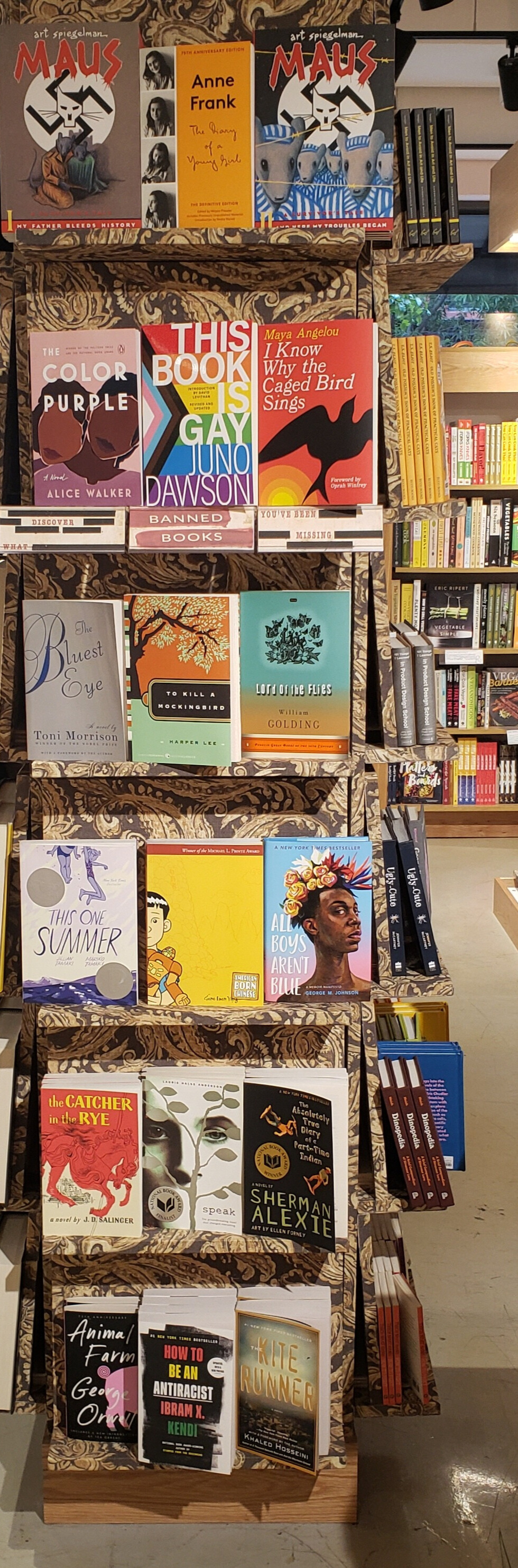
On a recent summer trip to Virgina, where one could argue that it all began in 1619, that is, the enslavement of Africans in what would become the United States of America, I stopped at a Barnes & Noble. During vacation, I get to read a couple of books for pure pleasure! At this Barnes & Noble in “Colonial” Virginia, as there was at a Barnes & Noble in Brooklyn, NY, there was a “banned book” section. I get that this is a way to sell books, but there is also something insidious at play. According to PEN America, a nonprofit organization that aims to support freedom surrounding literature, since July 2021, book bans have been reported in 26 states. Five states have reported the most book bans: Texas (713); Pennsylvania (456); Florida (204); Oklahoma (43); and Kansas (30). Note that New York has also made the list! The list of banned books total 1,145 titles by 874 different authors. Banned books, mostly fiction, with protagonists of color, comprised 467 titles – talk about “cancel culture!” Books covering historical topics on the likes of Rosa Parks, Martin Luther King Jr., and Cesar Chavez make up 111 banned titles! Note that The Clansman, the 1905 novel and play that was the inspiration for “The Birth of a Nation,” by Thomas Dixon Jr., is not on the banned list, as it probably should not be!
We look to history to help us understand who we are today. Yet history is also an imperfect, often inadequate record of events. Depending on who is depicting the past, certain truths go untold. That is indeed the lesson of 1619, a year that few people understood as significant in American and African American history until nearly two years ago.
https://mashable.com/article/1619-why-does-it-matter
There was a time, not too long ago, when we burned Black bodies, not books. We also burned books, but the burning of Black bodies is more recent than the burning of books. In any event, the spines of books and pages crackling on a bonfire cannot compete with the stench of smoking bodies charred by fire!
Black singers and authors have used fire, as metaphor, and some white folk, as a manifestation of white hate, think the burning of Black Churches, and the burning of the Black Wall Street (1921), in Tulsa, Oklahoma, and the Rosewood Massacre (1923), in Rosewood, Florida! (Note that in 2021, Florida and Oklahoma, not so respectively, are third and fourth in the nation in banning, which could very well be burning, books.) As far as singers and authors go, I immediately think of Chaka Khan’s “Through the Fire,” and James Baldwin’s “The Fire Next Time.”
The fire next time is right here, right now – the past is never past. Embers of white hate smolders, and it just takes a little fuel to ignite it.
When we look at book banning as symbolic book burning, and when we look at the Black authors that are being banned (burned), it speaks volumes about the degree of civilization in our society, and the degree of resistance to Black thought and brilliance, which flies in the face of pseudo-theories of white supremacy. On this list of banned Black authors we have Nobel laureate Toni Morrison, Pulitzer Prize winner Alice Walker, New York Drama Critics’ Circle Award winner Lorraine Hansberry, and Ibram X., Kendi.
The gift of story and song of Black folk resonates throughout American history.


 Easy Waters
Brother Eric, thanks for exposing the absurdity and insanity of that essential point: The Clansman (1905) is NOT banned, but books on Rosa Parks and MLK, Jr. are!! And thanks for lifting James Baldwin who reminds us that the REAL, eternal fire is coming for the satanic, wicked, demonic forces that oppose truth and justice! For Christians who accept the vision given to John in the Book of Revelation, this is a comforting reality!
LikeLike