Roots – Back in 1805

I have been doing some research into my family’s family tree, and I have made it back in time 200+ years! I am back in 1805, and the White people in my family tree are starting to pop up. They’re popping up in both the South (North Carolina: father’s side) and the Caribbean (Barbados: mother’s side). Now it’s getting hard to identify individuals, because White slave masters didn’t claim their progeny by black women, and in the Census the children, even the mulattos, are identified as the children of the Negro husband (“relationship to head of household) and Negro wife — now tell me how that’s possible! One striking thing I encountered is the number of children women had. I’m seeing as many as 14, 10 surviving.

One thing you can say for the Old South: it kept good records, keeping track of African slaves (their chattel “property”). I bet this had something to do with the Three-Fifths Compromise, where every five slaves were counted as three for purposes of representation in the U.S. House of Representatives. The Census records have been invaluable in tracking my ancestors.

Posted in Genealogy | 1 Comment

From “Black Shadows and Through the White Looking Glass”

Preamble

From slavery to freedom.
From pre-colonialism to post-modernism.
From revolution to reactionism.
From the War for Independence
to the Civil War
From the slave enlistment bill
to Selective Service.
From Articles of Confederation
to the Confederacy.
From agrarianism to technocratism.
From pre-industrialization.
to post-industrialization

From George Washington
to George Bush.
From the birth of a nation
to a kinder, gentler nation.
From Thomas Jefferson
to William Jefferson Clinton.
From Democratic Republicanism
to the New Democrats.
From honest Abe
to tricky Dick
to Slick Willie.
From preserving the Union
to fighting a “lawless society”
to establishing a New Covenant.
From Radical Republicanism
to Roosevelt’s reign
to Reaganism.

From Reconstruction
to public works
to trickle-down economics.
From the Welfare State
to a Police State.

From the Do Nothing Party
to the Freedom Now Party.
From New Deal Democrats
to Dixiecrats.
From the Grand Old Party
to the Great Society
to this dialogue on race.
From the melting pot
to multiculturalism.
From Jim Crow
to the Rainbow Coalition.

From Griots to the Last Poets
From Phillis Wheatley
to Gwendolyn Brooks.
From highly imitative
to Pulitzer Prize-winning poetry.
From Various Subjects, Religious and Moral
to Annie Allen.
From Zora Neale Hurston
to Toni Morrison.
From Their Eyes Were Watching God
to Paradise.
From folklore
to Nobel Laureate fiction.
From Mules and Men
to Beloved.
From Richard Wright
to James Baldwin
to Walter Mosley.
From Native Son
to “Sonny’s Blues”
to A Devil in a Blue Dress.

From the Royal Family—
Count Basie, Duke Ellington
and Nat King Cole
to the King of Pop.
From a Lady singing the blues
to the Funky Divas.
From the Queen of Soul
to Queen Latifah.
From Bojangles
to M.C. Hammer
to the Tap Dance Kid.
From Porgy and Bess
to Jelly’s Last Jam.
From slave songs and spirituals
to soul.
From delta blues
to rhythm and blues.
From New Orleans jazz
to Brass Construction.
From ragtime
to rock ‘n’ roll
to rap.

The gift of story and song.

From slavery
to sharecropping.
From pickin’ cotton
to hoeing fields.
From the farm
to the factory.
From grapes of wrath
to industrial traps.
From the plantation
to the penitentiary.
From the old slavery
to the new slavery.
From chattel slavery
to the convict lease system
to the chain gang
to prisons for profit.

The gift of sweat and brawn.

From Africa to America.
From chains to the cross.
From a slave religion
to a religion of salvation.
From segregated balconies
to the front of the pews.
From hearing the Word
to proclaiming it.
From making a way out of no way
to leading the way.

The gift of the spirit.

The long shadows
of black history in America,
once hidden, often denied,
now revealed.

Posted in Poetry | 1 Comment

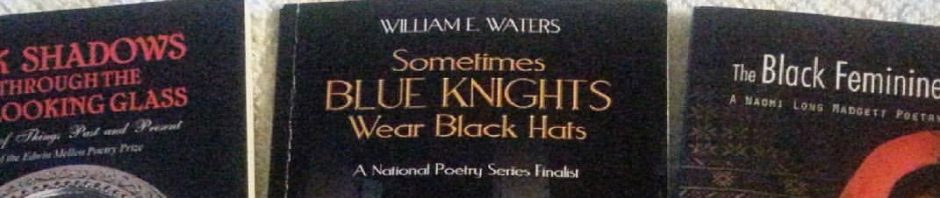
About the book — Black Shadows and Through the White Looking Glass: Remembrance of Things Past and Present

Black Shadows and Through the White Looking Glass: Remembrance of Things Past and Present is about the captivity, exploitation and suffering of Black people in America, and their triumphs.

The author, a history buff, took the challenge to look at the history of Black people in America, who are normally given one month, the shortest month of the year, February, to highlight “Black History” in America, and wrote this “epic.” For those who would separate “Black History” in America from American history, know this: American history and Black History in America are one and the same; one does not exist without the other, even though the latter has oftentimes been relegated to the shadows of American history.

Posted in Poetry | Leave a comment

About the book — Sometimes Blue Knights Wear Black Hats

Sometimes Blue Knights Wear Black Hats is a collection of poetry about law enforcement excesses. Most of the poems were inspired by actual cases from around the country. The author did not set out to compile a collection of these poems, but more and more, nearly every day, another case of law enforcement’s excessive use of force was reported in the Media. The author also did not set out to demonize law enforcement, but focused on those cases where things went terribly wrong, for a number of reasons. As a poet, as someone deeply committed to realizing a just society, the poet chose to report these cases in poetic forms. The poet acknowledges how tough the job is for those entrusted with “public safety.”

Posted in Uncategorized | Leave a comment

In the Line of Duty — From Sometimes Blue Knights Wear Black Hats

IN THE LINE OF DUTY

The heroes are dead and nothing else matters
Under a gray sky the women are dressed in black
At the grave site hearing homilies paying homage to heroics
Their sobs background music to pontificating politicians

Under a gray sky the women are dressed in black
Weeping widows hold on to their offspring for dear life
Their sobs background music to pontificating politicians
Punctuating sentences with their inconsolable grief

Weeping widows hold on to their offspring for dear life
At the grave site hearing homilies paying homage to heroics
Punctuating sentences with their inconsolable grief
The heroes are dead and nothing else matters

Posted in Poetry | Leave a comment

Blue Knight Riders — From Sometimes Blue Knights Wear Black Hats

BLUE KNIGHT RIDERS

They don’t wear white sheets
Or burn crosses in the night,
But there’s an unmistakable connection
Between these blue and white knights.
They kill innocent Black males
For horrific crimes real and imagined,
And because grand juries won’t vote true bills —
They give these cops a license to kill.
There’s something familiar in their faces,
A clearly recognizable white rage —
There since the birth of this nation —
Misreported in this tabloid age.
This is no mere comedy of errors,
But a full-fledged reign of terror.

Posted in Poetry | Leave a comment

Also look for my new collection of poetry, “Sometimes Blue Knights Wear Black Hats,” in two to three weeks…

Sometimes Blue Knights Wear Black Hats is a collection of poems, most based on actual cases, of police misconduct. The collection was a National Poetry Series Competition Finalist. In this collection, I experiment with various forms, e.g., sonnets, pantoums, triolets, etc.

Posted in Poetry | Leave a comment

My award-winning book, “Black Shadows and Through the White Looking Glass,” to be reissued in two to three weeks

My epic poem, “Black Shadows and Through the White Looking Glass: Remembrance of Things Past and Present,” was described by Norman Leer as “a powerful expression of black anger and despair. Waters clearly knows his history…. I’m impressed that Waters is able to relate slavery back to historic and current African practices, which were in fact aggravated and exploited but not originated by Europeans…. The poem has some excellent materials on the sexual exploitation of blacks by whites during slavery, and on the artificial color categories that emerged from this and that were used to buttress segregation and racism. Stylistically, the poem is strong when it uses repetition to support its angers and ironies…. One might say that Waters’ poem celebrates the heroism of black survival.”

Posted in Poetry | Leave a comment

Reentry is like…

A number of years ago I was on a panel with a number of criminal justice experts and formerly incarcerated people (criminal justice experts in their own right), and a formerly incarcerated woman was describing reentry. She said, “Reentry is like…walking through the Stargate.” She then asked the audience if anyone had seen the movie and or the series on the Sci-Fi Channel. She described how, when leaving one world and entering another, there’s this…this thing that happens to the body. On Stargate you see, I guess, she explained, the molecules of the body going through a subtle but visible change, because of the movement from one world to another.

I have been on almost countless criminal justice panels, conferences and the like, and this was the first time I thought that someone came close to describing reentry. Reentry can be so otherworldly that one has to use Sci-Fi metaphors and language to attempt to describe it.

I am relatively well-read. I have read widely across a number of fields, religion, law, criminal justice, literature, and for the most part am smart enough to understand what I am reading. Still, one subject matter always eluded me: physics. I have read Einstein and other scientists, and I might as well have been reading Greek (which I studied while in Seminary), and not until I read Stephen Hawking did I begin to understand the theory of relativity, black holes and the like. While reading another scientist, I had a Eureka! moment when I came across this definition of a “quantum jump”: “going from one state to another with nothing in between.” I said, “That’s reentry!”

We lock people up, America, that is, for long periods of time, and when they have served their time we release them. We send them through the Reentry Stargate, to a world that has dramatically changed since they were last in it, and wonder why the rate of return to prisons and jails (recidivism) is so high. Part of it, I think, is our fundamental misunderstanding of reentry. We think it’s simply an act, the actual return, but it’s a process. It’s a process that people reentering will need guides to successfully navigate.

Reentry is like….

Posted in Justice Chronicles, Reentry | Tagged , | Leave a comment

Reentry is about relationships

In the last 15 years, “reentry” has become a buzzword in the criminal justice world. Reentry, however, has existed as long as we have had prisons and jails. Reentry is simply the point where people are released from prisons and jails. Period. They have “reentered” society. (I think of everything that follows as the “transition.”)

Reentry, for the people being released from prisons and jails, is complicated, and becomes more complicated the longer people have been “incapacitated” in prisons and jails. (“Incapacitation” is considered one of the “legitimate penological goals.”) For the record, which most Americans should know by now, the United States imprisons more people than any other nation in the world. The U.S. has other dubious distinctions in this field: the U.S. holds people in prisons for longer periods of time than any other nation in the world; the U.S. sentences more people to life without the possibility of parole than any other nation in the world; the U.S. sentences more people to life sentences than any other nation in the world; the U.S. has more juveniles sentenced to life than any other nation in the world — this list of dubious distinction goes on and on, and if I continue I won’t get to the subject at hand.

I wanted to write a little about the process of reentry, what’s most important in this process. If one were to survey organizations working in the field of reentry, as well as the people they serve, and requested a list of the Top 5 things people need in order to make a seamless and successful transition from prisons and jails to their families and their communities, the list would look something like this, not necessarily in this order: 1) employment; 2) alcohol and/or substance abuse treatment; 3) a support system (that would include financial support until the individual becomes gainfully employed); 4) Voc/Ed training and 5) counseling. To this list I would add “debriefing” the prison/jail experience (different than counseling), and financial literacy. But the most important thing, which is somewhat implied in number 3, is family.

The Osborne Association, the organization for which I work, has been serving people impacted by the criminal justice system since 1931, and under the leadership of its Executive Director, Liz Gaynes, for the past 25 years, has been one of the few if not the only organization serving people impacted by the criminal justice system that has been “family-focused,” that is, that has stressed the importance of family in reentry, beginning with working with people even before they are sentenced (through its Court Advocacy Services), during imprisonment and after imprisonment (reentry). When we look at how people manage those primary relationships (family), and if they manage them well, we would see that those people who manage those primary relationsips well, manage other relationships well, and are more successful in making the transition from prisons and jails to their families and their communities.

Indeed, reentry is about relationships, “right” relationships.

To learn more about the Osborne Association, visit its webpage at http://www.osborneny.org.
Posted in Reentry, Uncategorized | Leave a comment