
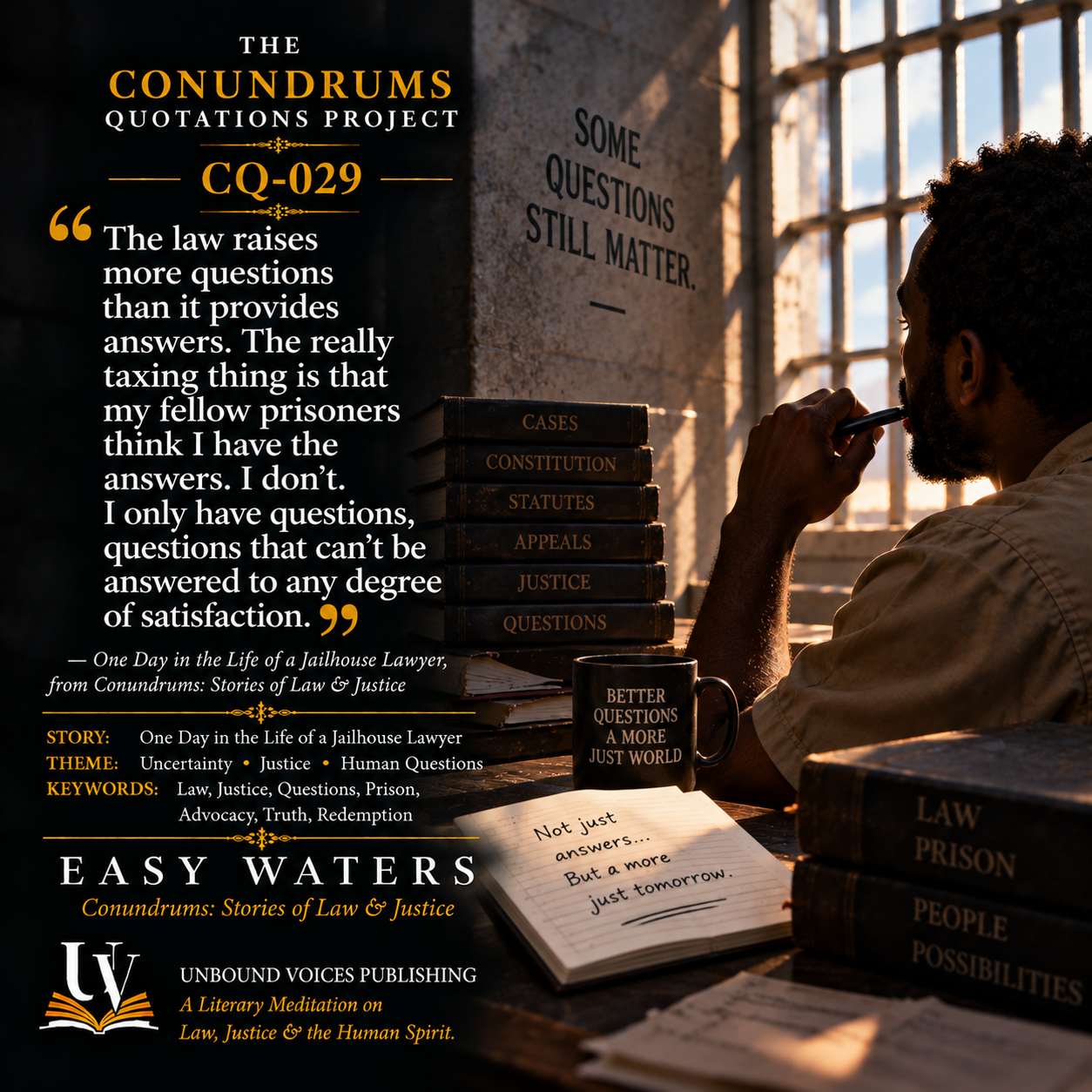
“The law raises more questions than it provides answers. The really taxing thing is that my fellow prisoners think I have the answers. I don’t. I only have questions, questions that can’t be answered to any degree of satisfaction.”
— One Day in the Life of a Jailhouse Lawyer, from Conundrums: Stories of Law & Justice
People come to a lawyer for answers.
Can this conviction be overturned?
Was the search legal?
Did the prosecutor violate the rules?
Can the sentence be reduced?
When will the court decide?
What must be filed?
Where must it be filed?
How much time remains?
Inside prison, those questions carry an urgency that people outside may never understand.
A missed deadline can close a courthouse door.
A misunderstood rule can cost years.
A newly discovered fact can become meaningless if it is presented in the wrong form.
The difference between hope and hopelessness may be a statute, a precedent, or a few words buried in a transcript.
People in prison bring their questions to E, the jailhouse lawyer, because they believe he has answers.
He knows better.
Every Case Ends With an Answer
The law presents itself as a system for answering questions.
Courts issue decisions.
Judges make findings.
Juries return verdicts.
Statutes define offenses.
Sentencing laws prescribe consequences.
Appellate opinions announce what the law means.
The language is authoritative:
Granted.
Denied.
Affirmed.
Reversed.
Guilty.
Not guilty.
Every case ends with an answer.
But not every answer resolves the question.
Legal Finality Is Not the Same as Human Resolution
A verdict of not guilty does not necessarily establish innocence.
It means the prosecution failed to prove guilt beyond a reasonable doubt.
A guilty verdict may establish legal responsibility without explaining why the act occurred, what conditions shaped it, or what justice requires afterward.
A procedural ruling may determine that a court cannot consider a claim without deciding whether the claim is true.
The law is often precise about what it has decided.
It can remain silent about what people most want to know.
Did justice occur?
That question may remain long after the case is closed.
The File Says Finished
E understands this gap because he works where legal finality and human uncertainty live together.
People in prison bring him records filled with official answers:
Convictions.
Sentences.
Appellate decisions.
Disciplinary findings.
Parole denials.
Each document appears conclusive.
Yet the men holding them continue to ask:
Did the witness lie?
Did counsel fail?
Was the punishment excessive?
Does rehabilitation matter?
Will anyone ever look at the case again?
The file says finished.
The life says otherwise.
That may be one of the central tensions of law.
Institutions require closure.
Human beings often continue living inside questions the institution has declared closed.
The Jailhouse Lawyer Must Translate Between Two Worlds
Jailhouse lawyering requires E to move between those worlds.
He must tell a person what the law permits without pretending that the law can supply everything the person needs.
He can identify an argument.
Draft a motion.
Explain a deadline.
Locate a precedent.
He cannot promise that a judge will listen.
He cannot guarantee that truth will overcome procedure.
He cannot tell a man when hope has become self-deception.
That may be the “really taxing” part of his work.
People do not merely ask E for legal analysis.
They ask him to interpret the future.
A Map Is Not an Open Road
The expectation is understandable.
Knowledge creates the appearance of control.
E knows the language of cases and courts.
He can enter the maze of statutes, rules, burdens, exceptions, and standards that confuse others.
To a person in priosn who cannot understand why an appeal failed, the jailhouse lawyer appears to possess a map.
But a map is not an open road.
It can show where the barriers are. It cannot make them disappear.
That distinction matters far beyond prison.
Knowledge can identify possibilities.
It cannot guarantee outcomes.
Expertise can clarify uncertainty.
It cannot abolish it.
Expertise Often Reveals How Much Cannot Be Known
We often imagine experts as people who possess answers.
The doctor should identify the illness.
The teacher should explain the meaning.
The minister should resolve spiritual doubt.
The lawyer should say what will happen.
But genuine expertise often produces the opposite result.
The more one understands a complicated system, the more clearly one sees its uncertainties, contradictions, exceptions, and limits.
The novice may answer quickly because he cannot see the complexity.
The experienced person hesitates because he can.
E’s admission—
“I don’t.”
—is therefore not evidence of ignorance.
It is evidence of intellectual honesty.
He knows enough about the law to know what the law cannot do.
What Law Can Do—and What It Cannot
Law can determine legal guilt.
It cannot measure the entirety of a human life.
It can impose punishment.
It cannot guarantee remorse.
It can order restitution.
It cannot restore what has been lost.
It can recognize a right.
It cannot ensure that a person has the resources to exercise it.
It can reverse a wrongful conviction.
It cannot return the years taken.
Some questions belong to law but exceed its remedies.
How much punishment is enough?
At what point does accountability become vengeance?
What does a person owe after causing irreversible harm?
What does society owe when its institutions cause harm?
Can someone become more than the act for which he is known?
Who has the authority to declare redemption complete?
The law may address pieces of these questions.
It rarely exhausts them.
Lawful and Just Are Not Synonyms
Statutes establish sentencing ranges.
Parole laws establish eligibility dates.
Courts define constitutional minimums.
Rules establish procedures.
All of that matters.
But lawful and just are not synonyms.
A punishment may be legally authorized and still be experienced as excessive.
A procedure may be correctly followed and still fail to uncover truth.
A court may have jurisdiction to decide an issue without possessing the ability to repair the full harm underneath it.
The law draws lines because institutions must act.
Human experience refuses to stay neatly on either side of them.
Beyond a Reasonable Doubt
This tension becomes especially visible in the phrase:
beyond a reasonable doubt.
The standard does not demand certainty.
It acknowledges that certainty is often impossible.
Then it determines how much uncertainty the legal system will tolerate before allowing a conviction.
That distinction is important.
The law resolves the case by establishing a threshold.
It does not eliminate every question.
That may be necessary.
Society cannot postpone every decision forever.
Courts must rule.
Juries must decide.
Sentences must be imposed or rejected.
But necessity should not be confused with infallibility.
A legal answer is a decision made under rules. It is not divine revelation.
Questions Can Be a Form of Resistance
E is surrounded by institutions that speak with certainty.
The court has ruled.
The sentence has been imposed.
The appeal has been denied.
The parole board has decided.
He responds by continuing to ask.
What evidence was excluded?
Which argument was never raised?
What assumption shaped the result?
What purpose does continued punishment serve?
What would justice look like if the person were not reduced to the official record?
Questions can become a form of resistance.
Institutions prefer the stability of settled answers.
Questions reopen possibilities.
They expose what a decision omitted.
They force authority to explain itself.
They keep closure from becoming complacency.
“Because We Decided” Is Not the Same as Justice
An institution possesses the power to decide.
That power is real.
But authority and justification are not identical.
“Because we decided” may establish that a decision is final.
It does not automatically establish that the decision is wise.
Fair.
Complete.
Or just.
This is why legal systems need advocates.
Including inconvenient ones.
Including people in prison who learn the law.
Including jailhouse lawyers willing to inspect what official records present as settled.
Advocacy keeps institutional power answerable to reasons.
But Questioning Has Its Own Danger
Questions are not automatically virtuous.
A person can become trapped in endless inquiry.
No answer is accepted.
No ruling is final enough.
No evidence is sufficient.
No loss is permitted to become grief because one more possibility might still exist.
Hope can sustain life.
It can also postpone acceptance.
That creates another conundrum.
When does persistence become denial?
When does acceptance become surrender?
When does hope remain morally serious?
When does it become an inability to inhabit the present?
E does not solve that problem.
He lives inside it.
Honest Uncertainty Is Not Evasion
There is also an important distinction between uncertainty and avoidance.
Sometimes “I don’t know” is the most intellectually responsible answer available.
Other times, uncertainty becomes a shield against responsibility.
A judge cannot refuse every decision because the facts are complicated.
A lawyer cannot avoid advice simply because outcomes are uncertain.
A citizen cannot postpone every moral judgment indefinitely.
The challenge is to hold two truths together:
We must sometimes decide.
We must remain aware that deciding does not mean possessing the whole truth.
That is a more demanding form of judgment than certainty.
Why It Matters Today
We are surrounded by people offering immediate certainty.
Complex events become slogans.
Legal disputes become declarations that one side is entirely right and the other entirely corrupt.
Questions are treated as weakness.
Hesitation becomes evidence that someone lacks conviction.
But moral seriousness requires questions.
What facts do we actually know?
What remains uncertain?
Who benefits from this account?
Whose voice is missing?
What does the rule require?
What does justice require beyond the rule?
The purpose of questioning is not to make all judgment impossible.
It is to prevent judgment from becoming arrogant.
We must make decisions.
But we should remember the difference between reaching a conclusion and possessing the whole truth.
Sometimes the Most Honest Answer Is Another Question
The jailhouse lawyer’s wisdom lies partly in refusing to manufacture certainty for people desperate to receive it.
He offers research.
Argument.
Labor.
Interpretation.
Possibility.
Hope.
But he does not pretend these are guarantees.
That restraint is not a failure of advocacy.
It may be one of its deepest ethical obligations.
Sometimes the most honest answer is another question.
And sometimes that question keeps justice alive.
Questions for Reflection
- When has an official answer failed to resolve the question that mattered most to you?
- How can we distinguish honest uncertainty from an unwillingness to make a necessary decision?
- What is the difference between a legally correct decision and a just one?
- What questions should remain open even after a court—or another powerful institution—declares a matter closed?
- When does continued questioning protect justice, and when can it prevent acceptance or responsibility?
About Conundrums
Conundrums: Stories of Law & Justice is a cycle of stories exploring imprisonment, law, justice, freedom, accountability, conscience, identity, redemption, and the resilience of the human spirit.
In One Day in the Life of a Jailhouse Lawyer, law appears not merely as a body of rules but as a field of unresolved tensions: between procedure and truth, authority and legitimacy, finality and uncertainty, legal answers and human questions.
E’s knowledge does not produce certainty.
It produces something more demanding:
A clearer understanding of uncertainty.
Closing Reflection
A person in prison brings E a file.
Inside it are answers.
A conviction.
A sentence.
An appellate decision.
Perhaps a parole denial.
Each document speaks with the confidence of institutional authority.
The matter has been decided.
Yet the person in prison is still asking questions.
E can read the cases.
He can identify the rule.
He can draft the motion.
He can explain the deadline.
But he cannot promise what happens next.
And he will not pretend otherwise.
That refusal matters.
Because there is a difference between giving someone hope and selling certainty.
There is a difference between interpreting law and claiming omniscience.
There is a difference between a court reaching a decision and justice reaching completion.
The law must answer questions.
Society could not function otherwise.
But perhaps justice depends equally upon preserving the questions that remain after the answer has been entered.
The file says finished.
The life says otherwise.
And somewhere between the two, the jailhouse lawyer keeps asking.
Justice begins with the courage to see clearly.
— Easy WatersContinue the Conversation
The Conundrums Quotations Project is an ongoing series of literary reflections on law, justice, freedom, memory, punishment, conscience, redemption, and the human spirit, inspired by Conundrums: Stories of Law & Justice.
Subscribe to Easy Waters to receive new essays from the Quotations Project, stories, poetry, commentary, and other writing as they are published.
Visit Easy Waters and subscribe →
If you discovered this essay somewhere other than the Easy Waters website, join the conversation at EZWWATERS.com and follow The Conundrums Quotations Project from there.
The Conundrums Quotations Project
CQ-029 | The Questions the Law Cannot Answer: When a Decision Is Not the Same as Justice
Easy Waters
Conundrums: Stories of Law & Justice
Unbound Voices Publishing
A Literary Meditation on Law, Justice & the Human Spirit.


