
Essay No. 13 | CQ-026
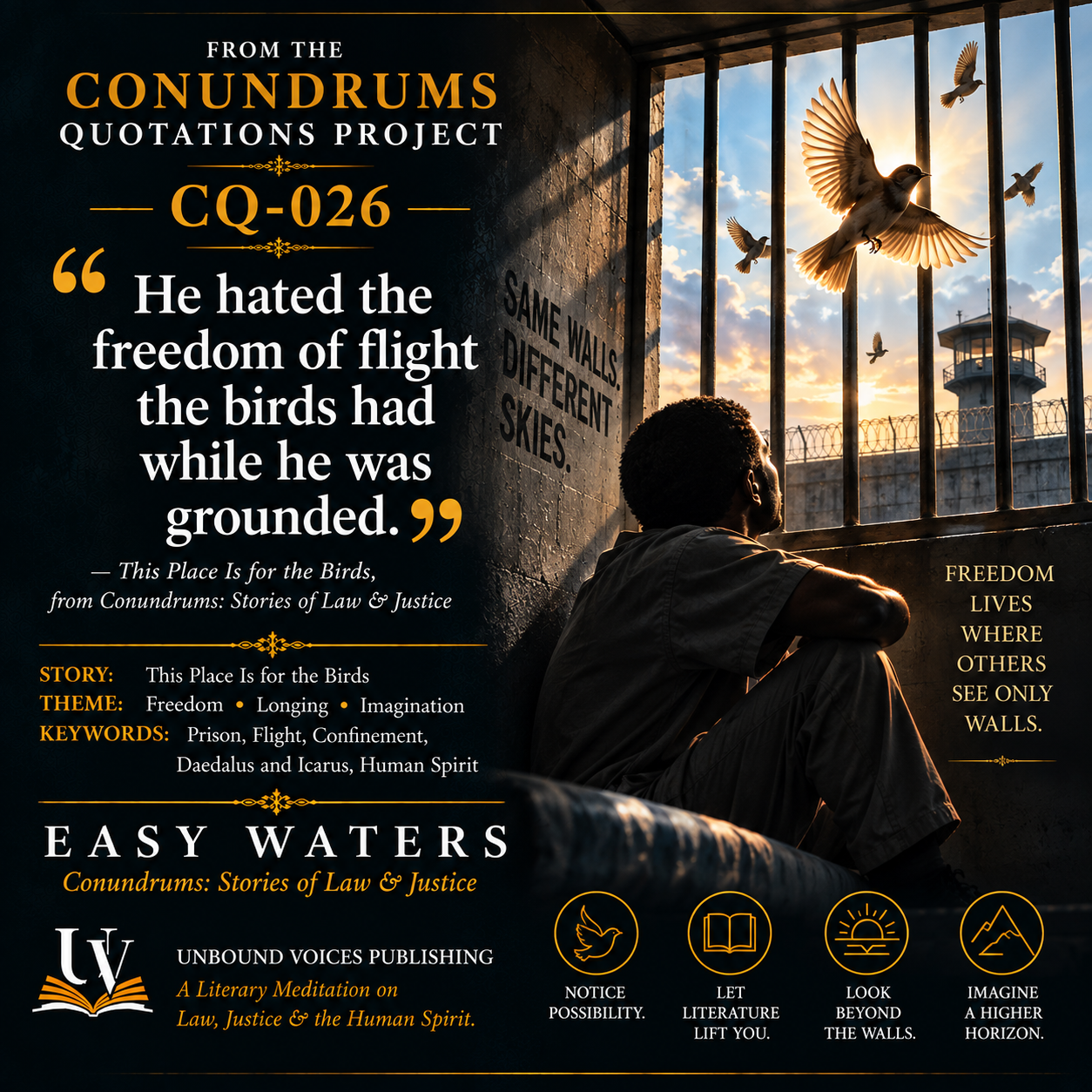
“He hated the freedom of flight the birds had while he was grounded.”
— This Place Is for the Birds, from Conundrums: Stories of Law & Justice
Freedom is often most visible to those who do not possess it.
A bird does not have to think about the political meaning of its wings.
It does not need a pass to cross the yard.
Permission to leave its nest.
An officer to unlock the sky.
It simply flies.
What is ordinary to the bird becomes extraordinary to the man watching from behind bars.
In This Place Is for the Birds, Alex lies on his cot in a maximum-security prison and listens to birds chirping in the cellblock. They squeeze through the bars, perform aerial maneuvers, eat bread scattered by prisoners, and escape whenever they have had enough.
Alex studies them with fascination.
He also resents them.
Their freedom feels like a personal insult.
They possess without effort what he longs for with his entire being. They can enter the prison without becoming prisoners. They can make a home inside the cage without belonging to it. They are subject to walls only when they choose to be.
Alex is grounded.
Two Meanings of Grounded
The word “grounded” carries two meanings.
A grounded person may be sensible, stable, and connected to reality.
A grounded child has been punished and forbidden to go anywhere.
Alex is grounded in the second sense, but the prison also demands the first.
He must remain realistic.
He must accept concrete, steel, guns, schedules, and distance as facts.
He must understand that dreaming of flight is foolish.
Prison teaches realism with weapons.
The birds violate that realism every morning.
They pass through the same bars that define Alex’s captivity. Their bodies are small enough, their wings strong enough, and the institution irrelevant enough that the prison cannot make prisoners of them.
They turn a maximum-security cellblock into a temporary shelter and its inhabitants into a captive audience.
Freedom Through Contrast
Alex’s hatred is not really directed at the birds.
It is directed at the contrast they embody.
Their movement reveals his immobility.
Their choices expose his lack of choice.
Every effortless flight measures the distance between the life he has and the life he wants.
We often become conscious of freedom in exactly this way:
through contrast.
The person who can walk out of a room rarely thinks about the door.
The person who cannot leave may think of nothing else.
A traveler treats the road as pavement.
The confined person sees destination, possibility, escape.
A commuter may complain about being delayed in traffic while someone behind a wall would welcome the privilege of being stuck in it.
Because delay still means movement.
The Ordinary Architecture of Freedom
Freedom is not always a grand declaration.
Sometimes it is the right to waste an afternoon.
It is deciding when to sleep.
What to eat.
Whom to call.
Where to stand.
Whether to step outside.
These choices appear small only because most people make them without asking permission.
Remove them one by one, and their cumulative value becomes unmistakable.
This is one of incarceration’s least understood injuries.
A sentence does not merely confine the body to a particular place.
It transfers thousands of ordinary decisions from the individual to the institution.
The prison determines when morning begins.
When the lights remain on.
When a person may shower.
Whether a visit will occur.
Whether a program will run.
Whether a cell door will open at all.
Freedom can therefore be measured not only by the distance one is permitted to travel, but by the number of ordinary decisions one is still permitted to make.
Hope Must Wait for Confirmation
Alex has developed a policy.
He remains in bed until he is certain the guards will release the men from their cells.
Lockdowns are unpredictable.
Why surrender sleep to a day the institution may suddenly cancel?
So Alex waits.
Hope must wait for confirmation.
The birds wait for no such announcement.
No count clears them for movement.
No officer opens their gate.
No loudspeaker announces that they may fly.
They simply do.
Their indifference to prison authority is precisely what makes their freedom so painful to watch.
From Envy to Imagination
Yet Alex does more than envy the birds.
He studies them.
He watches how they turn.
Climb.
Descend.
Pass through narrow openings.
His imagination begins where observation meets longing.
The impossible slowly becomes a question of technique.
This movement—from resentment to imagination—is essential.
Envy alone keeps a person fixed on what someone else possesses.
Imagination asks a different question:
Could another way of living be possible for me?
Alex first wants to be a bird.
Later, after discovering that the Bird Man has constructed wings from feathers, he decides to learn how to fly.
The idea sounds absurd.
That is part of its power.
When Mythology Becomes Engineering
The Bird Man has found his design in the Greek myth of Daedalus and Icarus.
Imprisoned in the Labyrinth, Daedalus constructs wings for himself and his son because the usual routes of escape are closed.
King Minos may control the land and sea.
But not the air.
The story survives because it expresses both the audacity and the danger of human longing.
Daedalus escapes.
Icarus, exhilarated by flight, ignores his father’s warning, flies too close to the sun, and falls.
Inside the prison, mythology becomes engineering.
The Bird Man gathers feathers.
He builds wings.
He practices in his cell.
Then Alex sees him rise three feet above the floor.
Alex, who had secretly laughed at him, immediately wants wings of his own.
Together they observe the birds.
Strengthen their bodies.
Build.
Practice.
Prepare.
Literature has crossed the boundary between imagination and action.
Literature Gives the Captive Mind Another Map
The Bird Man’s knowledge of mythology gives him something confinement tries to extinguish:
an alternative map.
The institutional map says every route ends at a locked gate.
The myth adds another direction.
Up.
That may be one of literature’s oldest functions.
Literature does not pretend the wall is absent.
It refuses to believe the wall contains every possibility.
A story written centuries ago cannot open a modern prison gate.
But it can rearrange the geography of the mind.
Suddenly the question is no longer:
Where is the door?
It becomes:
Why must the door be the only way out?
The institution controls the horizontal routes.
Literature introduces the vertical.
Imagination Is Not Freedom
Alex and the Bird Man eventually fly from the prison.
The Bird Man reaches Canada.
Alex flies too close to a gun tower.
A guard shoots him.
As Alex falls outside the wall, he knows he will land in “the land of the free.”
The phrase becomes both truth and accusation.
He has crossed the boundary.
He is free of the prison.
But a freedom reached only through death is a brutal parody of liberty.
The story therefore refuses an easy consolation.
Imagination does not always triumph.
Power is real.
Guns are real.
Walls are real.
Longing does not make the forces arranged against freedom disappear.
Imagination is not freedom.
But it is often where freedom first takes form.
A Person Looking Toward the Sky
Power may control the body without completely controlling desire.
That distinction matters.
The person in prison who can still imagine another life has preserved a part of himself the institution does not own.
Before every escape, migration, liberation movement, reinvention, or return, someone must first imagine a world that the present arrangement declares impossible.
Alex hates the birds because they awaken that imagination painfully.
Their flight forces him to confront what has been taken from him.
But it also reminds him of what he still desires.
A person who no longer longs for freedom may be easier to confine.
A person looking toward the sky remains dangerous.
Envy Can Become Information
There is another lesson hidden in Alex’s resentment.
Envy is usually treated as an emotion to overcome.
Sometimes it should be.
But envy can also contain information.
It tells us that something another person possesses has exposed a desire we have not fully acknowledged.
Alex envies the birds because they can fly.
But beneath that envy is something more important:
He wants agency.
Movement.
Choice.
Possibility.
A future not completely determined by walls.
His resentment identifies what matters to him.
The question then becomes whether he will remain consumed by the contrast or learn from it.
Alex learns from it.
He studies what he envies.
That is the turning point.
Why It Matters Today
We do not need to be physically incarcerated to become accustomed to forms of confinement.
Fear can ground us.
Debt can ground us.
Illness can ground us.
Grief.
Obligation.
Habit.
The expectations of others.
All can narrow the distance we believe ourselves capable of traveling.
Sometimes those limitations are material and cannot simply be wished away.
Sometimes, however, we have lived with them so long that we stop testing whether the door is still locked.
The birds in the cellblock offer no easy lesson.
Their freedom torments Alex before it instructs him.
But they remind him that the bars are not the whole universe.
Every time they enter and leave, they demonstrate that another relationship to the same space is possible.
When have you become most aware of freedom?
Perhaps it was after losing it.
Perhaps it was while watching another person exercise a choice denied to you.
Perhaps it was the first time you left a place you once believed you could never escape.
Or perhaps it happened during an ordinary moment:
A walk.
A drive.
An open door.
A decision made without asking permission.
And suddenly you recognized that movement itself is a gift.
We should not have to lose freedom to value it.
But too often, like Alex, we do not see the sky until something grounds us.
Questions for Reflection
- When have you become most aware of freedom, and what made you recognize it?
- Have you ever resented another person’s freedom because it revealed a limitation in your own life?
- What might your envy be telling you about something you genuinely value or desire?
- What role has literature, imagination, or another person’s example played in helping you see a possibility beyond your circumstances?
- What “wall” in your life might look different if, instead of searching only for a door, you looked in another direction?
About Conundrums
Conundrums: Stories of Law & Justice is a cycle of stories exploring imprisonment, law, justice, freedom, accountability, conscience, identity, redemption, and the resilience of the human spirit.
In This Place Is for the Birds, flight becomes more than escape. It becomes a way of examining what confinement takes from a person, what imagination can preserve, and why the desire for freedom may survive even when the route toward it appears impossible.
The birds do not understand Alex’s longing.
They simply fly.
That is enough.
Closing Reflection
Alex watches the birds.
They pass through the bars that define his world.
They do not know that the building is maximum security.
They do not recognize its authority.
They do not understand the meaning of a life sentence.
They enter.
Eat.
Sing.
Fight.
Build nests.
Then leave.
To the birds, none of this is remarkable.
To Alex, it is freedom made visible.
At first, he hates them for it.
Then he studies them.
And somewhere between resentment and observation, something changes.
The birds cease to be merely reminders of what he lacks.
They become evidence of what he can still imagine.
That distinction may be small.
Inside confinement, it is enormous.
The walls remain.
The gun tower remains.
The sentence remains.
But the sky has entered the argument.
“He hated the freedom of flight the birds had while he was grounded.”
— This Place Is for the Birds, from Conundrums: Stories of Law & Justice
Justice begins with the courage to see clearly.
— Easy Waters
Continue the Conversation
The Conundrums Quotations Project is an ongoing series of literary reflections on law, justice, freedom, memory, punishment, conscience, redemption, and the human spirit, inspired by Conundrums: Stories of Law & Justice.
Subscribe to Easy Waters to receive new essays from the Quotations Project, stories, poetry, commentary, and other writing as they are published.
Visit Easy Waters and subscribe →
If you discovered this essay somewhere other than the Easy Waters website, join the conversation at EZWWATERS.com and follow The Conundrums Quotations Project from there.
The Conundrums Quotations Project
CQ-026 | The Freedom of Flight: When the Captive Mind Looks Up
Easy Waters
Conundrums: Stories of Law & Justice
Unbound Voices Publishing
A Literary Meditation on Law, Justice & the Human Spirit.
Justice, Literature & Memory — Delivered to Your Inbox
Essays from the archive and new writing on race, literature, history, incarceration, freedom, and the American criminal legal system.


