
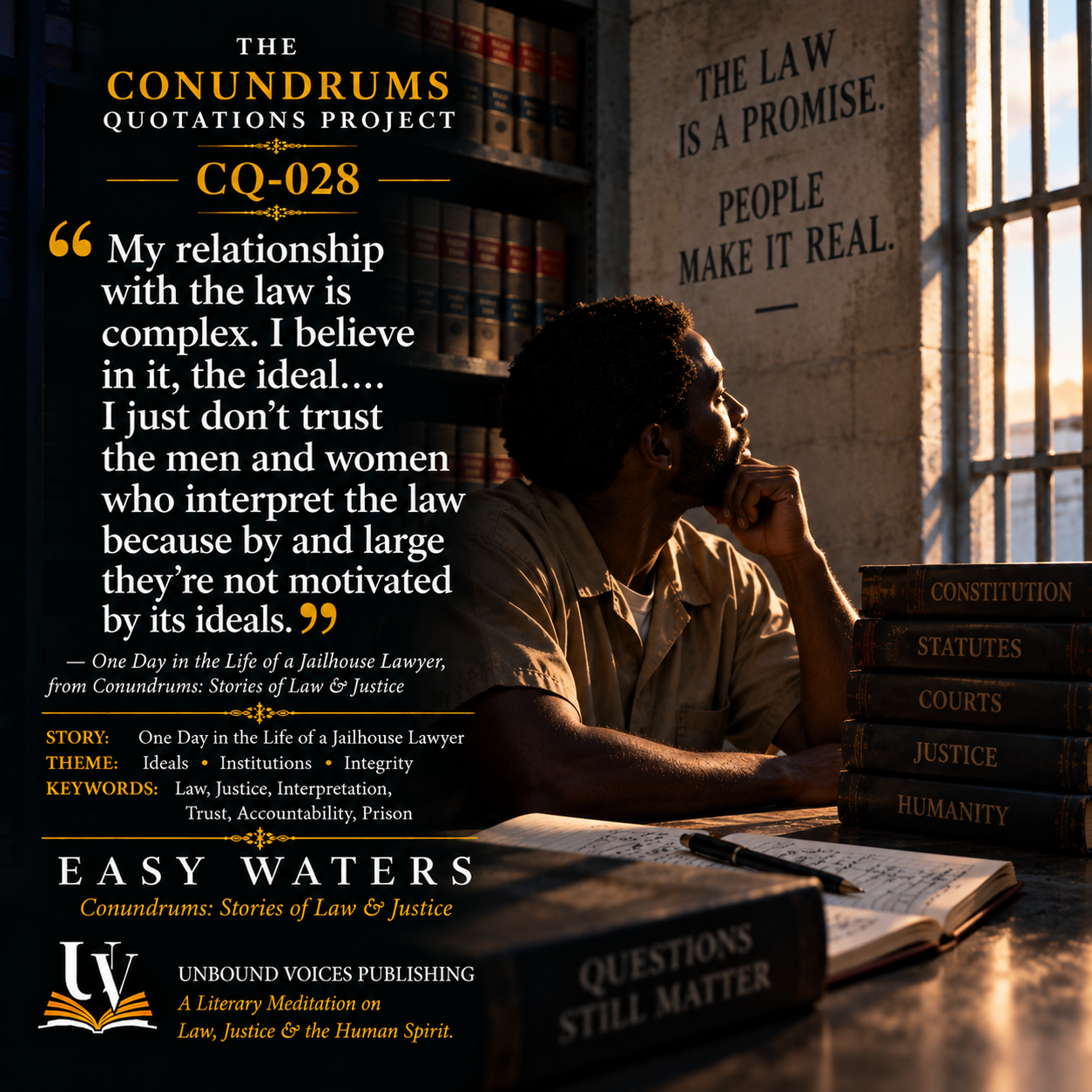
“My relationship with the law is complex. I believe in it, the ideal.… I just don’t trust the men and women who interpret the law because by and large they’re not motivated by its ideals.”
— One Day in the Life of a Jailhouse Lawyer, from Conundrums: Stories of Law & Justice
The jailhouse lawyer believes in the law.
That may be the most surprising confession in the story.
The law has not freed him.
Courts have rejected his arguments.
Years of imprisonment have accumulated around him.
He has watched prosecutors pursue convictions instead of justice, defense lawyers fail their clients, and judges transform disputed facts into permanent legal conclusions.
He assists people in prison who arrive at the law library after nearly every recognized remedy has been exhausted.
Still, he believes.
Not necessarily in the courts.
Not automatically in judges, prosecutors, parole commissioners, or lawyers.
He believes in the ideal—the promise that law can restrain power, require fairness, protect liberty, and provide a remedy when institutions cause harm.
He trusts the idea.
He distrusts its interpreters.
Belief Is Not Obedience
We are often told that believing in the law requires confidence in the legal system.
The two are treated as though they are inseparable.
To criticize courts is to attack the rule of law.
To question a prosecutor’s conduct is to excuse crime.
To challenge a sentence is to disrespect the victim.
To expose injustice is to weaken public faith in the institution.
But faith that cannot survive scrutiny is not faith.
It is obedience.
The narrator’s relationship with law is complex because law itself is complex.
It can be shield and weapon.
Principle and procedure.
Aspiration and excuse.
Law can articulate ideals that institutions fail to embody.
That distance between promise and practice is precisely where criticism becomes necessary.
Law Speaks in Universals
Law speaks the language of universals:
Everyone.
No person.
Equal.
Impartial.
Due process.
But human beings must apply those words to particular lives.
That is where the difficulty begins.
An ideal does not interpret itself.
Someone decides which facts matter.
Which precedent controls.
Which witness is credible.
Which violation deserves a remedy.
Which punishment is proportionate.
Those decisions are made by human beings shaped by ambition, fear, prejudice, politics, professional culture, compassion, experience, and conscience.
A robe does not remove human limitation.
A law degree does not confer moral clarity.
An oath does not guarantee fidelity to the values expressed within it.
Justice depends upon human hands.
The Irony of the Jailhouse Lawyer
E understands this tension not as an abstract philosophical problem but as a condition of daily life.
He practices a hybrid form of lawyering from inside prison.
He is not licensed.
He cannot sign the motions he prepares.
He has not been officially declared “morally fit” to practice law.
Yet people in prison seek him after licensed attorneys and formal procedures have failed them.
The irony is difficult to miss.
The system questions the jailhouse lawyer’s authority while depending upon his labor to make access to the courts meaningful.
He researches.
Drafts.
Explains.
Interprets.
Advocates from the shadows.
His clients file papers in their own names.
The institution may regard him with suspicion, but it cannot entirely dispense with him because legal rights have little practical value when no one knows how to invoke them.
The law on the page may promise a remedy.
The jailhouse lawyer must find the route to it.
A Right Must Be Usable
There is an important distinction between possessing a right in theory and being able to exercise it in practice.
A person may have the right to petition a court.
But can he identify the proper court?
Does he understand the deadline?
Can he obtain the relevant cases?
Does he know which procedural rule applies?
Can he frame the claim in language the court will recognize?
A right that exists only for those capable of navigating a complicated system is a fragile kind of right.
This is where E becomes indispensable.
He translates abstract entitlement into practical access.
The institution may not recognize him as a lawyer.
The prisoners recognize what he can do.
Criticism Can Be an Act of Belief
E’s belief in law is therefore neither naïve nor sentimental.
He knows its failures intimately.
He continues because the ideal gives him a standard against which the people administering the system can be judged.
Without that standard, injustice becomes merely whatever the powerful are permitted to do.
This is why critics of legal institutions may sometimes demonstrate greater fidelity to legal ideals than those who defend every institutional outcome.
The critic says:
You promised due process.
You promised equality.
You promised that guilt must be proven.
You promised that punishment would be governed by law rather than vengeance.
Now honor the promise.
Criticism becomes an act of belief.
The Law as Life Preserver
E describes law as a life preserver he will not release while weathering the storm of imprisonment.
The image matters.
A life preserver does not calm the sea.
It does not determine the direction of the current.
It does not guarantee rescue.
It keeps a person afloat long enough to continue believing rescue remains possible.
For an incarcerated person, a legal argument may serve a similar purpose.
A motion.
An appeal.
A grievance.
A petition.
Each organizes hope around a recognizable process.
There are rules.
Deadlines.
Precedents.
Procedures.
And somewhere within them remains the possibility—however remote—that someone with authority will finally say:
“Enough is enough.”
A Locked Building Filled With Doors
But what happens when the people interpreting the law are not motivated by its ideals?
Procedure can become a way of avoiding justice.
A court can determine that a claim was filed too late.
Raised in the wrong form.
Presented to the wrong tribunal.
Previously rejected.
Procedurally barred.
Each ruling may have a legal basis.
Together, they can create a system in which everyone follows procedure and no one reaches the underlying wrong.
The law then becomes:
a locked building filled with doors.
The jailhouse lawyer keeps searching for the one that will open.
Institutions Shape Their Interpreters
E’s distrust is not indiscriminate.
He does not need to claim that every judge is corrupt.
Every prosecutor dishonest.
Every defense lawyer incompetent.
His concern is deeper.
Institutions create incentives.
Professional cultures establish expectations.
Career structures reward some behaviors and discourage others.
Prosecutors may build reputations by winning.
Judges may worry about reversal, controversy, or the consequences of appearing lenient.
Defense lawyers may carry overwhelming caseloads.
Parole commissioners may perceive denial as safer than release.
Each decision-maker may be able to explain an individual decision.
The accumulated result may still be injustice.
That is one reason institutional accountability requires more than identifying obviously bad actors.
A system can produce harmful outcomes even when every participant believes he or she is merely performing an assigned role.
The Ideal Protects E From Despair
Separating law from its interpreters also allows E to preserve hope.
If every unjust ruling proved that justice itself was meaningless, there would be no reason to continue.
No reason to research.
No reason to draft another motion.
No reason to read another case.
No reason to assist another person in prison.
By separating the ideal from its imperfect administration, E preserves both criticism and hope.
The ideal allows him to say:
This outcome failed the law’s own promise.
That is different from saying:
There is no promise worth defending.
But Ideals Can Become Excuses
There is danger in this separation too.
An institution can fail repeatedly while its defenders continue praising the beauty of its principles.
Equality in theory can coexist with inequality in practice.
Constitutional rights can be celebrated while remaining extraordinarily difficult to enforce.
Due process can become a phrase recited more often than a protection experienced.
The beauty of the promise can distract from the brutality of the outcome.
At some point, belief must demand evidence.
Does the law restrain power when power exceeds its authority?
Does it correct wrongful convictions?
Does it distinguish accountability from endless punishment?
Does it hear people who lack wealth, status, and institutional credibility?
Does it treat its own errors with the same seriousness it applies to the errors of defendants?
If the answer is repeatedly no, reciting the ideal is not enough.
The law must become what it claims to be.
Trust Must Be Earned
Trust in law cannot depend solely upon institutional authority.
It must depend upon institutional behavior.
A trustworthy legal system does not claim never to make mistakes.
No human institution can make that promise honestly.
A trustworthy institution demonstrates that mistakes can be identified.
Acknowledged.
Corrected.
And learned from.
The capacity for self-correction is not evidence of weakness.
It is evidence that principle matters more than reputation.
Silence preserves reputation. Accountability preserves purpose.
That distinction reaches the heart of E’s distrust.
The question is not whether imperfect people will interpret the law.
They inevitably will.
The question is whether the institution is capable of correcting them when their interpretations betray its ideals.
Belief Must Demand Evidence
E continues believing because law provides a vocabulary for holding power accountable to something beyond itself.
But belief cannot remain indefinitely abstract.
Eventually, ideals must become practices.
Due process must be experienced as process that is genuinely fair.
Equal protection must produce more than elegant constitutional language.
Rights must be usable.
Errors must be correctable.
Remedies must sometimes remedy.
Trust cannot simply be demanded from those who have experienced institutional failure.
Belief must demand evidence.
Otherwise, the ideal becomes ceremonial.
A principle displayed above the courthouse door but absent from what happens inside.
Why It Matters Today
Public arguments about justice often force a false choice:
Support the legal system.
Or condemn it.
E offers a more demanding position.
We can believe deeply in law’s purpose while refusing to confuse that purpose with every action taken in its name.
This distinction reaches beyond courts.
A person can believe in education while criticizing a school.
In religion while challenging a church.
In public safety while questioning institutions that produce harm.
In an organization’s mission while demanding accountability from its leadership.
Loyalty to an ideal does not require silence about betrayal.
It may require the opposite.
The question is not whether institutions are administered by imperfect people.
They always will be.
The question is whether institutions contain meaningful ways to identify error, correct abuse, and bring practice closer to principle.
An institution that welcomes no correction is not defending its ideals.
It is defending itself.
Hope Survives the Evidence
The jailhouse lawyer continues to work.
Another case.
Another motion.
Another precedent.
Another person arrives with papers and questions.
E returns to the law.
Not because the system has earned unquestioning trust.
Not because every court has behaved justly.
Not because every legal remedy has worked.
He returns because somewhere beneath the failures remains an idea he refuses to surrender:
Power should have limits.
Facts should matter.
Liberty should not be taken casually.
Errors should be correctable.
Justice should mean more than institutional convenience.
He believes someone, somewhere, may interpret the law as a command to do justice.
His hope survives his evidence.
That may be faith.
It is also an indictment.
Questions for Reflection
- Can you believe in an institution’s ideals while distrusting the people responsible for carrying them out?
- When does loyalty require defending an institution, and when does it require publicly challenging it?
- What is the difference between criticizing the law and demanding that the legal system live up to the law’s own principles?
- What mechanisms of accountability make institutional trust deserved rather than merely expected?
- What evidence should a legal system provide before asking the public—or the people it has punished—to trust it?
About Conundrums
Conundrums: Stories of Law & Justice is a cycle of stories exploring imprisonment, law, justice, freedom, accountability, conscience, identity, redemption, and the resilience of the human spirit.
In One Day in the Life of a Jailhouse Lawyer, E’s complicated relationship with law becomes a meditation on the distance between ideals and institutions, rights and remedies, authority and legitimacy, criticism and faith.
He does not reject the law because people have failed to honor it.
He uses the law’s own ideals to measure their failure.
Closing Reflection
The jailhouse lawyer enters the law library.
Around him are books filled with promises.
Rights.
Duties.
Standards.
Remedies.
Precedents.
Rules limiting what government may do.
Rules describing what courts must do when those limits are violated.
Somewhere in those volumes is the ideal E still believes in.
But books do not interpret themselves.
A human being must read the words.
Another must argue their meaning.
Another must decide whether they apply.
And another may determine whether the error matters enough to correct.
Justice passes through human hands.
That is its necessity.
It is also its danger.
E knows both truths.
So he neither worships the institution nor abandons the ideal.
He questions.
Researches.
Drafts.
Challenges.
Persists.
He holds onto the law like a life preserver in a storm—not because the sea has treated him kindly, but because letting go would surrender the possibility that somewhere ahead there remains a shore.
“My relationship with the law is complex. I believe in it, the ideal.… I just don’t trust the men and women who interpret the law because by and large they’re not motivated by its ideals.”
— One Day in the Life of a Jailhouse Lawyer, from Conundrums: Stories of Law & Justice
Justice begins with the courage to see clearly.
— Easy WatersContinue the Conversation
The Conundrums Quotations Project is an ongoing series of literary reflections on law, justice, freedom, memory, punishment, conscience, redemption, and the human spirit, inspired by Conundrums: Stories of Law & Justice.
Subscribe to Easy Waters to receive new essays from the Quotations Project, stories, poetry, commentary, and other writing as they are published.
Visit Easy Waters and subscribe →
If you discovered this essay somewhere other than the Easy Waters website, join the conversation at EZWWATERS.com and follow The Conundrums Quotations Project from there.
The Conundrums Quotations Project
CQ-028 | The Law and Those Who Interpret It: When Justice Depends on Human Hands
Easy Waters
Conundrums: Stories of Law & Justice
Unbound Voices Publishing
A Literary Meditation on Law, Justice & the Human Spirit.


