
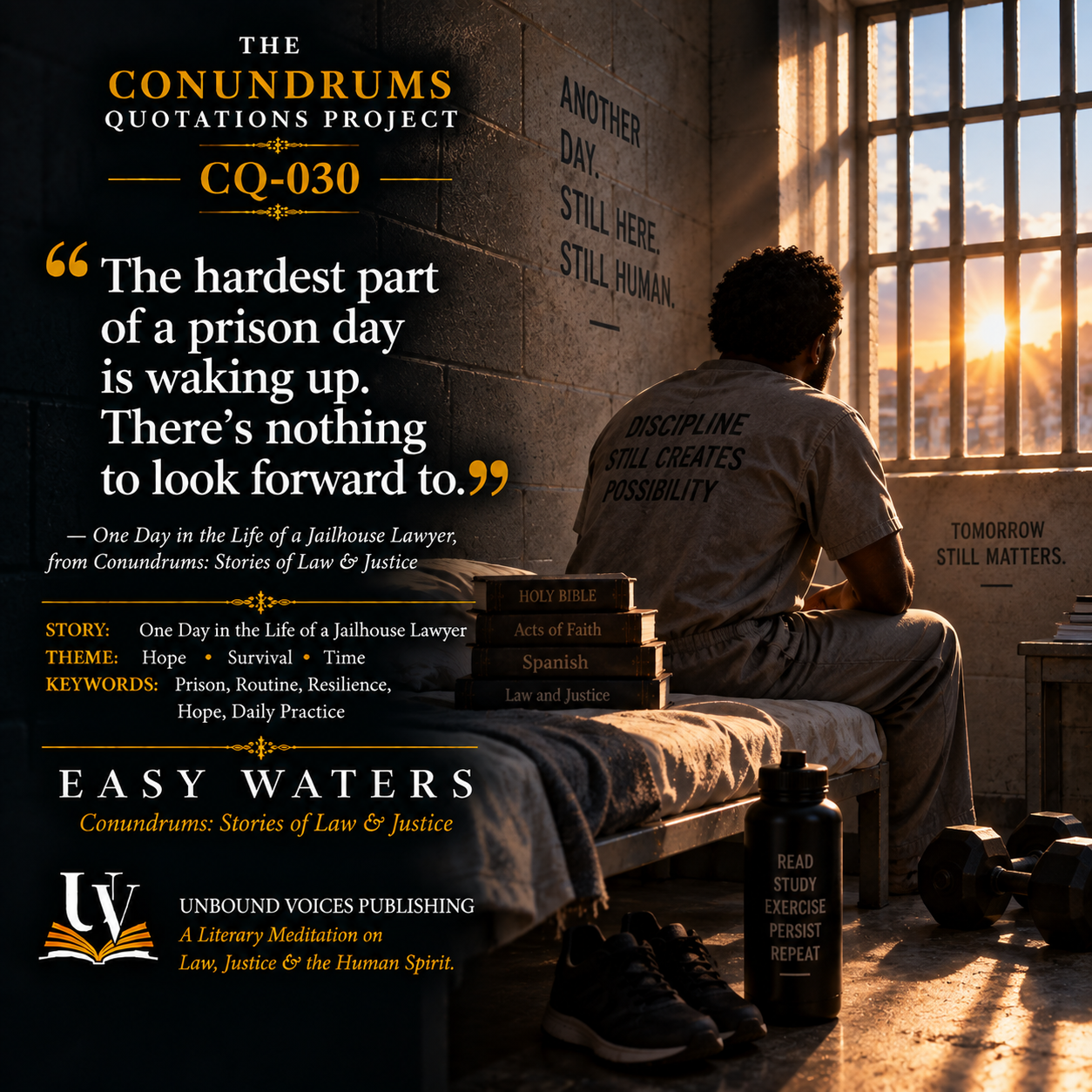
“The hardest part of a prison day is waking up. There’s nothing to look forward to.”
— One Day in the Life of a Jailhouse Lawyer, from Conundrums: Stories of Law & Justice
Waking is usually treated as a beginning.
The day is new. The body has rested. Morning arrives carrying possibility—or at least the familiar promise that something may happen that did not happen yesterday.
In prison, waking can mean returning.
The eyes open to the same narrow cell, the same walls, the same sentence, and the same institutional clock. Sleep has offered a temporary furlough. Consciousness restores the facts.
For E, the jailhouse lawyer, the hardest part of the prison day is not the count, the noise, the surveillance, the legal work, or the confinement of a cell narrower than his outstretched arms.
It is waking up with nothing to look forward to.
Reflection
Hope is often imagined as a dramatic force. We picture it as courage in a crisis, faith against impossible odds, or a light at the end of a tunnel. But much of hope’s work is ordinary. It persuades us to rise.
There is something ahead: a person to see, a task to complete, a meal to enjoy, a place to go, a conversation to continue. These modest expectations pull the body into the day. We may not call them hope because they are woven so thoroughly into ordinary life.
Remove them, and morning becomes a confrontation.
E wakes in prison after decades of confinement. His first thoughts turn to parole commissioners. He lies on his cot and fills the ceiling with questions. He organizes them, prioritizes them, and eliminates them one by one until a single question remains: “What do you really want from me?”
The question belongs to a later entry in this project. Here, what matters is the ritual itself. Before E’s feet touch the floor, the institution has entered his mind. The day begins with an imagined hearing before people who possess the power to continue his imprisonment.
He does not remain in bed.
That decision is important. E knows that if he lies still, his thoughts may “get the best” of him. So he jumps up. He reads scripture, Acts of Faith, and prayers written on index cards. He struggles with forgiveness, repentance, and the Christian promise of dying and rising. Then he exercises. In the cramped geometry of the cell, he positions his body between the bed, desk, locker, and wall. He completes pushups, crunches, headstands, and breathing exercises.
He constructs a morning from the materials available.
Nothing about this routine changes his sentence. The cell does not expand. The parole board does not announce his release. The criminal legal system does not apologize. Yet the routine prevents despair from making the first and final decision of the day.
When there is nothing to look forward to, E creates something to do.
That distinction may be the beginning of survival.
Prison deprives people not only of freedom but of anticipation. The future is divided into institutional events: the next count, meal, visit, court date, parole appearance, or release eligibility date. Time no longer feels like an open field. It becomes a corridor with locked doors.
Anticipation can become dangerous in such a place. A visit may be canceled. A letter may not arrive. A court decision may be delayed. A program may be suspended. A parole hearing may produce another denial. Hope repeatedly attached to events outside one’s control can become another source of pain.
Some people protect themselves by expecting nothing.
But expecting nothing has a cost. It may reduce disappointment, yet it also empties the day before the day begins. The person survives the loss of a particular hope by surrendering the habit of hoping.
E stands at that boundary. He admits there is nothing to look forward to, but his actions tell a more complicated story. He looks forward through practice rather than prediction. He reads because meaning may still be found. He exercises because his body remains his responsibility. He studies Spanish because another language suggests another country and another possible life. He goes to the law library because a motion may still reach someone willing to say, “Enough is enough.”
He cannot guarantee an outcome.
He can prepare himself to meet one.
This is hope stripped of sentimentality. It does not insist that everything will work out. It refuses to let uncertainty become an excuse for self-abandonment.
The quotation also asks us to consider the relationship between punishment and time. A prison sentence is measured in years, but it is served in mornings. Twenty years is an abstraction. Waking up more than seven thousand times inside confinement is an experience.
The calendar records duration.
The body records repetition.
Each morning requires the person in prison to recover a reason to participate in life. That labor is rarely included in public discussions of punishment. We debate sentence lengths, deterrence, incapacitation, and rehabilitation. We speak in numbers large enough to conceal the days inside them.
Five years.
Twenty years.
Life.
But no one serves “life” all at once. A person serves Tuesday. Then Wednesday. Then Thursday. He wakes, remembers where he is, and decides whether to rise.
This is why “nothing to look forward to” is more than sadness. It identifies a form of deprivation that walls alone cannot describe. Human beings need futurity—the belief that our actions can lead somewhere. When every road appears to circle back to the same cell, the self can begin to shrink to the dimensions of the institution.
E resists that shrinking through disciplined acts. Reading enlarges the room. Law connects him to arguments beyond the wall. Spanish imagines another geography. Exercise converts confined space into movement. Prayer places his suffering within a story of death and resurrection, even while he admits that believing is the hard part.
None of these practices should be romanticized. Resilience does not justify the conditions that require it. We should not admire a person’s ability to survive deprivation so much that we stop questioning the deprivation.
The burden of creating hope cannot rest entirely upon the person from whom hope has been systematically removed.
Institutions also have responsibilities. If prisons claim rehabilitation as a purpose, they must provide reasons for people to imagine a future beyond custody. Education, meaningful work, family connection, spiritual life, creative expression, and credible opportunities for release are not luxuries. They are ways of preserving the relationship between effort and possibility.
Without that relationship, routine becomes mere maintenance.
The person is kept alive without being invited to live.
E’s morning offers no easy triumph. He does not awaken grateful for another day in prison. He does not transform despair into cheerful optimism. He gets out of bed because remaining there would allow his thoughts to defeat him.
Sometimes hope is not a feeling.
Sometimes it is a practiced refusal to stay down.
Why It Matters Today
The emotional truth of the quotation extends beyond prison, although confinement gives it its sharpest form. Depression, grief, illness, unemployment, retirement, isolation, and prolonged uncertainty can also drain the future of expectation. The alarm sounds, but the day appears to contain no destination.
Telling someone simply to “think positive” misunderstands the problem. E does not survive through positive thinking. He survives through structure, meaning, movement, study, service, and the stubborn preservation of possibility.
When the future cannot yet offer a promise, the next faithful action may have to be enough.
Get out of bed. Read the page. Move the body. Make the call. Help another person. Prepare for the opportunity that has not appeared.
These actions do not guarantee that tomorrow will be different.
They keep us capable of entering it.
Questions for Reflection
- What gives you a reason to rise when the future offers no immediate promise?
- Which daily practices preserve your sense of possibility during periods of uncertainty or confinement?
- What responsibilities do institutions have to ensure that punishment does not become the destruction of hope?
About the Conundrums Quotation Project
The Conundrums Quotation Project examines selected lines from Conundrums: Stories of Law & Justice and the moral, literary, and social questions contained within them. Each quotation becomes a point of departure for reflecting on law and justice, crime and punishment, freedom and responsibility, and the complicated choices through which human beings reveal themselves.
From The Conundrums Quotation Project by Easy Waters
Conundrums: Stories of Law & Justice
Justice, Literature & Memory — Delivered to Your Inbox
Essays from the archive and new writing on race, literature, history, incarceration, freedom, and the American criminal legal system.


