
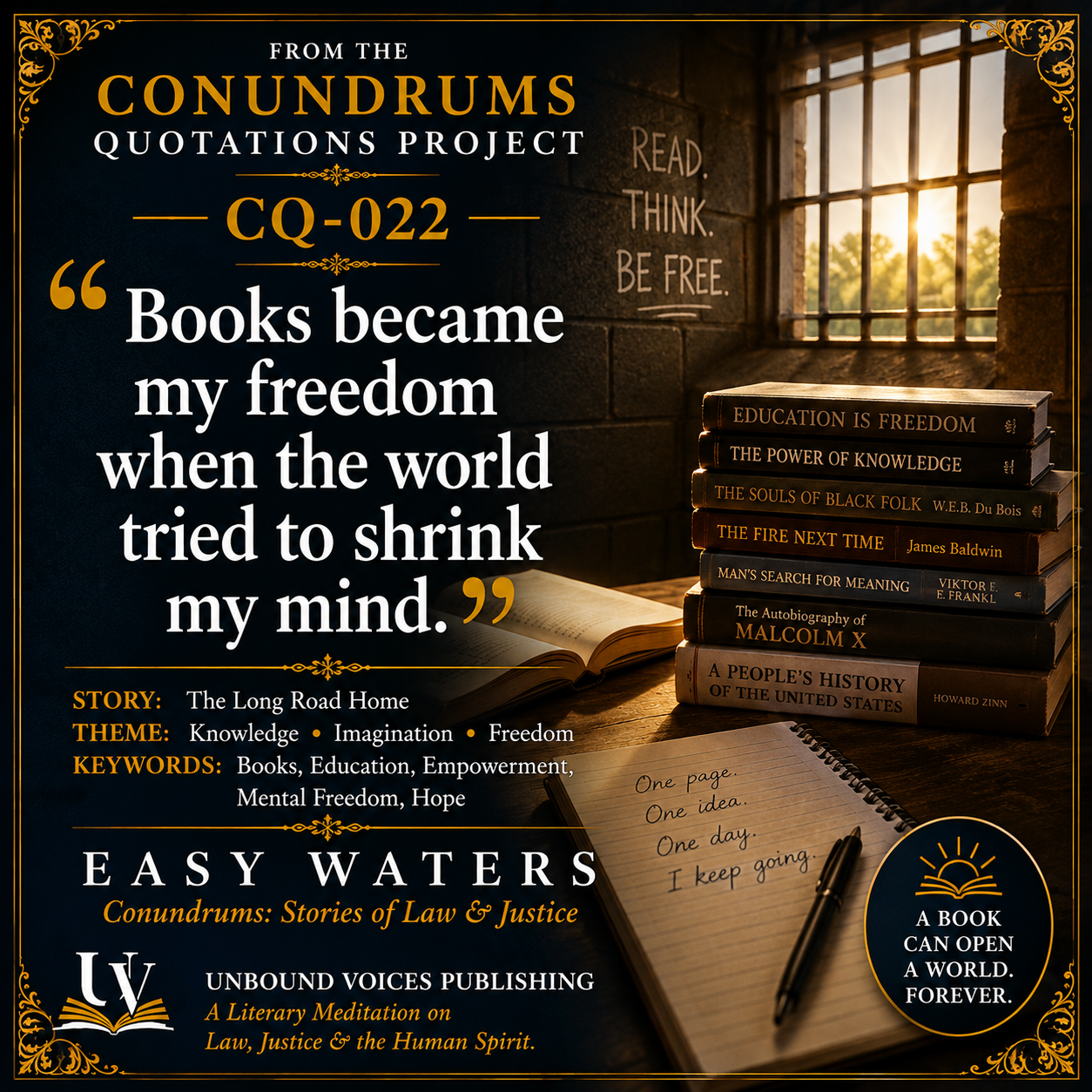
THE CONUNDRUMS QUOTATIONS PROJECT
“Education is the passport to the future, for tomorrow belongs to those who prepare for it today.”
— Malcolm X
When Books Become Freedom
There are many ways to confine a human being.
Walls are one.
Bars are another.
Locks.
Rules.
Numbers.
Uniforms.
Schedules determined by someone else.
But there is another form of confinement that can be even more consequential.
The shrinking of possibility.
Convince a person that the world is smaller than it really is.
Convince them that certain rooms are not meant for them.
That certain books are too difficult.
Certain ideas too sophisticated.
Certain professions beyond reach.
Certain futures reserved for other people.
Do that long enough and physical walls may become almost unnecessary.
The boundaries have moved inside.
Books can break those boundaries.
They did for me.
When circumstances attempted to define the limits of my world, reading showed me that the world was much larger than the place in which I happened to be standing.
Books became a form of freedom.
A Book Does Something Strange to a Locked Door
There is something almost subversive about reading in confinement.
The body remains where it is.
The mind leaves.
A book can transport someone from a prison cell to nineteenth-century Russia.
Ancient Greece.
Harlem.
Paris.
West Africa.
A courtroom.
A battlefield.
A university.
A future not yet imagined.
No officer needs to unlock the door.
No judge needs to modify the sentence.
No institution needs to grant permission for the journey.
You open a book.
And go.
That is an extraordinary form of freedom.
Reading Is More Than Escape
It would be easy to describe reading simply as escape.
Sometimes it is.
There are moments when escaping circumstances for an hour is valuable.
But the most important books do something more demanding than help us leave reality.
They return us to reality differently.
A serious book can disturb assumptions.
Expand vocabulary.
Complicate certainty.
Introduce history we were never taught.
Give language to feelings we could not name.
Allow us to inhabit another person’s consciousness.
Show us that an experience we thought belonged only to us has been lived, survived, and written about by someone else.
That is not escape.
That is enlargement.
The Politics of a Shrinking Mind
There is a reason access to knowledge has always been connected to power.
Throughout history, controlling what people can read has been a means of controlling what they can imagine.
If you control the story of the past, you influence what people believe is possible in the future.
If you decide which voices count as authoritative, you influence whose experience is treated as legitimate.
If you convince a population that intellectual life belongs to someone else, you do not need to prohibit thought explicitly.
People begin censoring their own ambitions.
This is why literacy has never been merely a technical skill.
Reading can be an act of self-determination.
The Most Dangerous Discovery: “I Can Understand This”
One of the most powerful moments in education occurs when someone encounters a difficult text and discovers:
I understand this.
Perhaps not immediately.
Perhaps not completely.
But enough.
Then another book.
Another idea.
Another conversation.
Another question.
Soon the person who once believed intellectual life belonged to other people begins to understand that thought has no natural aristocracy.
Ideas do not belong exclusively to professors.
Or judges.
Or lawyers.
Or politicians.
Or people with degrees.
You can enter the conversation.
That realization can change a life.
Because once someone learns that they can think critically, it becomes considerably harder to convince them that they should simply accept what they are told.
Prison Libraries and Possibility
A prison library is a peculiar institution.
It exists inside a structure designed to restrict movement, yet its shelves contain almost unlimited movement.
Geography.
History.
Philosophy.
Law.
Religion.
Poetry.
Biography.
Fiction.
Science.
A person may possess very little control over the physical environment and still encounter entire civilizations between two covers.
This is one reason educational opportunities in correctional settings matter far beyond credential attainment.
Education restores something punishment can easily erode:
agency.
The student begins making intellectual choices.
What will I read?
What do I believe?
What questions do I have?
What argument can I make?
What might I become?
Those are acts of self-definition.
A Number Cannot Read for You
Institutions classify people.
Defendant.
Inmate.
Offender.
Parolee.
Case number.
Identification number.
Risk category.
Classification level.
These labels may serve administrative functions.
But none can capture an intellectual life.
A number cannot read a novel.
A category cannot wrestle with philosophy.
A classification cannot write a poem.
A file cannot experience revelation.
The human being behind the institutional designation continues thinking.
Questioning.
Remembering.
Imagining.
Reading reminds both the individual and, perhaps, the institution that the person remains larger than the label.
Books Introduced Me to People I Could Never Meet
One of the great gifts of literature is impossible friendship.
Writers can speak across centuries.
People long dead can enter the room.
Their questions remain alive.
Their arguments wait patiently on the page.
Through books, we sit with thinkers, poets, novelists, historians, revolutionaries, theologians, philosophers, and ordinary people whose lives became testimony.
We discover that human beings in other places and other times wrestled with familiar questions:
What is justice?
What is freedom?
What do we owe one another?
Can people change?
What gives life meaning?
How should power be exercised?
What does suffering do to the human spirit?
What does love require?
These questions existed before us.
They will remain after us.
Reading allows us to join the conversation.
Literature Teaches Us to Complicate Judgment
This is particularly important when thinking about law and justice.
The legal system must categorize behavior.
Guilty.
Not guilty.
Permitted.
Prohibited.
Aggravating.
Mitigating.
The law needs definitions.
Literature thrives in the spaces definitions cannot fully contain.
A good story asks us to remain with complexity.
The character may be wrong and wounded.
Responsible and sympathetic.
Harmful and capable of change.
Victimized in one chapter and responsible for harm in another.
That complexity resembles actual human beings.
Literature therefore trains a capacity essential to justice:
the ability to see more than one truth about a person at the same time.
Reading and the Development of Empathy
We sometimes speak about empathy as though it were simply kindness.
It is more intellectually demanding than that.
Empathy requires imagination.
It asks us to enter a perspective without necessarily agreeing with it.
To ask why someone sees the world differently.
To understand circumstances without automatically excusing behavior.
To distinguish explanation from justification.
Literature gives us practice.
For a few hundred pages, we inhabit another consciousness.
We know what the character knows.
Fear what they fear.
Misunderstand what they misunderstand.
Discover what they discover.
That experience can make simplistic judgments more difficult.
And justice should be suspicious of simplistic judgments.
Books Do Not Automatically Make Us Good
We should avoid romanticizing reading.
Educated people can be cruel.
Brilliant people can construct unjust systems.
History contains no shortage of well-read tyrants.
Books do not automatically produce wisdom.
They provide material from which wisdom might be constructed.
The reader must still question.
Reflect.
Compare.
Challenge.
Apply.
A library is possibility.
What we do with it remains our responsibility.
The Freedom to Question
Perhaps the most important freedom books gave me was not the ability to find answers.
It was permission to ask better questions.
Why is the system organized this way?
Who wrote this rule?
Who benefits?
Whose voice is missing?
What history produced this institution?
What does justice mean if the outcome is technically lawful but morally troubling?
What happens after punishment?
What is the difference between accountability and vengeance?
Can a person be both responsible and redeemable?
Those questions live at the center of Conundrums: Stories of Law & Justice.
The title itself reflects the point.
Justice is filled with conundrums.
Easy answers should make us cautious.
From Reader to Writer
Eventually reading creates another possibility.
The realization that you might write.
At first, books belong to other people.
Authors seem like distant figures whose names appear on covers.
Then something changes.
You begin recognizing technique.
Voice.
Structure.
Character.
Argument.
You start noticing how sentences work.
And perhaps one day a dangerous thought appears:
I have something to say too.
That thought can be liberating.
Because reading is an entrance into a conversation.
Writing is the moment you decide to answer back.
The person who once consumed stories begins creating them.
The reader becomes a witness.
The witness becomes an author.
Why Conundrums Exists
In that sense, Conundrums itself is connected to the freedom described in CQ-022.
The stories emerge from observation, experience, memory, questions, and decades of reading and thinking about law, punishment, justice, race, institutions, human behavior, and redemption.
Books helped create the intellectual space in which those questions could develop.
And now those questions become stories offered to another reader.
That is the extraordinary circulation of literature.
Someone writes.
Someone reads.
Something awakens.
That reader eventually writes.
And somewhere another person opens the book.
The conversation continues.
The Books We Deny People Matter
If books can enlarge the mind, then access to books becomes a justice issue.
What happens when schools lack libraries?
When prison libraries are poorly stocked?
When books are restricted unnecessarily?
When literacy instruction is inadequate?
When children grow up without seeing people like themselves represented as thinkers, creators, leaders, and complex human beings?
We should take these questions seriously.
A society concerned about opportunity cannot be indifferent to intellectual access.
A book may cost twenty dollars.
The idea inside it may alter forty years of someone’s life.
Few investments offer comparable returns.
Why It Matters Today
We now carry extraordinary quantities of information in our pockets.
But information is not necessarily knowledge.
And knowledge is not necessarily wisdom.
Scrolling is not the same as reading.
Reading requires sustained attention.
A book asks us to remain with an argument or story longer than the few seconds demanded by a post.
It trains concentration.
Patience.
Memory.
Interpretation.
In an era increasingly designed around interruption, sustained reading may itself become a form of resistance.
The world says:
Faster.
Shorter.
React.
Move on.
A book says:
Stay here. Think about this.
That is increasingly radical.
What Books Cannot Imprison
There is a freedom nobody can completely guarantee.
And there is a freedom nobody can completely confiscate.
The freedom of the mind.
Institutions can constrain it.
Propaganda can manipulate it.
Fear can narrow it.
Ignorance can limit it.
But the human imagination possesses a remarkable capacity to travel beyond circumstances.
Books give that imagination transportation.
A page becomes a door.
A sentence becomes a road.
An idea becomes a horizon.
And suddenly the world is larger again.
Questions for Reflection
- What book first made the world feel larger to you?
- Has reading ever given you language for something you had experienced but could not explain?
- What happens to people when institutions restrict not only their movement, but also their intellectual possibilities?
- Which book has most significantly changed the way you understand justice, freedom, or human nature?
- What are you reading now that is challenging you rather than merely confirming what you already believe?
About Conundrums
Conundrums: Stories of Law & Justice is a cycle of stories exploring imprisonment, law, justice, memory, accountability, redemption, and the resilience of the human spirit. Through literature grounded in lived experience, Easy Waters examines the human beings behind institutional labels and the power of thought, education, storytelling, and imagination to reach beyond the boundaries imposed upon them.
Closing Reflection
The world will attempt to tell us how large our lives are allowed to become.
Circumstances may narrow the horizon.
Institutions may assign labels.
Other people may underestimate us.
Sometimes we may underestimate ourselves.
Then a book arrives.
Someone we have never met speaks from another place, another time, another life.
A sentence opens.
An idea enters.
A question refuses to leave.
And the walls move farther apart.
That is what books can do.
They do not always change where we are.
Sometimes they do something even more important.
They change how far we can see from there.
“Books became my freedom when the world tried to shrink my mind.”
Justice begins with the courage to see clearly.
— Easy Waters
Continue the Conversation
The Conundrums Quotations Project is an ongoing series of literary reflections on law, justice, freedom, memory, redemption, and the human spirit, inspired by Conundrums: Stories of Law & Justice.
Subscribe to Easy Waters to receive new essays from the Quotations Project, stories, poetry, commentary, and other writing as they are published.
Visit Easy Waters and subscribe →
If you discovered this essay somewhere other than the Easy Waters website, join the conversation at ezwwaters.com and follow The Conundrums Quotations Project from there.
The Conundrums Quotations Project
CQ-022 | When Books Become Freedom
Easy Waters
Conundrums: Stories of Law & Justice
Unbound Voices Publishing
A Literary Meditation on Law, Justice & the Human Spirit.
Justice, Literature & Memory — Delivered to Your Inbox
Essays from the archive and new writing on race, literature, history, incarceration, freedom, and the American criminal legal system.


