
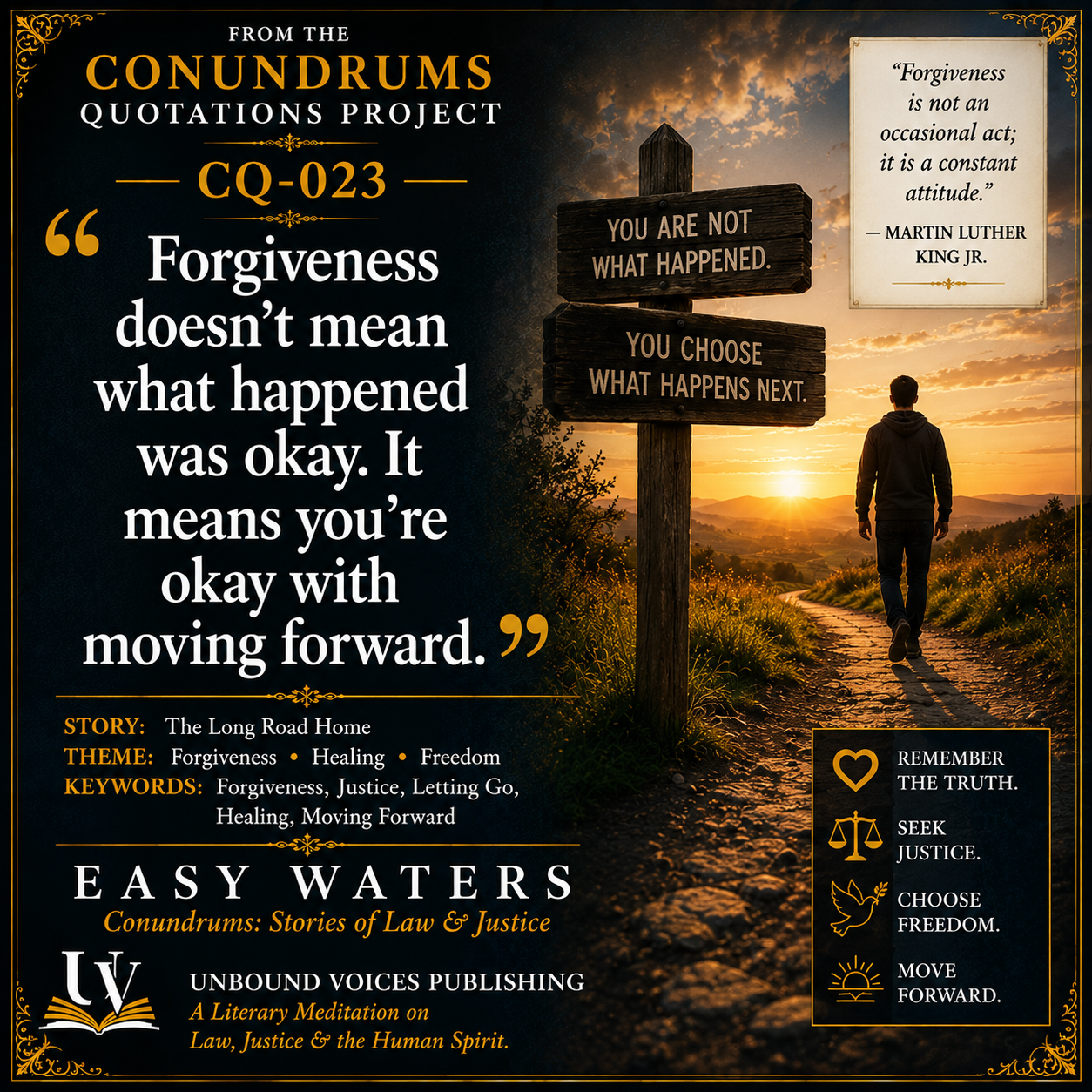
“Forgiveness is not an occasional act; it is a constant attitude.”
— Martin Luther King Jr.
Forgiveness and the Freedom to Move Forward
Forgiveness may be one of the most misunderstood words in our moral vocabulary.
We confuse it with forgetting.
With reconciliation.
With excusing.
With pretending.
With absolving someone of responsibility.
Sometimes we even imagine forgiveness requires us to look at something painful and declare that it no longer matters.
I believe precisely the opposite.
Something may matter enormously and still be forgiven.
A wound may remain part of your history.
A betrayal may permanently alter a relationship.
An injustice may require accountability.
A loss may never be restored.
You can acknowledge all of that and still decide that what happened will not determine the direction of the rest of your life.
That is the distinction at the center of CQ-023.
Forgiveness does not mean what happened was okay.
It means you have decided to move forward anyway.
What Forgiveness Is Not
Before discussing forgiveness, we should be clear about what it does not require.
Forgiveness does not mean saying:
It didn’t hurt.
It wasn’t wrong.
It doesn’t matter.
I trust you again.
We can return to the way things were.
Those are separate questions.
Some relationships should not be restored.
Some boundaries should remain.
Some people should never again be given the access they once possessed.
Forgiveness and reconciliation are not synonymous.
Reconciliation requires participation from both parties.
Forgiveness does not.
That distinction can be liberating.
Because if forgiveness requires the person who harmed us to understand, apologize, change, or make restitution, then our freedom remains dependent upon their behavior.
Sometimes they will never do those things.
What then?
Must we remain emotionally connected to the injury forever?
I do not believe so.
The Difference Between Justice and Revenge
Forgiveness also does not eliminate justice.
A person can forgive and still believe consequences are necessary.
A victim can forgive someone who committed a crime and still believe that person should be held accountable.
A community can pursue reconciliation while demanding institutional reform.
A family can forgive an individual while maintaining boundaries.
This distinction matters because we sometimes present forgiveness and justice as opposites.
They are not.
Justice asks:
What happened?
Who was harmed?
Who bears responsibility?
What should be done?
Forgiveness asks another question:
How much of my remaining life will I permit this injury to occupy?
The questions overlap.
They are not identical.
When Anger Becomes a Sentence
Anger has an important purpose.
It alerts us that something is wrong.
It can mobilize action.
It can help establish boundaries.
It has fueled movements against slavery, segregation, violence, exploitation, and injustice.
There is nothing inherently immoral about anger.
But anger can change.
What begins as a response to injury can become an identity organized around injury.
We replay the event.
Rehearse the argument.
Imagine what we should have said.
Imagine what we would say now.
The person who harmed us may have moved on, forgotten, changed, disappeared, or died.
Yet the conversation continues inside us.
At some point we must ask:
Who is serving the sentence now?
That question does not excuse the person who caused the harm.
It examines what continued attachment to the harm is doing to us.
The Prison of Resentment
Resentment creates a peculiar form of confinement.
The person who injured us occupies space in our lives without paying rent.
They appear in our thoughts.
Influence our relationships.
Shape our reactions.
Sometimes determine whom we trust.
We may begin constructing future relationships around an injury caused by someone in the past.
A new person pays for an old person’s betrayal.
A new opportunity is rejected because an earlier opportunity ended painfully.
A new friendship encounters walls built by someone who is no longer present.
The injury reproduces itself.
This is one reason forgiveness can become an act of liberation.
It interrupts the reproduction.
Forgiveness and Memory
CQ-023 follows naturally from CQ-019:
“Healing is not forgetting what happened; it’s deciding it no longer controls you.”
Forgiveness works similarly.
It does not require forgetting.
In fact, forgetting can sometimes be dangerous.
Memory teaches.
A person who repeatedly violated your trust may not deserve renewed access merely because you have forgiven them.
Wisdom remembers.
The question is whether memory becomes a teacher or a jailer.
Forgiveness allows us to say:
I remember what happened.
I understand what it taught me.
I have changed because of it.
But I will not continue living inside it.
That is not weakness.
It requires considerable strength.
Forgiving Someone Who Never Apologizes
One of the hardest situations arises when the person who caused harm never acknowledges it.
No apology.
No remorse.
Perhaps denial.
Perhaps justification.
Perhaps they genuinely do not understand what they did.
This can make forgiveness feel almost offensive.
Why should I forgive someone who isn’t sorry?
The answer depends upon what we believe forgiveness is for.
If forgiveness is a reward given to the offender, perhaps they do not deserve it.
But if forgiveness is partly an act through which the injured person releases themselves from perpetual emotional captivity, then the offender’s participation is not always required.
You may forgive someone who never apologizes.
Not for them.
For you.
Self-Forgiveness May Be Harder
Sometimes the person we have the greatest difficulty forgiving is ourselves.
We replay our own failures with remarkable precision.
The relationship we damaged.
The opportunity we wasted.
The child we disappointed.
The years we lost.
The addiction.
The crime.
The words we wish we could retrieve.
Other people may forgive us long before we forgive ourselves.
Self-forgiveness can feel morally suspicious because we worry that releasing guilt means minimizing responsibility.
But permanent self-condemnation does not repair the past.
Accountability asks us to learn.
To make amends where possible.
To change behavior.
To accept consequences.
Once those things have occurred, continuing to punish ourselves indefinitely may serve no constructive purpose.
At some point, responsibility must become transformation.
What Prison Teaches About Forgiveness
Questions of forgiveness become particularly complicated within criminal justice.
We often want clear roles.
Victim.
Offender.
Innocent.
Guilty.
But human lives can resist simple categories.
A person responsible for serious harm may also have experienced profound harm.
That history does not erase responsibility.
It complicates understanding.
One of literature’s functions is to hold these complexities together.
A story can ask us to understand someone without asking us to excuse them.
That distinction is crucial.
Understanding is not absolution.
Compassion is not acquittal.
Humanization is not denial of harm.
We can recognize the humanity of people who have done terrible things while still recognizing the humanity of those they injured.
Justice must be capable of holding both.
Victims Do Not Owe Forgiveness
There is an important boundary here.
No victim should be commanded to forgive.
Forgiveness imposed from outside can become another violation.
Religious communities sometimes make this mistake.
Families sometimes make it.
Institutions sometimes make it.
“Forgive and move on” can become a way of avoiding accountability.
The injured person may need anger.
Distance.
Truth.
Consequences.
Time.
Forgiveness cannot become another obligation imposed upon someone who has already had control taken from them.
It must remain an act of agency.
That is what gives forgiveness moral power.
I decide when—or whether—I am ready.
Forgiveness Is Not Always a Moment
We often imagine forgiveness as a single decision.
Sometimes it is.
More often, it is a practice.
You forgive.
Then remember.
Then become angry again.
Then forgive again.
An anniversary arrives.
A familiar place triggers memory.
Someone asks a question.
The wound feels unexpectedly fresh.
This does not mean forgiveness failed.
Healing is not linear.
Neither is forgiveness.
Sometimes we must release the same injury many times before we realize it no longer weighs what it once did.
Moving Forward Is Not the Same as Moving On
There is a reason I prefer the phrase moving forward to moving on.
Moving on can sound like abandonment.
As though we leave the past behind and never look back.
Moving forward allows us to carry what matters.
The lesson.
The memory.
The names.
The wisdom.
Even the scar.
But we carry them toward something.
That distinction matters.
You do not have to abandon the person you were in order to become the person you are becoming.
You integrate the experience.
It becomes part of you without becoming all of you.
Forgiveness and Institutional Justice
Institutions also face questions of forgiveness.
What does society owe someone who has served a sentence?
If punishment has been completed, at what point should restoration begin?
Can a society claim to believe in rehabilitation while preserving lifelong exclusion?
When should a conviction stop functioning as the dominant fact about a person?
These are not simple questions.
Public safety matters.
Accountability matters.
Victims matter.
But transformation must matter too if rehabilitation is more than rhetoric.
A justice system incapable of recognizing genuine change risks turning punishment into permanent identity.
There must be some pathway from:
You did this
to
You did this, accepted responsibility, changed, and are now something more.
Without that possibility, we have punishment.
We do not necessarily have justice.
Forgiveness and Power
Forgiveness is sometimes portrayed as surrender.
It can be the opposite.
To forgive is to reclaim authorship.
The person who harmed you no longer determines the emotional structure of your life.
The event remains historically true.
But its power changes.
You choose where the story goes next.
That is agency.
That is why forgiveness can coexist with strength.
You are not saying:
You were right.
You are saying:
You will not control what comes next.
Those are radically different statements.
Why It Matters Today
We live in a culture that remembers everything.
Old statements resurface.
Old mistakes become searchable.
Public condemnation can become permanent.
Some accountability is necessary.
But we should ask whether a culture with infinite memory also needs a deeper vocabulary for forgiveness.
Can people change?
Can beliefs evolve?
Can someone who caused harm make restitution and reenter community?
Can we distinguish between accountability and permanent exile?
These questions extend beyond criminal justice.
They concern what kind of society we want to become.
A society without accountability becomes dangerous.
A society without forgiveness becomes merciless.
Justice must navigate between them.
The Freedom on the Other Side
Forgiveness does not guarantee reconciliation.
It does not restore lost years.
It does not return the dead.
It does not undo betrayal.
It does not erase trauma.
What it can do is alter the relationship between the injury and the future.
The past becomes something that happened.
Not something that is still happening every day.
That difference can be enormous.
The event remains behind you.
You begin moving.
At first slowly.
Perhaps painfully.
But forward.
Questions for Reflection
- Have you ever confused forgiving someone with excusing what they did?
- Is there a resentment in your life that is now costing you more than it costs the person you resent?
- What would forgiveness look like if reconciliation were not required?
- Is there something for which you have accepted responsibility but still refuse to forgive yourself?
- How should a justice system demonstrate that it genuinely believes people are capable of change?
About Conundrums
Conundrums: Stories of Law & Justice is a cycle of stories exploring imprisonment, law, justice, memory, accountability, forgiveness, redemption, and the resilience of the human spirit. Through literature grounded in lived experience, Easy Waters examines the difficult territory between harm and healing, punishment and restoration, memory and release—and asks what becomes possible when human beings refuse to let their worst experiences write the ending.
Closing Reflection
Forgiveness does not rewrite yesterday.
What happened happened.
The wound was real.
The betrayal mattered.
The injustice deserves its name.
The consequences may remain.
But there comes a moment when another question becomes possible:
What happens next?
That question belongs to you.
You may carry the memory.
You may carry the lesson.
You may carry the scar.
But you do not have to carry the person who caused it into every room you enter for the rest of your life.
Sometimes forgiveness is not about letting someone else off the hook.
Sometimes it is about taking yourself off it.
And beginning to walk.
“Forgiveness doesn’t mean what happened was okay. It means you’re okay with moving forward.”
Justice begins with the courage to see clearly.
— Easy Waters
Continue the Conversation
The Conundrums Quotations Project is an ongoing series of literary reflections on law, justice, freedom, memory, redemption, and the human spirit, inspired by Conundrums: Stories of Law & Justice.
Subscribe to Easy Waters to receive new essays from the Quotations Project, stories, poetry, commentary, and other writing as they are published.
Visit Easy Waters and subscribe →
If you discovered this essay somewhere other than the Easy Waters website, join the conversation at ezwwaters.com and follow The Conundrums Quotations Project from there.
The Conundrums Quotations Project
CQ-023 | Forgiveness and the Freedom to Move Forward
Easy Waters
Conundrums: Stories of Law & Justice
Unbound Voices Publishing
A Literary Meditation on Law, Justice & the Human Spirit.
Justice, Literature & Memory — Delivered to Your Inbox
Essays from the archive and new writing on race, literature, history, incarceration, freedom, and the American criminal legal system.


