
Essay No. 12 | CQ-025
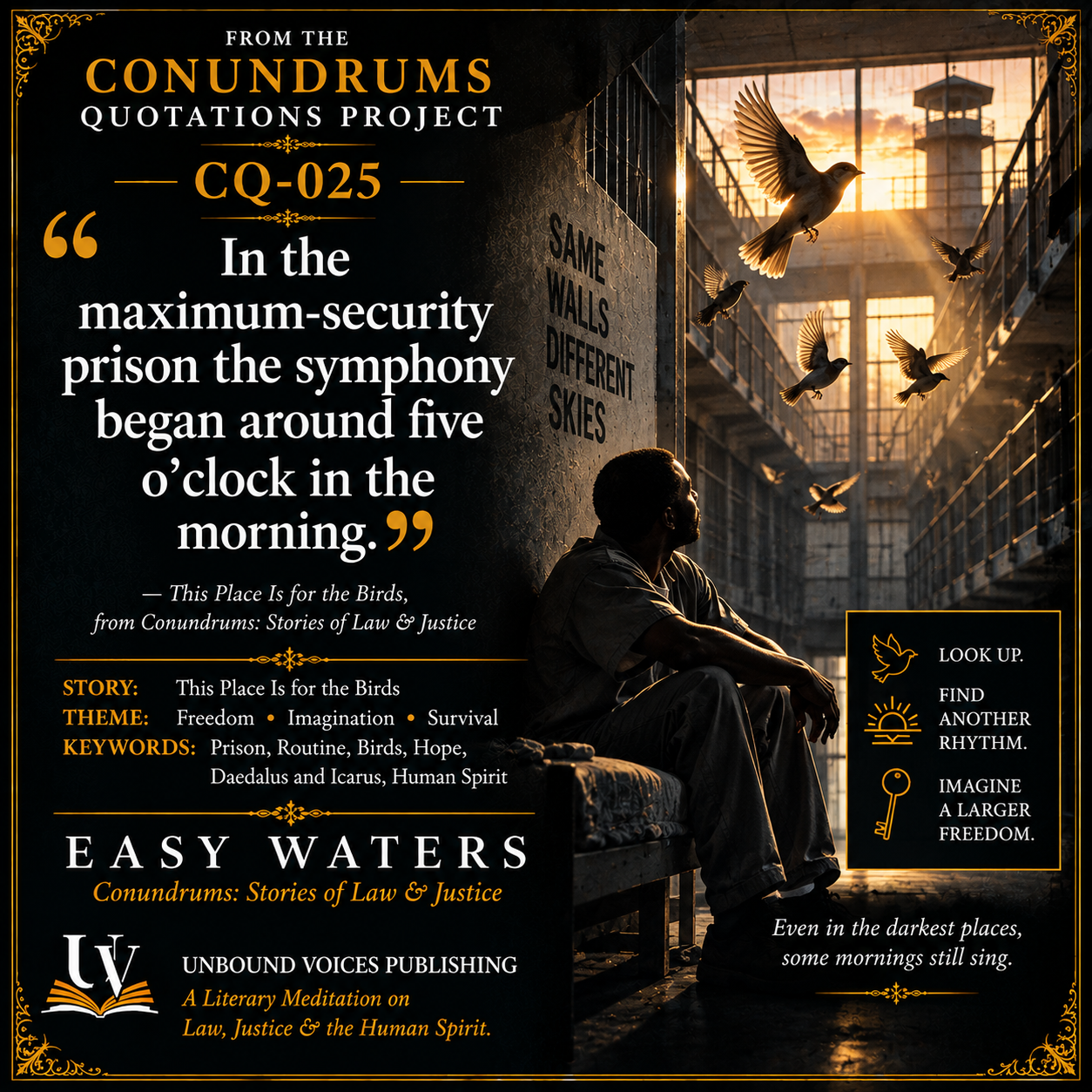
In the maximum-security prison the symphony began around five o’clock in the morning.
— This Place Is for the Birds, from Conundrums: Stories of Law & Justice
Prisons have their own clocks.
Count time.
Chow time.
Yard time.
Work time.
Lock-in time.
Lights-out.
The hands of those clocks do not belong to the people living beneath them. A bell rings, a gate opens, an officer shouts, and hundreds of human beings move. Another order is given, and they stop.
But in This Place Is for the Birds, the day begins before the guards command it to begin.
At five o’clock in the morning, one bird chirps.
Alex has named him Leonard Birdstein.
Another bird answers.
Then another.
Before long, the entire cellblock fills with a call and response like the Black church.
A symphony has begun inside a maximum-security prison.
Alex does not initially appreciate the concert. The birds are chirping him “right out of his mind.” He has planned to sleep away one-third of his captivity, only to discover that creatures free to come and go have placed him on their schedule.
The irony is almost cruel.
The guards control his waking hours during the day.
The birds steal his sleep before dawn.
Still, beneath Alex’s irritation is wonder. The birds have entered a place built to keep life under control, and they refuse to behave like prisoners.
Two Kinds of Routine
Routine can preserve a person.
Routine can also imprison him.
Inside prison, routine gives shape to days that might otherwise become indistinguishable. When nearly every day resembles the one before it, small rituals matter.
A person reads at a certain hour.
Exercises according to a private schedule.
Waits for mail.
Listens for footsteps.
Saves a particular food for later.
Or lies on his cot until he is absolutely certain the guards will open the cells.
These habits are not trivial. They can become methods of survival—small territories of choice inside a world organized around the removal of choice.
Alex’s morning policy is one such ritual.
He refuses to get out of bed until he knows the cell doors will open. A lockdown can occur without warning. Why surrender sleep to a day the prison may not permit him to have?
Remaining on his cot is a modest act of conservation.
He will not spend energy preparing for movement until movement is possible.
Then Leonard Birdstein chirps.
Another System of Time
That first note belongs to another system of time.
The birds do not recognize counts.
Gates.
Disciplinary rules.
Prison schedules.
They arrive after the prisoners lock in. They fly around the cellblock as though performing an aerial show for a captive audience. They land on the flats, eat the bread prisoners scatter for them, and leave when they choose.
Eventually they build nests.
Breed.
Fight.
Sing.
And make themselves at home.
The prison contains the men. It does not contain the morning.
This is why the opening sentence is more than scene-setting.
The “symphony” announces a contest between two kinds of routine.
One is imposed through walls, weapons, schedules, and surveillance.
The other comes from nature:
Dawn.
Hunger.
Flight.
Nesting.
Song.
The prison routine insists that nothing moves without permission.
The birds answer by squeezing through the bars.
For the Birds, Prison Is a Restaurant
Alex is both fascinated and offended by them.
He envies their freedom but resents their presence. They bring nature inside, yet they also deprive him of sleep, dive-bomb the prisoners, and soil them.
These are not sentimental symbols perched politely outside a window.
They are noisy.
Sexual.
Hungry.
Inconsiderate.
They do not arrive to comfort the incarcerated men.
They arrive because the bread is plentiful and the predators are few.
For the birds, prison is a restaurant.
For the men, it is a cage.
That difference determines everything.
A place is not defined only by its walls.
It is defined by whether one can leave.
When Annoyance Becomes Imagination
Alex begins imagining the birds communicating with one another.
He hears one tell a hesitant newcomer:
“Try the bread.”
He studies every tone, timbre, nuance, and tempo until he believes he is learning birdspeak.
Something important has happened.
What began as annoyance has become interpretation.
The sounds that interrupted his routine have enlarged his imagination.
The birds have not changed.
Alex has changed the way he sees them.
And once perception changes, possibility enters the story.
In Prison, Hope Can Look Like Madness
The prisoner known as the Bird Man has been feeding the birds for a reason.
He has used their feathers to construct wings.
Drawing upon the Greek myth of Daedalus and Icarus, he intends to fly out of prison.
Alex initially thinks him insane.
Then he sees him hovering three feet above the floor.
“And I thought you was crazy!”
There may be no environment in which hope looks more irrational than prison.
The institution is constructed to make its boundaries appear absolute.
Walls say:
You cannot pass.
Bars say:
You cannot leave.
Gun towers say:
Do not try.
Sentences convert those physical boundaries into years.
Eventually, captivity can become more than a condition.
It can become an assumption.
The Bird Man refuses the assumption.
When Routine Becomes Preparation
Alex joins him.
The two men build another pair of wings.
They study how birds fly.
They exercise.
Practice.
Prepare.
Their effort begins to resemble flight school.
And now the story reverses the meaning of routine.
The same repetition that can deaden the spirit—day after day, count after count—can also train the body and concentrate the will.
Routine, once an instrument of confinement, becomes a method through which they pursue freedom.
That is another conundrum.
Routine is not inherently liberating or oppressive.
Its meaning depends upon who designs it and toward what end.
The prison’s routine maintains custody.
The men’s routine prepares escape.
Literature Gives the Captive Mind Another Map
The Bird Man’s knowledge of mythology gives him more than a story.
It gives him a design.
Daedalus becomes an instructor across centuries.
An ancient tale enters a modern prison and teaches two Black men to imagine that the walls are not the limits of the world.
The institutional map says every route ends at a locked gate.
Literature adds another direction:
Up.
That is what books can do inside confinement.
They cannot abolish concrete.
They cannot unlock steel.
They cannot neutralize a gun tower.
But they can challenge the proposition that the visible world contains every possibility.
Literature does not open the gate. It does something the gatekeepers may fear even more: it teaches the captive mind to look up.
The Danger of Flight
When Alex and the Bird Man finally take flight, Alex immediately understands what the birds have known all along.
Flying is freedom.
But the myth of Daedalus and Icarus has not entered the story merely as decoration.
It carries a warning.
Icarus flew too close to the sun.
Alex flies too close to the gun tower.
A guard shoots him.
He falls outside the wall.
His final recognition is bitterly precise: he will land in “the land of the free,” but he will arrive there dead.
The Bird Man reaches Canada.
The two outcomes resist an easy moral.
Preparation does not guarantee liberation.
Courage does not make weapons disappear.
Imagination can reveal a path beyond confinement, but power still guards the boundary.
Alex becomes free of the prison at the exact moment he loses the life he hoped to reclaim.
The Flight Still Matters
Yet his flight is not meaningless.
Before the birds entered the cellblock, the sky was something above him.
Through observation, friendship, literature, and disciplined practice, it became a route.
That transformation matters.
The prison had taught Alex to think horizontally.
Cell.
Gallery.
Corridor.
Gate.
Wall.
The birds teach him another geometry.
Vertical possibility.
They make him look upward.
And once a person begins looking beyond the boundaries he has been told are absolute, confinement has lost something important.
It may still control the body.
It no longer possesses the entire imagination.
Why It Matters Today
Most of us live by sounds we barely notice.
An alarm clock.
A train.
Children preparing for school.
Traffic outside a window.
A neighbor overhead.
A phone announcing another message.
Those sounds tell us where we are, what is expected of us, and when we must move.
Routine can become so complete that we mistake it for reality itself.
We stop asking who established it.
Whom it serves.
Whether it is preserving us.
Whether it is diminishing us.
Whether it is carrying us toward life or merely helping us endure.
The birds in Alex’s cellblock suggest another question:
What enters our lives as an interruption but might actually be an instruction?
A sound can be a nuisance.
It can also be evidence that another world exists.
The birds awaken Alex before he wants to rise.
Eventually, they awaken something else.
The desire to fly.
Sometimes survival means protecting a routine.
Sometimes it means hearing a different rhythm.
And sometimes freedom begins when we realize that the clock governing our lives is not the only clock running.
Questions for Reflection
- What sounds define the place where you live, and what do they reveal about freedom, obligation, or belonging?
- Which of your routines preserve you, and which have quietly become another kind of confinement?
- What interruption in your life eventually revealed itself as an invitation or opportunity?
- What role can literature, art, or imagination play when physical circumstances cannot immediately be changed?
- What would it mean in your own life to stop looking only at the walls and begin looking up?
About Conundrums
Conundrums: Stories of Law & Justice is a cycle of stories exploring imprisonment, law, justice, freedom, accountability, conscience, identity, redemption, and the resilience of the human spirit.
In This Place Is for the Birds, the absurd presence of birds inside a maximum-security prison becomes something larger: a meditation on routine, imagination, literature, captivity, and the dangerous human desire for freedom.
The birds do not come to teach the prisoners anything.
They simply fly.
The lesson emerges because someone is watching.
Closing Reflection
Five o’clock in the morning.
A maximum-security prison.
Men sleeping behind steel.
Gun towers beyond the walls.
Officers preparing another day of counts, movements, meals, work assignments, searches, and lock-ins.
Then a bird chirps.
Another answers.
Then another.
The institution has not authorized the performance.
No officer has opened a gate.
No schedule lists the event.
No rule explains it.
The morning simply arrives.
And with it comes a sound the prison cannot manufacture and does not control.
At first, Alex hears only noise.
Then he hears language.
Eventually, he hears possibility.
The birds have not removed a single bar.
They have done something else.
They have reminded a captive man that there are creatures in the world for whom walls are merely things to fly over.
“In the maximum-security prison the symphony began around five o’clock in the morning.”
— This Place Is for the Birds, from Conundrums: Stories of Law & Justice
Justice begins with the courage to see clearly.
— Easy Waters
Continue the Conversation
The Conundrums Quotations Project is an ongoing series of literary reflections on law, justice, freedom, memory, punishment, conscience, redemption, and the human spirit, inspired by Conundrums: Stories of Law & Justice.
Subscribe to Easy Waters to receive new essays from the Quotations Project, stories, poetry, commentary, and other writing as they are published.
Visit Easy Waters and subscribe →
If you discovered this essay somewhere other than the Easy Waters website, join the conversation at EZWWATERS.com and follow The Conundrums Quotations Project from there.
The Conundrums Quotations Project
CQ-025 | The Symphony at Five O’Clock: When Another Rhythm Becomes Freedom
Easy Waters
Conundrums: Stories of Law & Justice
Unbound Voices Publishing
A Literary Meditation on Law, Justice & the Human Spirit.
Justice, Literature & Memory — Delivered to Your Inbox
Essays from the archive and new writing on race, literature, history, incarceration, freedom, and the American criminal legal system.


