
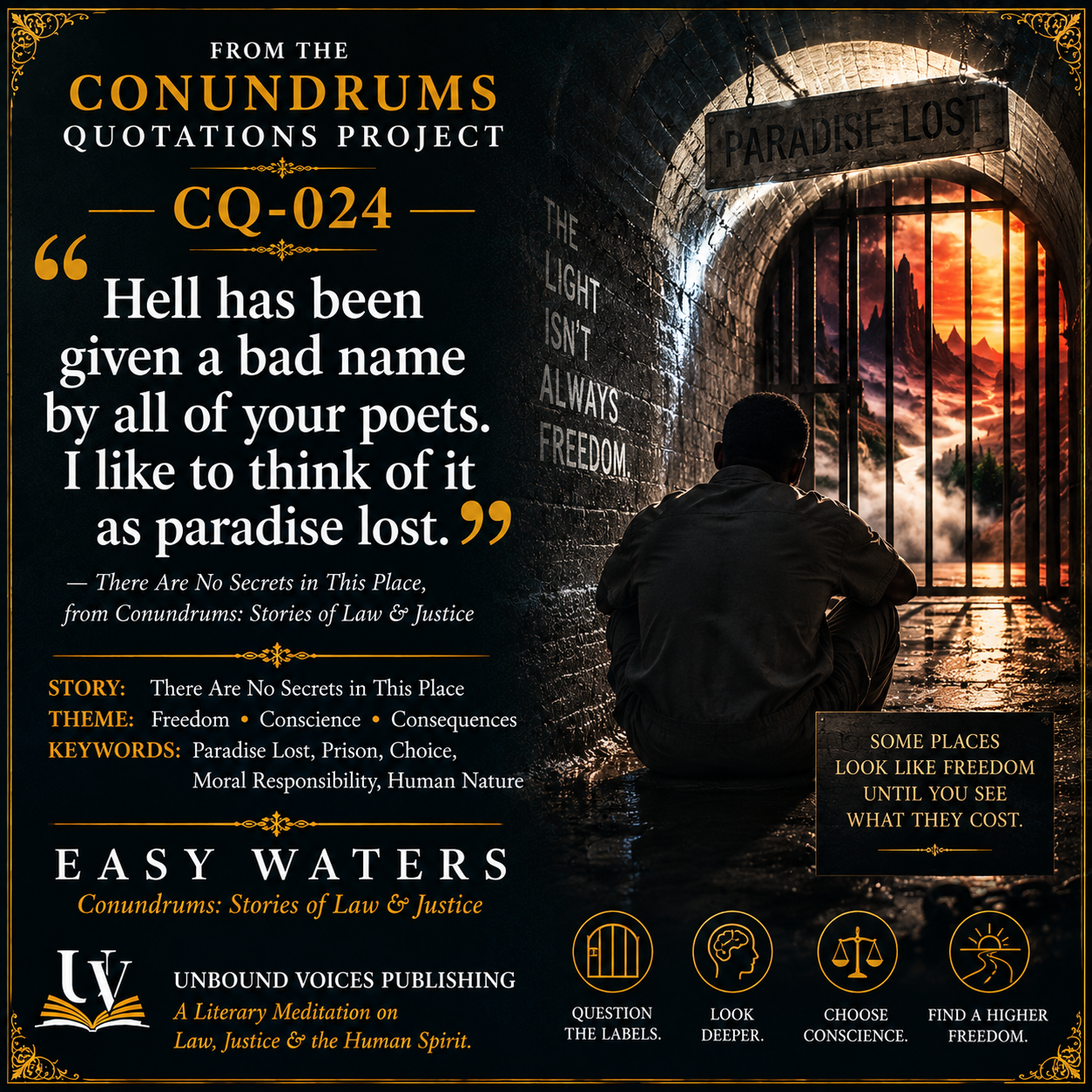
“Hell has been given a bad name by all of your poets. I like to think of it as paradise lost.”
— There Are No Secrets in This Place, from Conundrums: Stories of Law & Justice
Essay No. 11 | CQ-024
Paradise Lost
There is something almost charming about the way the Devil speaks to Norman.
He does not greet him with fire and brimstone.
He does not announce himself with horns, a pitchfork, or one of those bloodcurdling screams Hollywood has taught us to expect.
He appears dressed like a prison guard: black shoes polished to a spit shine, navy-blue pants with razor-sharp creases, and a sky-blue shirt. He is an albino with woolly hair.
He jokes.
He quotes.
He offers Norman a tour.
Hell, it seems, has a public-relations department.
Norman arrives there while trying to escape from a maximum-security prison. For years, he has worked in the prison Sign Shop under the supervision of Officer Kevin K. Kirsch, known simply as Officer K.
The prison is old, its cornerstone laid in 1898, and beneath it lies a forgotten network of tunnels. Norman discovers one of those tunnels behind an old furnace. He searches it patiently until, one day, he sees the proverbial light at the end of the tunnel.
Every prisoner knows what that light means.
Freedom.
But proverbs can lie.
Norman runs toward the light, stumbles, and falls into what he first assumes is merely another part of the prison.
When he asks where he is, the uniformed stranger answers with one word:
“Hell.”
Norman thinks he may have said hello.
That small misunderstanding contains the story’s dark joke.
Hell does not always introduce itself honestly.
Sometimes it sounds like a greeting.
Sometimes it arrives as an opportunity.
Sometimes it calls itself freedom.
The Seduction of Renaming
The phrase “paradise lost” carries an obvious literary echo.
John Milton used it as the title of his epic poem about humanity’s fall from grace, Satan’s rebellion, and the terrible consequences of confusing freedom with the right to reject every limit.
In Milton, Paradise is something humanity loses.
In There Are No Secrets in This Place, Hell borrows the phrase and turns it into advertising.
That is what evil often does.
It does not create language.
It corrupts it.
The Devil tells Norman that Hell has been misunderstood by poets. He presents it as a place without rules or restraints, a place where Norman can do whatever he wants without fear of punishment.
To a man serving a life sentence, the offer is perfectly tailored.
Prison has controlled Norman’s movement, labor, privacy, and time.
Hell promises the opposite.
No counts.
No gates.
No officers watching.
No disciplinary tickets.
No parole board.
No consequences.
Or so it appears.
Is the Absence of Restraint Freedom?
The Devil’s sales pitch depends upon a familiar confusion:
Freedom means the absence of restraint.
But does it?
Freedom without responsibility is not necessarily liberation.
It may simply be appetite with permission.
Power separated from conscience.
The license to harm another human being because no authority will intervene.
Norman soon learns what this new “freedom” requires of him.
He is shown violence, degradation, and suffering.
He sees a dirty child gnawing on a rat.
He sees the conditions of the streets reproduced below—in Hell as they are on earth.
Then the Devil points to beautiful women on a beach and tells Norman he may “take” whichever woman he wants.
The euphemism collapses almost immediately.
“Take” means rape.
Here the story’s conundrum becomes unavoidable.
Norman has escaped the institution that restrained his body, but he has entered a place that invites him to imprison his own soul.
The question is no longer whether a guard can stop him.
The question is whether he can stop himself.
The Last Witness
The Devil’s most revealing condition is almost an afterthought.
Norman may do anything he wants:
“as long as you can live with yourself afterwards.”
That sentence exposes the fraud.
There are consequences in Hell after all.
They are simply internal.
Memory survives.
Shame survives.
The knowledge of what one has done survives.
A person may escape the courtroom.
The prison.
The rulebook.
The judgment of other people.
There remains, however, that last witness:
the self.
Prison Above, Hell Below
Norman’s predicament complicates the language we use about prisons.
Prison is often described as Hell, and understandably so.
It is a place of forced confinement, relentless surveillance, isolation, violence, and the daily erosion of privacy.
In the story, however, the connection becomes literal.
The prison is built directly over Hell.
Norman trades one life sentence for another.
Yet the two places are not opposites.
They mirror each other.
The Devil wears a correction officer’s uniform.
Hell conducts orientations.
Lawyers hold mock trials.
Acquittals are plentiful because, the Devil boasts:
“Down here we are honest.”
Even damnation has adopted the language and routines of an institution.
Words Control the Narrative
The satire is pointed.
Systems that exercise enormous power rarely describe themselves as cruel.
They rename domination as order.
Punishment as correction.
Deprivation as rehabilitation.
Despair as public safety.
Words control the narrative.
Give suffering the proper administrative title and respectable people can learn not to see it.
The Devil understands this perfectly.
He does not deny that Norman is in Hell.
He disputes the branding.
That may be the most important distinction in the story.
“Paradise lost” is therefore more than a literary joke.
It is a warning about the seduction of renamed realities.
If Hell can be marketed as Paradise, a cage can be called care.
Surveillance can be called protection.
Vengeance can be called justice.
Exploitation can be called opportunity.
And a human being can be reduced to the worst thing he has ever done while the institution doing the reducing calls itself moral.
Obedience Is Not Transformation
Norman’s imagined encounter reveals something else uncomfortable about incarceration:
External control does not necessarily produce internal transformation.
Prison can compel obedience.
It can dictate where a person stands.
When he sleeps.
What he wears.
Which doors he may enter.
But obedience enforced by walls is not the same as moral growth.
Remove the walls and the unresolved self remains.
This does not mean Norman is beyond redemption.
It means redemption cannot be manufactured through restraint alone.
A person becomes accountable when he recognizes the humanity of the person he could harm—not merely when he fears the punishment that may follow.
The absence of a guard should not become permission to become a monster.
The Conscience No Institution Can Supply
This distinction matters well beyond Norman’s predicament.
Laws can prohibit conduct.
Institutions can impose consequences.
Prisons can restrain bodies.
But none of those things, by themselves, can create conscience.
Conscience requires something internal.
The recognition that another person possesses dignity independent of whether the law protects it.
The recognition that possessing the power to do something does not establish the moral right to do it.
The recognition that freedom carries obligations.
The deepest test of character therefore may not occur when someone is being watched.
It occurs when no one appears to be watching at all.
What do we choose when punishment seems impossible?
What limits remain when the external limits disappear?
Norman believes he has escaped confinement.
What he actually encounters is the question confinement had temporarily concealed.
Who is Norman when Norman alone must decide what Norman will do?
There Are No Secrets in This Place
Norman ultimately awakens in the prison infirmary.
He had fallen and lain unconscious, traveling between worlds while Officer K and a nurse listened to him reveal what he believed no one could hear.
When he opens his eyes, Officer K is waiting.
The guard delivers the sentence that began the story:
“There are no secrets in this place.”
The line now means more than prison gossip.
Norman has exposed the secret corridors beneath the institution.
The secret desire he harbored for Officer K’s wife.
And the secret self that emerged when he imagined there would be no consequences.
The prison knows because prisoners and guards watch one another.
Hell knows because nothing is hidden there.
Norman knows because conscience records what authority may never discover.
What We Bury Eventually Surfaces
Perhaps there are no secrets in any place—not forever.
What we bury beneath old furnaces, institutional language, polished uniforms, and respectable explanations eventually finds a tunnel to the surface.
That idea connects CQ-024 to another recurring concern of The Conundrums Quotations Project:
What is hidden does not necessarily disappear.
Institutions hide things.
People hide things.
Language hides things.
Sometimes we hide things from ourselves.
But concealment is not erasure.
Eventually something emerges.
A document.
A witness.
A memory.
A confession.
A story.
A tunnel.
The light at the end may lead to freedom.
It may lead to judgment.
Sometimes, cruelly, it leads to both.
The Dangerous Appeal of “No Rules”
There is something seductive about imagining absolute freedom.
No restrictions.
No judgment.
No consequences.
But civilization itself depends upon recognizing that individual desire cannot be the sole measure of what is permissible.
My freedom encounters your humanity.
Your freedom encounters mine.
The moral question is not simply:
What am I allowed to do?
It is:
What should I do when another human being will bear the consequences of my choice?
That distinction separates liberty from license.
It also separates justice from power.
Why It Matters Today
We live in a world saturated with euphemism.
Institutions, corporations, governments, and individuals understand that controlling language can shape how reality is perceived.
Harm can be made bureaucratic.
Violence can be made clinical.
Exclusion can be made procedural.
Cruelty can be made necessary.
The question CQ-024 asks is therefore larger than Norman’s encounter with the Devil.
It asks us to examine the names we have accepted.
What have we been taught to call normal?
Necessary?
Protective?
Corrective?
Just?
And what becomes visible when we look past the label and examine the human consequence?
The Devil’s genius is not that he lies about where Norman is.
He tells him plainly.
Hell.
The deception is subtler.
He teaches Norman to reconsider whether Hell might actually be Paradise.
That is how dangerous language works.
It does not always conceal reality.
Sometimes it persuades us to admire it.
The Freedom Worth Having
If freedom means only the absence of restraint, the Devil’s argument is difficult to defeat.
Hell offers Norman enormous freedom.
But it is freedom emptied of responsibility.
A freedom in which another person’s suffering places no claim upon us.
A freedom without empathy.
Without accountability.
Without conscience.
That is not the freedom worth seeking.
Real freedom requires something more demanding.
The capacity to choose restraint when no one forces it.
To recognize another person’s dignity when violating it would be easy.
To possess power without assuming that power establishes permission.
To remain human when circumstances provide an excuse not to be.
Perhaps that is the paradox at the center of Norman’s journey.
He spends years dreaming about getting outside the walls.
Then discovers that the most important boundary may be the one a person chooses not to cross.
Questions for Reflection
- Is a person truly free when no external rule restrains him, or does freedom require responsibility toward other people?
- What harmful realities in contemporary life have been made acceptable by changing the language used to describe them?
- Can confinement produce genuine moral transformation, or can it only compel temporary obedience?
- What is the difference between a limitation imposed by authority and a moral boundary we choose for ourselves?
- When institutions rename punishment, control, or suffering, what responsibility do we have to examine the reality behind the terminology?
About Conundrums
Conundrums: Stories of Law & Justice is a cycle of stories exploring imprisonment, law, justice, freedom, accountability, conscience, redemption, and the resilience of the human spirit. Through literature grounded in lived experience, Easy Waters examines the moral ambiguities hidden inside institutions and individual choices—and asks what happens when the language of justice obscures the human consequences of power.
Closing Reflection
Norman wanted freedom.
He found Hell.
The Devil told him there was little difference.
No rules.
No restraints.
No punishment.
No authority standing between desire and action.
Paradise, perhaps, if freedom means only doing whatever one wants.
But the story leaves us with a harder definition.
Freedom is not merely the removal of the guard.
It is what remains when the guard is gone.
Conscience.
Responsibility.
Recognition of another person’s humanity.
The ability to possess a choice without surrendering to appetite.
The ability to say no to ourselves when no one else is there to say it for us.
That may be the boundary that matters most.
The conundrum is not whether Hell can be mistaken for Paradise.
It is how often we accept the new name.
“Hell has been given a bad name by all of your poets. I like to think of it as paradise lost.”
Justice begins with the courage to see clearly.
— Easy Waters
Continue the Conversation
The Conundrums Quotations Project is an ongoing series of literary reflections on law, justice, freedom, memory, punishment, conscience, redemption, and the human spirit, inspired by Conundrums: Stories of Law & Justice.
Subscribe to Easy Waters to receive new essays from the Quotations Project, stories, poetry, commentary, and other writing as they are published.
Visit Easy Waters and subscribe →
If you discovered this essay somewhere other than the Easy Waters website, join the conversation at ezwwaters.com and follow The Conundrums Quotations Project from there.
The Conundrums Quotations Project
CQ-024 | Paradise Lost
Easy Waters
Conundrums: Stories of Law & Justice
Unbound Voices Publishing
A Literary Meditation on Law, Justice & the Human Spirit.
Justice, Literature & Memory — Delivered to Your Inbox
Essays from the archive and new writing on race, literature, history, incarceration, freedom, and the American criminal legal system.


