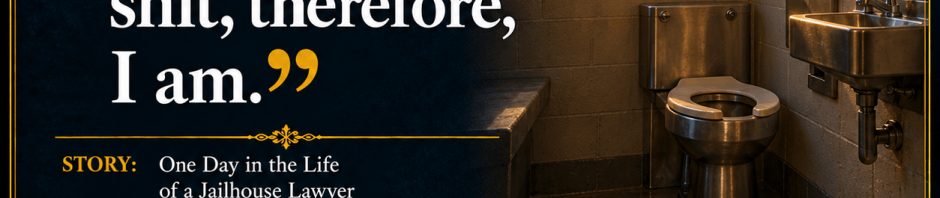

“I piss and shit, therefore, I am.”
— One Day in the Life of a Jailhouse Lawyer, from Conundrums: Stories of Law & Justice
A toilet seat is an unlikely place to begin a discussion of human dignity.
That is precisely why the sentence works.
In One Day in the Life of a Jailhouse Lawyer, E compares maximum-security confinement with life in a medium-security prison. There are obvious differences: a fence instead of a wall, greater freedom of movement, and a key to his own cell. But the difference that moves him most is smaller. The toilets have seats.
He can raise or lower one according to his body’s needs. An ordinary choice reconnects him to the rest of humanity. Then he revises a familiar philosophical declaration:
“I piss and shit, therefore, I am.”
Philosophy Goes to the Bathroom
Descartes gives us a thinking self. E gives us a body that must use the toilet.
The joke brings philosophy down from its elevated room and places it beside a shared sink. It is blunt, profane, and deliberately resistant to polite language. A person does not stop having a body because an institution has taken custody of it.
That body has needs. Those needs do not wait for a hearing, a favorable decision, or an official acknowledgment of humanity.
E’s sentence refuses to make dignity an abstraction. He finds it in the handling of a toilet seat.
The Choice Most People Never Notice
Outside prison, many ordinary decisions disappear into habit. We shut a bathroom door. Adjust a seat. Wash our hands. Choose when to leave the room. We rarely consider those actions expressions of freedom because no one has required us to explain them.
Take the choices away, and their meaning becomes visible.
E recognizes something in the restored movement of a toilet seat that he does not find as immediately in the larger changes around him. This is freedom close enough to touch. It belongs to the body rather than to an argument about the body.
The detail matters because public discussions of imprisonment often operate at a distance. We speak about security levels, sentence lengths, capacity, costs, and release dates. The person living inside those categories must also find somewhere to wash, sleep, relieve himself, and endure the next hour.
A sentence is administered through ordinary objects.
What the Mirror Gives Back
The bathroom scene contains another unsettling detail. The aluminum mirror distorts E’s features like a fun-house mirror. Later, back in his cell, he hangs a square mirror from the barred window with a paper clip. The face looking back is one he hardly recognizes.
The physical and inward disturbances sit beside each other. One mirror alters the image. Another encounter with his reflection makes him question what is happening to him.
The story does not tell us that a proper mirror would resolve his uncertainty. It places us in a world where even the basic act of seeing oneself is complicated by confinement.
What does an institution give a person back when he looks for himself? A face? A file? A conviction? A number?
E’s bodily declaration answers those reductions with something stubbornly immediate. Before he is a record to be reviewed, he is a human being attending to the needs of a human body.
Dignity Is Not a Prize
The scene also challenges a familiar way of discussing prison conditions: whether people deserve particular comforts.
A toilet seat is hardly an extravagant reward. Yet that is the trap in the question. Once we make ordinary dignity something a person must earn, almost any deprivation can be defended by returning to the conviction.
The person’s past becomes an explanation for whatever happens to his body in the present.
Accountability for harm matters. So does the responsibility of the institution exercising custody. One does not exhaust the other.
The criminal legal system may impose confinement. That authority does not settle every question about how people should be treated within it. We still have to ask what a condition serves, what harm it causes, and why it persists.
E’s attention to a toilet seat makes those questions difficult to evade. He does not begin with a grand demand. He describes a small act that restores a connection he has missed.
Reconnected to the Rest of Humanity
The most important movement in the passage is toward connection.
E does not celebrate becoming superior to anyone. He describes feeling part of humanity again. The recognition is ordinary, bodily, and shared.
Everyone must attend to bodily needs. The scene locates common ground in something that public language often keeps out of sight. Beneath the classifications, reputations, and judgments, a person still needs a bathroom.
The humor helps carry that recognition. It prevents the scene from turning into a sermon. It also denies the reader the comfortable distance of elevated language. We cannot discuss the body here without encountering what the body does.
The profanity is part of the literary work.
Why It Matters Today
We often judge institutions by their mission statements. E asks us to look at their fixtures.
What does a person encounter in the bathroom? At the sink? Beside the bed? What can that person choose without permission? Which ordinary needs become occasions for humiliation?
These questions matter in prisons and in other settings where people depend on institutions for daily care. They also matter whenever we design services for people whose choices have already been narrowed by poverty, illness, disability, or displacement.
A promise of respect must eventually become a condition someone can experience.
The ordinary detail is evidence.
Questions for Reflection
- What ordinary choice would you miss most if someone else controlled it?
- Why might a small change in daily conditions matter more immediately than a large institutional promise?
- How does E’s revision of a philosophical declaration change the way we think about dignity?
- When does the language of deserved comfort conceal a question about basic human treatment?
- What everyday details reveal whether an institution’s stated respect for people is reflected in its practices?
Closing Reflection
A fence replaces a wall. A key permits a choice. A toilet has a seat.
E notices all of them. But it is the smallest object that restores something most powerfully.
He can attend to his body in a familiar way. For that moment, prison has not made him a separate species.
The statement is ridiculous only if we have forgotten what deprivation can do to ordinary life.
Dignity can begin where the mission statement never thinks to look.
About the Conundrums Quotation Project
The Conundrums Quotation Project examines selected lines from Conundrums: Stories of Law & Justice and the moral, literary, and social questions contained within them. Each quotation becomes a point of departure for reflecting on law and justice, freedom and responsibility, and the complicated choices through which human beings reveal themselves.
CQ-033 | The Ordinary Things That Make Us Human: When Dignity Begins with a Toilet Seat
Easy Waters
Conundrums: Stories of Law & Justice
Justice, Literature & Memory — Delivered to Your Inbox
Essays from the archive and new writing on race, literature, history, incarceration, freedom, and the American criminal legal system.


