
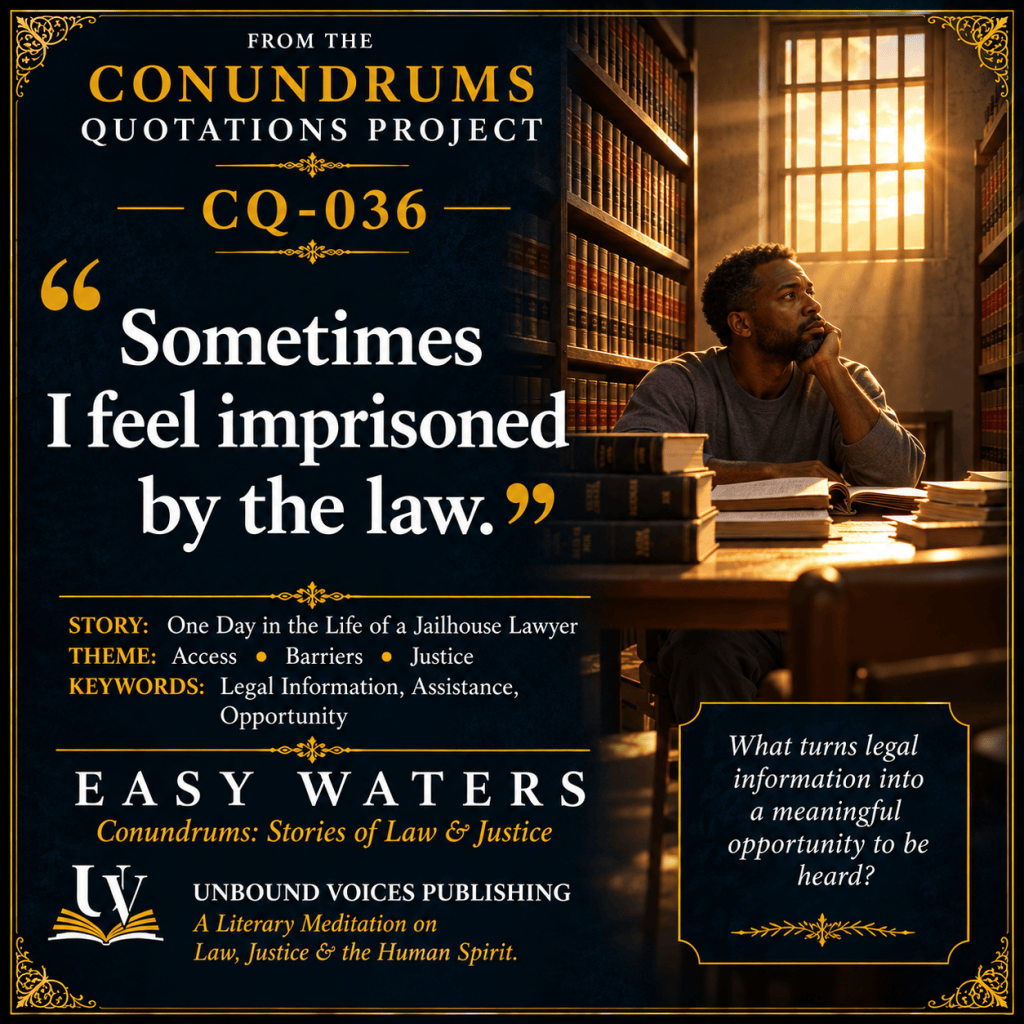
“Sometimes I feel imprisoned by the law.”
Easy Waters, “One Day in the Life of a Jailhouse Lawyer,” Conundrums: Stories of Law & Justice
What happens when the law becomes another wall?
In “One Day in the Life of a Jailhouse Lawyer,” E sits in a room full of legal books. Federal Supplements in front of him. Federal Reporters behind him. He has been working on another person’s parole appeal. His own freedom remains unresolved. He turns in his chair, looks at the volumes surrounding him, and recognizes another kind of confinement.
The room is a law library. It is also a prison within the prison.
The sentence matters because E knows how to use the books. He is no stranger to motions, appeals, or the work of reading a decision closely enough to discover what it says—and what it avoids saying. His frustration cannot be dismissed as the bewilderment of someone who has never learned the language. He has learned it. He continues to speak it. Still, he waits for an answer that addresses his argument.
That is one of the conundrums of the story: the same law that holds out the possibility of relief also supplies the procedures through which relief can remain out of reach.
The library’s material details bring this contradiction down to earth. There are old wooden tables, typewriters, crowded shelves, and windows partly obstructed by books. People seek out the machines that can produce the copies they need without an additional copying expense. These are ordinary details, until you consider what depends on them. A document must be prepared. An argument must be made legible. The required copies must somehow appear.
A right can sound wonderfully complete in a speech. Exercising it takes equipment, time, knowledge, and help.
The jailhouse lawyer occupies the space between the promise and the practical difficulty. He reads, explains, types, and works through the documents that determine other people’s lives. His labor makes visible how much assistance is required before a person can even present a claim in the form an institution expects.
For someone outside prison, a difficult form may lead to a telephone call, a search, or an appointment. Inside, each of those possibilities may depend on rules, schedules, available resources, or another person’s willingness to help. The effort required to ask can consume the energy needed to argue.
E’s observation also warns against an easy celebration of legal literacy. Learning matters. Teaching matters. So does an institution’s willingness to hear what a person has learned to say. A room of books cannot answer for a process that treats an argument as an inconvenience.
The story asks us to look at the whole journey from information to a hearing: understanding the material, preparing a claim, obtaining assistance, and receiving an answer that engages the substance. Somewhere along that journey, access either becomes meaningful or narrows into a formality.
This is a question for educators, librarians, advocates, and the people who administer the criminal legal system. We should be able to describe what someone can actually do with the resources we say are available.
E keeps working. That persistence gives the sentence its weight. He feels imprisoned by the law while continuing to search it for a way out. The books remain both an obstacle and a possibility. Someone must still open them.
Join the Conversation
What practical support most helps someone turn access to legal information into a meaningful opportunity to challenge a decision?
About the Conundrums Quotations Project
CQ-036 explores a quotation from “One Day in the Life of a Jailhouse Lawyer,” in Easy Waters’s Conundrums: Stories of Law & Justice. The project reads individual lines closely to examine the larger questions of law, justice, memory, and the human spirit they open.
Justice, Literature & Memory — Delivered to Your Inbox
Essays from the archive and new writing on race, literature, history, incarceration, freedom, and the American criminal legal system.


