
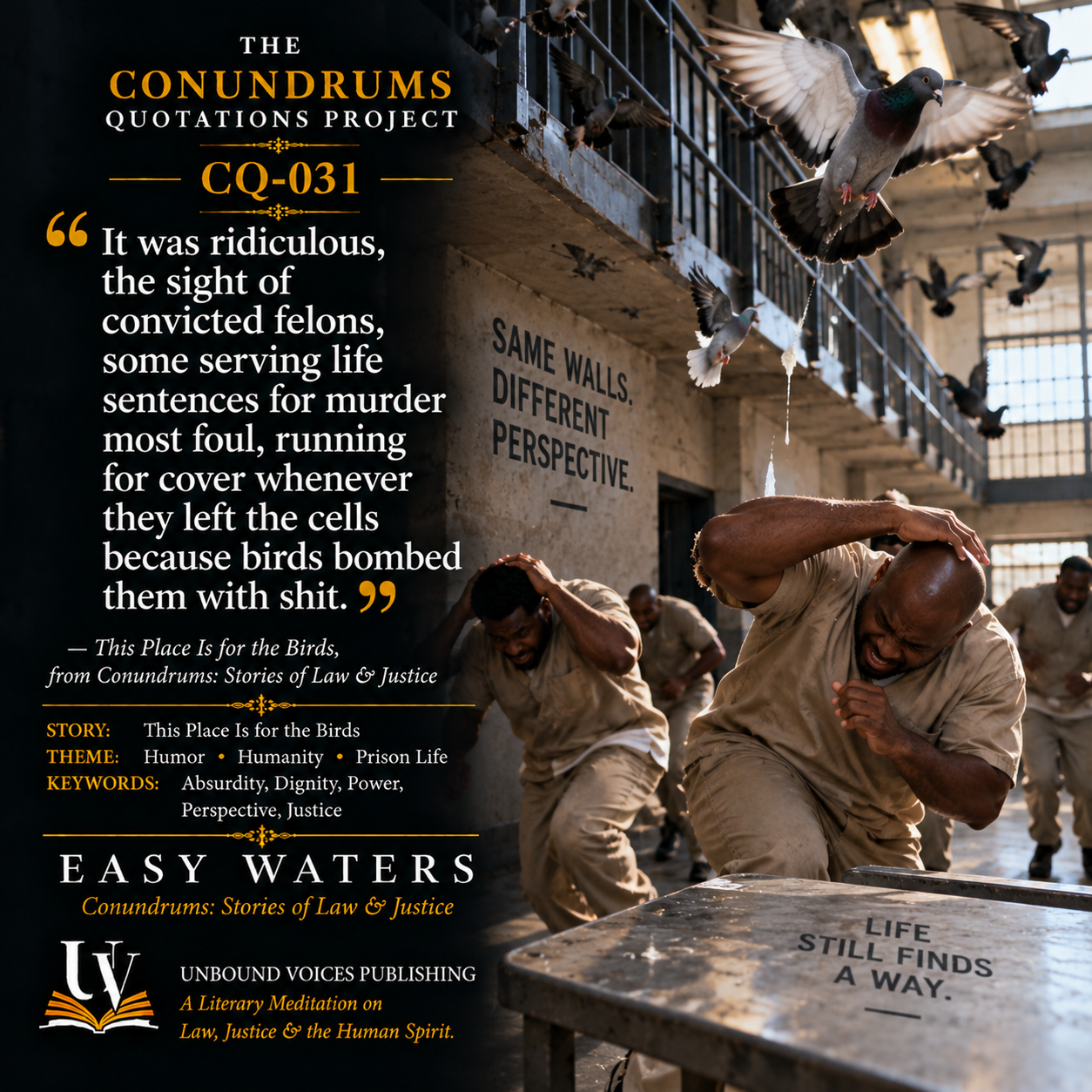
“It was ridiculous, the sight of convicted felons, some serving life sentences for murder most foul, running for cover whenever they left the cells because birds bombed them with shit.”
— This Place Is for the Birds, from Conundrums: Stories of Law & Justice
Some of the men are serving life sentences for murder. The story introduces them through the gravity of their convictions.
Then the birds arrive.
They do not review anyone’s criminal record. They do not recognize prison reputations, gang affiliations, disciplinary histories, or the distinctions men use to establish rank among themselves. From the rafters of the cellblock, everyone below is simply a target.
The cell doors open. The men step onto the gallery. Birds dive-bomb them.
The men run for cover.
Murder most foul meets murder most fowl.
Reflection
Prison is supposed to be a serious place.
Its architecture announces seriousness: stone, steel, bars, walls, gun towers, razor wire. Its language carries the weight of authority: conviction, sentence, custody, count, discipline, parole. The people confined there are publicly defined by serious acts and solemn judgments.
Then a bird shits on someone.
The moment punctures the institutional drama. A man may be feared throughout the cellblock, but fear offers no protection from above. He may have survived violence, years of confinement, and every effort by the prison to break him, yet a small creature with wings can send him scrambling beneath a table.
The scene is funny because it rearranges power.
The men are confined. The birds are free. The guards supervise the men but cannot control the birds. The cellblock was designed to make human movement predictable, yet the birds turn it into uncontrolled airspace. They enter through the bars, nest where they please, eat the bread the men scatter, reproduce, sing before dawn, and relieve themselves upon the population.
Maximum security has been breached by creatures weighing only a few ounces.
No escape plan could be more humiliating to the institution.
Humor often begins with such reversals. The powerful becomes ridiculous. The feared becomes vulnerable. The system built to control every detail encounters something it did not anticipate and cannot easily command. For a moment, the official arrangement of the world is exposed as less permanent than it appears.
Inside prison, that exposure matters.
Humor does not remove the bars. It does not shorten a sentence or erase suffering. But it interrupts the institution’s claim to define the entire emotional reality of the people within it. A person who can laugh has created a small distance between himself and the thing attempting to overwhelm him.
That distance can be survival.
The quotation refuses to sentimentalize the men or erase the harm at issue. The phrase “murder most foul” deliberately invokes the gravity of the convictions. Yet a conviction cannot describe the entirety of a human life.
But the birds reveal something punishment often conceals: people remain human after conviction.
They can be startled. Embarrassed. Irritated. Superstitious. Petty. Afraid of having their clothes soiled. They can look ridiculous.
Public stories about people in prison usually allow only a narrow range of images. A person appears as threat, victim, symbol, statistic, or evidence in an argument about crime. Humor complicates those categories because comedy depends upon recognition. We laugh when we see familiar human behavior appearing in an unexpected place.
Everyone runs when something is falling from the sky.
That shared instinct reconnects the men to ordinary life more effectively than any abstract declaration about their humanity. They do not become human because the story excuses what they have done. They become recognizable because the story permits them to be absurd.
The scene also reverses the gaze. People in prison live under constant observation. Officers watch them. Cameras watch them. Administrators record them. Courts and parole boards examine documents describing them. The public imagines them.
Here, the men are watched by the reader as they run from birds.
But the laughter does not belong entirely to the outside observer. Alex participates in the absurdity. After being hit, he becomes furious and files a grievance demanding that the birds be removed. The prison authorities initially find the complaint amusing. They stop laughing when he contacts the state Department of Health and threatens the federal accreditation the prison is seeking.
The joke becomes a legal argument.
That movement is characteristic of the jailhouse world in Conundrums. Comedy and institutional critique occupy the same cell. Bird droppings are ridiculous, but they are also a sanitation problem. The authorities can laugh at the men dodging birds until the matter threatens something the institution values.
Alex understands leverage.
He does not ask the prison to care about his dignity. He identifies the regulation, outside agency, and accreditation process capable of converting his humiliation into an administrative concern. His grievance succeeds not because the prison suddenly recognizes his humanity but because he has translated the problem into the language of institutional risk.
Even shit requires the proper legal theory.
That may be the darkest joke in the scene.
The quotation also reminds us that suffering and humor are not opposites. People often laugh in the hardest places precisely because the alternative would give hardship complete authority over the imagination. Soldiers joke during war. Families laugh at funerals. Hospital patients tease nurses. People in prison create nicknames, imitate officers, exchange stories, and find comedy in rules that would otherwise be merely degrading.
The laughter does not mean the circumstances are painless.
It means pain has not taken every available language.
Humor can say what direct protest cannot. A joke passes beneath defenses. It exposes contradiction without first requesting permission. When we laugh at a maximum-security prison unable to control birds, we also recognize the limits of institutional power. When we laugh at men convicted of murder running for cover, we see the fragile human beings hidden beneath their reputations.
But humor carries risks.
It can humanize people, and it can dehumanize them. Laughter shared with someone creates community. Laughter directed only at someone can become another punishment. The question is not merely whether a situation is funny, but where the joke locates dignity.
In This Place Is for the Birds, the humor travels in several directions at once. The men are ridiculous. The prison is ridiculous. Alex is ridiculous for allowing the birds to drive him toward thoughts of murdering the Bird Man. The authorities are ridiculous for dismissing a legitimate health concern until accreditation becomes involved.
No one escapes the satire.
That equality of comic exposure is one reason the scene retains its humanity. The story does not stand outside prison and invite respectable readers to laugh at strange people in a strange world. It reveals that prison contains the same vanity, annoyance, intelligence, fear, friendship, and foolishness found everywhere else—only compressed beneath extraordinary pressure.
The birds understand none of this.
They have come for the bread.
Their indifference may be the final joke. Human beings construct courts, prisons, hierarchies, reputations, and theories of punishment. The birds fly through the bars and treat the entire system as a nesting site with free meals.
Perspective has wings.
Why It Matters Today
Serious subjects need humor—not because injustice is funny, but because solemn language can sometimes protect the very institutions that deserve scrutiny. A system may surround itself with official titles, procedures, statistics, and declarations of necessity. Satire asks the impolite question that breaks the spell.
What if this is absurd?
That question can expose contradictions hidden by familiarity. It can help us see how bureaucracy responds only when its reputation is threatened, how people reduced to criminal labels remain recognizably human, and how supposedly total systems of control are defeated by ordinary life.
Humor also protects perspective. A painful circumstance can become so large that it appears to contain the whole world. Laughter does not deny the circumstance. It changes its size.
For one moment, the prison is not the final authority.
It is a building full of angry men ducking birds.
Questions for Reflection
- Why does humor often emerge in the hardest places?
- When does laughter restore someone’s humanity, and when does it become another way of denying dignity?
- What powerful institution or serious situation became easier to understand once you recognized its absurdity?
About the Conundrums Quotation Project
The Conundrums Quotation Project examines selected lines from Conundrums: Stories of Law & Justice and the moral, literary, and social questions contained within them. Each quotation becomes a point of departure for reflecting on law and justice, crime and punishment, freedom and responsibility, and the complicated choices through which human beings reveal themselves.
From The Conundrums Quotation Project by Easy Waters
Conundrums: Stories of Law & Justice
Justice, Literature & Memory — Delivered to Your Inbox
Essays from the archive and new writing on race, literature, history, incarceration, freedom, and the American criminal legal system.


