
THE CONUNDRUMS QUOTATIONS PROJECT
Essay No. 4 | CQ-017
Not Every Cell Has Bars. Some Are Built by Fear, Regret, and Self-Doubt.
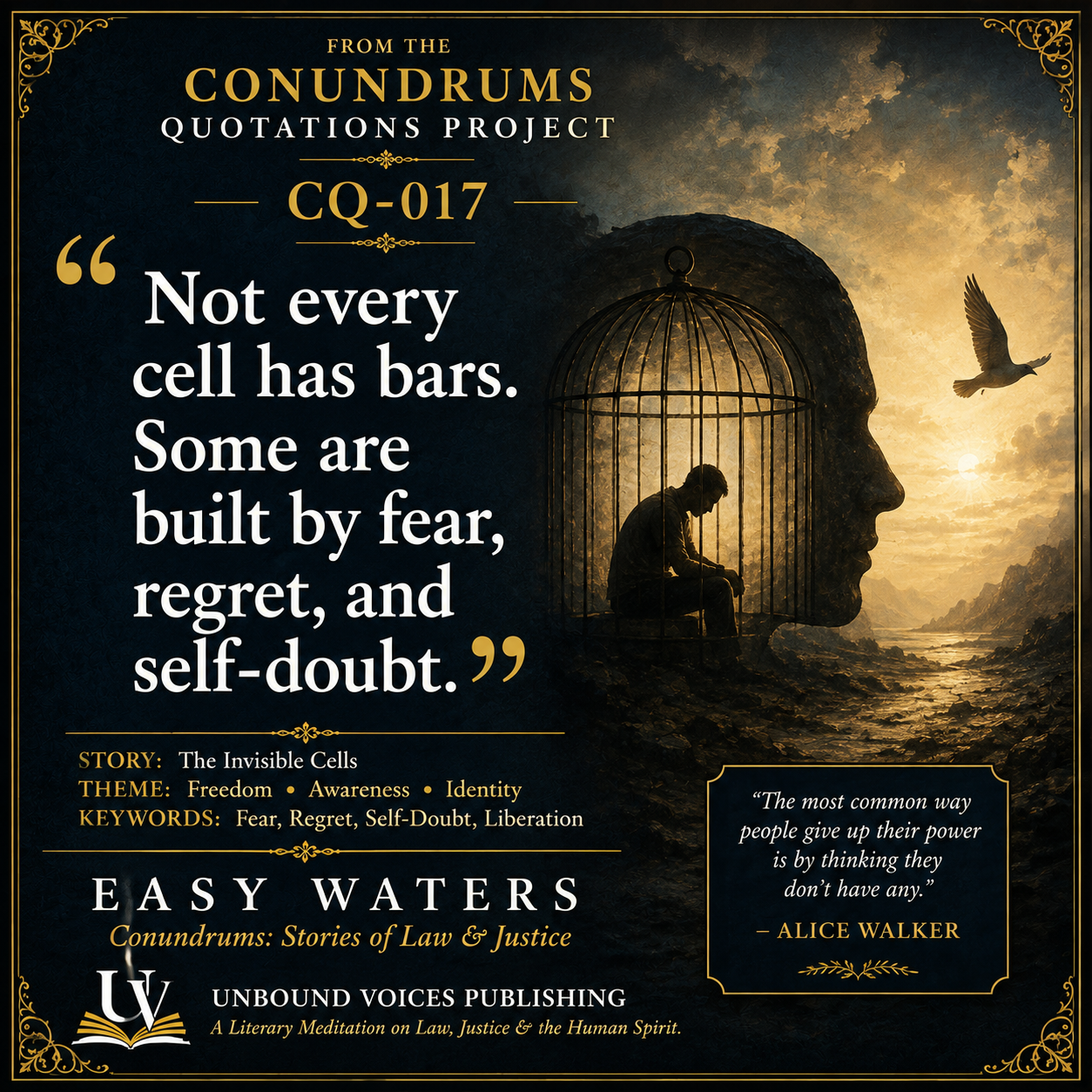
“Not every cell has bars. Some are built by fear, regret, and self-doubt.”
— Easy Waters
“The most common way people give up their power is by thinking they don’t have any.”
— Alice Walker
The Invisible Cells
When most people hear the word prison, they imagine architecture.
Concrete walls.
Steel doors.
Razor wire.
Guard towers.
Bars.
These are the visible instruments of confinement. They tell us immediately that one space is separated from another and that the person on one side of the barrier cannot freely cross to the other.
But not every prison announces itself so clearly.
Some cells have no bars.
Some doors have no locks.
Some prisoners carry their confinement wherever they go.
Fear can become a cell.
Regret can become a cell.
Shame can become a cell.
And perhaps one of the most effective prisons ever constructed is self-doubt—the conviction that we are incapable of becoming more than the person circumstances, institutions, other people, or our own mistakes have told us we are.
When the Prison Moves Inside
Physical imprisonment is unmistakable. Someone else controls where you sleep, when you eat, where you walk, whom you see, and when a door opens.
Psychological imprisonment is more elusive.
The person living inside it may possess the physical freedom to go almost anywhere while believing there is nowhere worth going.
That is what makes invisible cells so powerful.
They require fewer guards because eventually we begin guarding ourselves.
Fear tells us not to apply.
Self-doubt tells us not to speak.
Shame tells us not to be seen.
Regret tells us we have already ruined whatever future might have existed.
The door may be open.
We remain seated.
Fear Is a Skilled Jailer
Fear is necessary.
It warns us of danger. It activates instincts that have helped human beings survive for thousands of years. A life entirely without fear would be reckless.
But healthy fear identifies danger.
Unhealthy fear manufactures captivity.
The distinction matters.
Fear becomes a jailer when it no longer asks, Is this dangerous? and begins declaring, You cannot do this.
You cannot change careers.
You cannot return to school.
You cannot repair that relationship.
You cannot recover.
You cannot lead.
You cannot start again.
You cannot become someone different.
Fear’s vocabulary is remarkably repetitive.
You can’t.
The more frequently we hear those words—particularly when they begin coming from our own voice—the stronger the walls become.
The Cell of Regret
Regret constructs its prison differently.
It does not threaten us with what might happen.
It reminds us endlessly of what already did.
We replay conversations.
Decisions.
Relationships.
Opportunities.
Mistakes.
Sometimes regret performs an important moral function. A person incapable of regret would also be incapable of meaningful accountability. Remorse can teach us where we violated our values or harmed another person.
But regret becomes imprisonment when reflection stops producing wisdom and begins producing paralysis.
There is a point at which we must ask:
What is this memory asking me to do now?
If the answer is apologize, apologize.
If restitution is possible, make restitution.
If behavior must change, change it.
If forgiveness must be requested, request it.
But if nothing more can be done to alter what happened, then regret must eventually surrender its authority to responsibility.
Otherwise yesterday continues serving a sentence that tomorrow never imposed.
Self-Doubt: The Prisoner Becomes the Guard
Self-doubt may be the most subtle of the three.
Fear says the world is dangerous.
Regret says the past cannot be changed.
Self-doubt says you are the problem.
You are not intelligent enough.
Not educated enough.
Not young enough.
Not experienced enough.
Not deserving enough.
Not talented enough.
Not worthy enough.
Once those judgments become internalized, the prisoner and the guard become the same person.
No institution needs to deny the opportunity.
We deny it ourselves.
No critic needs to dismiss our voice.
We silence ourselves before speaking.
No one needs to lock the door.
We stop trying the handle.
This is one reason Alice Walker’s observation is such an appropriate companion to CQ-017: power can be surrendered before anyone physically takes it from us.
What Prison Teaches About Invisible Confinement
Conundrums: Stories of Law & Justice repeatedly examines the difference between physical confinement and the more complicated forms of imprisonment that occur within the human mind.
A prison sentence establishes obvious boundaries.
But what happens when those boundaries are internalized?
What happens when a person begins believing the institution’s definition of them?
What happens when a number replaces a name, a conviction replaces an identity, or a past act becomes the permanent explanation for an entire human life?
Those questions do not disappear when someone leaves prison.
In some ways, they become more urgent.
Reentry is commonly described in practical terms: housing, employment, identification, benefits, transportation, supervision, treatment.
All are essential.
But there is another dimension of reentry that is harder to measure.
A person must learn to imagine themselves as free.
That may sound simple to someone who has never lost freedom.
It is not.
Freedom Is More Than Geography
We often define freedom spatially.
Inside.
Outside.
Confined.
Released.
But human freedom is more complicated.
A person can live outside prison and remain psychologically governed by prison.
The habits of vigilance may remain.
The distrust may remain.
The anger may remain.
The institutional identity may remain.
The belief that opportunity belongs to other people may remain.
This is why release and liberation are not necessarily the same event.
One is a change in legal status.
The other can require years of work.
The Prisons Outside Prison
CQ-017 is not only about incarceration.
Invisible cells exist everywhere.
A successful executive may be imprisoned by the fear of failure.
A person in an unhealthy relationship may be imprisoned by the belief that loneliness would be worse.
A gifted writer may spend decades refusing to publish because rejection feels unbearable.
A student may avoid challenging courses because someone once convinced them they were not intelligent.
A community may accept injustice because generations have been taught that nothing can change.
An older person may abandon dreams because society has quietly suggested that ambition belongs to the young.
There are no bars around any of these people.
But confinement is real.
Institutions Can Build Invisible Cells Too
The problem is not purely psychological.
Institutions can reinforce internal captivity.
Consider what happens when someone returning from incarceration repeatedly hears:
We don’t hire people with records.
We don’t rent to people with convictions.
You aren’t eligible.
You don’t qualify.
Your background disqualifies you.
Eventually, external rejection risks becoming internal expectation.
A structural barrier becomes a psychological one.
The person stops applying before being rejected.
This is why discussions about personal responsibility must be accompanied by discussions about opportunity.
We should encourage people to believe in their ability to change.
But society must also construct doors through which changed people can walk.
Otherwise, we preach transformation while institutionalizing exclusion.
Literature and the Liberation of Imagination
This is where literature becomes particularly important.
Books cannot eliminate every physical barrier.
But they can challenge the boundaries of imagination.
Reading allows us to enter lives we have never lived.
To visit places we have never traveled.
To encounter people we might never meet.
To imagine futures our present circumstances have not yet revealed.
For someone physically confined, that experience can be profound.
The body remains within walls.
The imagination does not.
Throughout history, imprisoned writers and thinkers have demonstrated this strange paradox: confinement can restrict movement without completely extinguishing intellectual freedom.
That distinction matters.
Because before many forms of liberation become possible externally, they must first become imaginable internally.
Finding the Door
Invisible cells share one characteristic with physical cells.
They have boundaries.
But they also have doors.
The challenge is finding them.
For fear, the door may be courage.
For regret, accountability.
For shame, forgiveness.
For self-doubt, action.
For isolation, community.
For ignorance, education.
For despair, hope.
None of these doors opens easily.
And sometimes we need someone else to help us find the handle.
That is why mentors matter.
Teachers matter.
Counselors matter.
Friends matter.
Faith communities matter.
Books matter.
Communities matter.
Healing is rarely an entirely solitary act.
Why It Matters Today
We live in a culture that speaks constantly about freedom.
Political freedom.
Economic freedom.
Religious freedom.
Freedom of expression.
These freedoms are essential.
But we should also ask whether people possess the internal freedom necessary to use them.
A society can offer opportunity while cultivating fear.
It can celebrate individual achievement while producing widespread self-doubt.
It can praise second chances while permanently labeling people according to their first mistakes.
It can open doors while convincing entire communities that those doors were never intended for them.
Justice therefore requires more than removing barriers.
It requires restoring agency.
The ability to say:
My past happened.
My fear is real.
My regret has something to teach me.
My doubts may still speak.
But none of them gets to decide everything that comes next.
That is the beginning of liberation.
Questions for Reflection
- Which invisible cell—fear, regret, shame, or self-doubt—has exercised the greatest influence over your life?
- What belief about yourself have you treated as a fact when it may actually be a wall someone else helped build?
- If the door to one of your invisible cells were already unlocked, what would taking the first step through it look like?
About Conundrums
Conundrums: Stories of Law & Justice is a cycle of stories exploring imprisonment, law, justice, memory, redemption, and the resilience of the human spirit. Through literature grounded in lived experience, Easy Waters examines not only the institutions that confine people, but also the invisible boundaries of fear, identity, memory, and self-perception that can survive long after physical walls disappear.
Closing Reflection
Some prisons are obvious.
We can photograph them.
Measure their walls.
Count their cells.
Name the institution.
Others are harder to identify.
They travel with us.
They speak in familiar voices.
They convince us that limitation is reality and fear is wisdom.
And because they are invisible, we may live inside them for years without realizing that the door has been unlocked all along.
Freedom begins with recognition.
Then comes courage.
Then the first uncertain step beyond the boundary we once believed could never be crossed.
Not every cell has bars. Some are built by fear, regret, and self-doubt.
Justice begins with the courage to see clearly.
— Easy Waters
The Conundrums Quotations Project
CQ-017 | The Invisible Cells
Easy Waters
Conundrums: Stories of Law & Justice
Unbound Voices Publishing
A Literary Meditation on Law, Justice & the Human Spirit.
Justice, Literature & Memory — Delivered to Your Inbox
Essays from the archive and new writing on race, literature, history, incarceration, freedom, and the American criminal legal system.


